Developer use guide resources
Introduction
We are committed to supporting our community in building Llama applications responsibly. In addition to our Llama Protections effort, we provide this Developer Use Guide that outlines best practices in the context of Responsible GenAI. In this section, we provide resources to facilitate the implementation of these best practices.
Determine use case
Based on the intended use and audience for your product, a content policy defines what content is allowable and may specify safety limitations on producing illegal, violent, or harmful content. These limits should be evaluated in light of the product domain, as specific sectors and regions may have different laws or standards.
If you are new to value considerations in the development and deployment of AI, refer to the principles and guidance on risk management released by academic institutions and governing organization, such as:
- OECD’s AI Principles
- NIST’s Trustworthy and Responsible AI Resource Center
- AI Act | Shaping Europe’s digital future
You can also use existing standards to build a baseline policy to cover commonly agreed upon harms. MLCommons published a taxonomy of these categories—along with definitions—as well as a survey on existing taxonomies in their whitepaper. The MLCommons harm taxonomy comprises the following harm areas:
- Violent crimes
- Non-violent crimes
- Sex-related crimes
- Child sexual exploitation
- Indiscriminate weapons: Chemical, Biological, Radiological, Nuclear, and high yield Explosives (CBRNE)
- Suicide & self-harm
- Hate
- Specialized Advice
- Privacy
- Intellectual Property
- Elections
- Defamation
- Sexual Content
Model-level alignment
There are 3 general steps needed to responsibly fine-tune an LLM for alignment, guided at a high level by Meta’s Responsible AI framework.
1. Prepare data
Preparing data includes annotating a dataset. Below are helpful tips on what to include in a guideline document for annotators, that provides instructions on how to complete the task:
Scope of your annotation requirements
- Provide explicit instructions for the prompt writing, response writing, or response labeling—and nothing unrelated to the particular task at hand.
- Provide plenty of examples specific to the task.
- Provide the exact modality of the input (prompt) and exact modality of the output (response).
- Specify which policy categories you are annotating against.
- Define which languages are needed for your annotations, and whether there are localization requirements.
Annotation volume
Consider what volume of data is required for your task.
- Detail how much volume is needed for each type of prompt, response, or label.
- Consider multiple reviews (e.g. two or three) to increase dataset quality.
Annotators interactions
Specify an appropriate interface for annotators
- Will the annotators have to interact with a model or will they just receive a dataset?
- Will the annotators have to source the data on their own?
- If so, where must or should they source it from?
- Where must they NOT source it from?
- What format must the data file be in, depending on the modality?
Privacy
Engage with your privacy or legal partner to ensure data processing is in accordance with relevant privacy regulations.
Considerations might include whether first-party data needs to be passed to the annotators and whether additional privacy mitigations, such as image blurring, might be required.
Feedback and Quality assessment
- Specify quality expectations up front, such as, about prompt length and complexity or about responses.
- Think about the workflow of the annotators to anticipate questions
- Organize quality assessment and feedback sessions.
Diversity and Bias mitigations
Pay attention to how human feedback and annotation of data may further polarize a fine-tuned model with respect to subjective opinions. Take steps to prevent injecting bias into annotation guidelines and to mitigate the effect of annotators’ bias. Resources on this topic include:
2. Train the model
Fine-tuning an LLM for safety can involve a number of techniques, many of which the research paper on Llama 2 and Llama 3.1 describes in greater depth. You can follow the Meta Llama fine-tuning recipe to get started with finetuning your model for safety. Hugging Face provides further detailed information on how to implement the most commonly used fine-tuning method in their alignment handbook.
3. Evaluate and improve performance
To evaluate your model, you could rely on your own private benchmarks. This requires building your own dataset and safety evaluation solution. However, we believe safety evaluations should be standardized to ensure transparency and a consistent, industry-wide approach to safety testing. Such standards are emerging, such as the MLCommons AI Safety v0.5 Proof of Concept.
In the meantime, we recommend using public benchmarking platforms and datasets:
- Cybersec eval for cybersecurity specific evaluations.
- Benchmarking of LLMs by Stanford’s Center for Research on Foundation Models (HELM): https://crfm.stanford.edu/helm/latest/
- EleutherAI LLM Evaluation Harness: https://github.com/EleutherAI/lm-evaluation-harness
- Hugging Face Hub which hosts open source models and datasets, and is a space for developers to share safeguards and access benchmark information: https://huggingface.co/docs/hub/index
System-level alignment
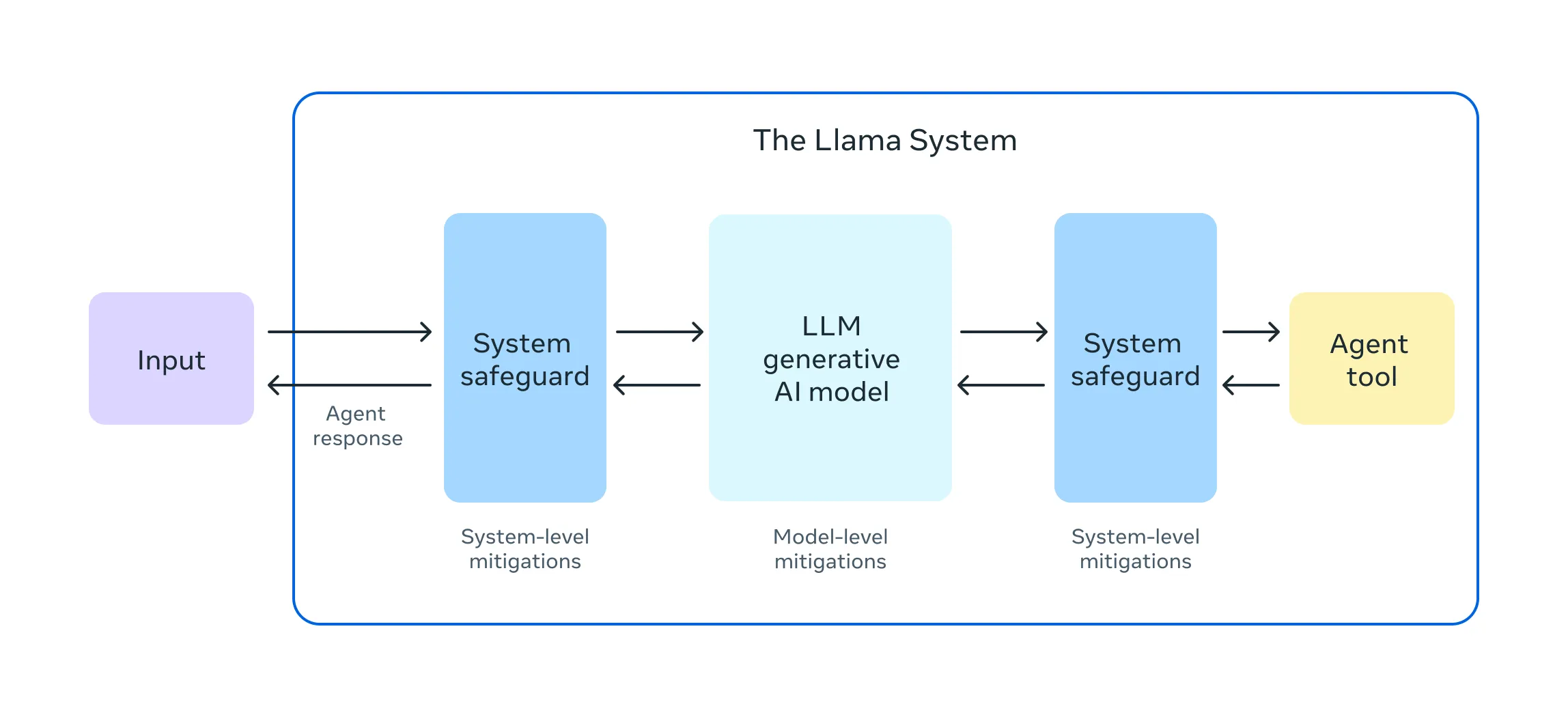
As outlined in our Developer Use Guide, you should deploy appropriate system level safeguards to mitigate safety and security risks of your system. As part of our responsible release approach, we provide open source solutions including:
- Llama Guard 3: our multilingual content moderation safeguard.
- Prompt Guard: our direct and indirect prompt injection detection safeguard.
- Code Shield: our insecure code detection safeguard.
To get started building with Llama safeguards, head to our ready-to-use recipes on GitHub. We also provide notebooks to tune Llama Guard on your own dataset: GitHub - PurpleLlama, GitHub - Cookbook - Responsible AI.
Transparency
Transparency and feedback mechanisms are of the utmost importance for safety. We recommend becoming familiar with the Llama Model Card and creating your own model card if you are building a custom LLM.
If you identify harmful content generated from Llama models, please provide feedback here.
