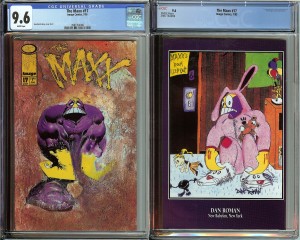
RIP Sam Kieth. His impact on my generation of comic creators cannot be understated.
As a personal aside, I had my first piece of fan art published on the back cover of the The Maxx issue #17. Sure, they got my name and hometown wrong…but for a comic-obsessed teenager from NORTH Babylon this was my first taste of being a published artist. I always thought it was so generous that Sam Keith not only included a fan art section inside each issue, he also used the back cover to spotlight emmerging artists (whereas MOST comic book backcovers were used for advertisements). And taking things even further, Sam’s The Maxx comic series also included a classifieds section called “Maxx Traxx” for fans to connect and send messages to each other. I made several penpals through this printed community hub, many of whom were other young cartoonists. I can’t understate how for a young depressed kid from Long Island how huge it was to be able to trade DIY comics with people in other states and even other countries in a pre-internet world! (I know the internet existed but I had barely used used it yet!)
And The Maxx comic itself felt so wholly unique. For a series published by Image Comics at the height of their superhero origins, it was so freakin’ weird! The story was enigmatic, often poetic, with raw, sketchy inked art that sometimes segued to fully-painted landscape that were in step with the masters of surrealism. Comic art that literally broke out of borders with endlessly creative layouys and design. Even the integration of the sound effects felt original!. Everything about it was clearly a singular, handdrawn vision. A topsy turvy fever dream with just enough muscles and punching to justify being shelved alongside the testosterone-superhero likes of Spawn, YoungBlood, and the Savage Dragon.
When I was in Highschool and hadn’t yet heard the word “graphic novel,” The Maxx was one of the earliest comic books I was able to share with teachers and even my girlfriend’s parents to convince them that comics could be seen as a form of “literature.” In 1993 I wasn’t yet familiar with the “alternative comics” published by Fantagraphics, Drawn and Quarterly, and was only recently exposed to the adult-leaning Vertigo imprint. For me, The Maxx was a gateway to that whole “comics aren’t just for kids” phase that was so integral to the “edgy” mid-to-late 90’s. And it was also a part of the adult animation boom that made MTV feel revolutionary at the time. Liquid Televion, Aeon Flux, Slow Bob in the Lower Dimensions, The Head….and then of course, The Maxx…a comic book adaptation like no other. Previous to The Maxx, the comic book-to-cartoon pipeline “adaptations” were filtered through a necessary streamlining process. Batman the Animated Series is one of my all-time favorite shows, and I grew to love Bruce Timm’s minimalism art style, but when the show debuted it didn’t look anything like Batman comics being drawn by Jim Aparo and Norm Breyfogle at the time. The X-Men animated series tried harder to emulate the designs of Jim Lee’s X-Men run but it never looked 100% comic accurate. And sure, the animation style and framerate on The Maxx series could be described as “limited” …but holy cow, they seemed to literally scan Sam Kieth’s drawings, comic panels and all, to bring them to life on the tee-vee. Kieth’s sketchy, personal art style completely maintained in all its moody glory. And that was a big part of the charm of Sam Keith’s work…the vibe. The Maxx was emo before that was a thing. The comic and its animated series took big swings between deadly serious and surprisingly silly. Teenagers like me and my tight-knit crew of comic-making friends were always hungry for that kind of melodramatic storytelling that also wasn’t afraid to sprinkle in a few cute guys with sharp teeth. Everyone I know loved the lovably dangerous creatures, the Itz–who were so fun to draw! And every Maxx fan had to get one of those iconic action figure sets produced by Todd McFarlane Toys.
Sam Kieth seemed to be one of those artists that every other artist I’ve ever talked to sites as an influence in some way. He truly crossed genres and demographics. Despite having attended countless comic conventions in my lifetime, and having crossed paths with many other creative heroes, I’m sad I never got to meet Sam Kieth. I like to think that all the compliments I’d have to give him is stuff he’d heard a million times before. I hope he knew how important his work was to so many people…especially us 90’s teens. And how many people were brought together though his wild creations.
PS. He always made hunching over look so cool…



 Does seeing a movie compare to hearing the music live? No. Nothing can compare to the shared experience of live theater–or a concert, which is closer to the vibe of Hadestown since you see all the musicians interacting with the actors and creating a meta experience with the audience. But I do think the Hadestown movie is one of the best “pro shots” I’ve seen and does its best to capture as much of the magic as it can for the adaptation to film. No one single performance is ever the perfect one, but in the spirit of “the show must go on,” having one of the lead actors, Patrick Page, dancing (during a key scene) with a ruptured Achilles tendon while wearing a steampunk medical boot could not be more appropriate for a show about Greek mythology and the power of creativity. 5 stars.


