A 53% off badge on a Samsung 870 EVO does not mean the drive got cheap. At $487.19 the 2TB model costs $243.60 per terabyte, which is 76% more than the typical 2TB SATA SSD cost a month ago. Amazon computes that badge against a $1,039.99 list price, and that list price went up with the NAND shortage too. So most Black Friday SSD deals this year compare a shortage price with a bigger shortage price.
The useful comparison is your own earlier reading. Our SSD price tracker logged 41 Amazon listings on October 27, and this page sets the same drives at today’s price against that reading and against the class median per terabyte. Drives that fall short get a “not a real deal” flag, whatever the badge says. Every price below was pulled from Amazon’s product feed on November 20, 2026, a week before Black Friday, and every spec comes from the maker’s own page or datasheet.
Two real price drops and three drives worth buying anyway
Only two drives fell 10% or more since October, and both are Samsung NVMe drives sold by Amazon itself. The other three picks earn a place because they’re the cheapest per terabyte in their class or because a homelab job needs them, not because Black Friday moved them. In reading order:
- Best NVMe deal: Samsung 9100 PRO 2TB, about $350, down 14% and cheaper per TB than most Gen4 drives.
- Best large VM pool: Samsung 990 PRO 4TB, about $700, the biggest dollar drop at roughly $100.
- Cheapest TLC terabyte: WD_BLACK SN7100 4TB, about $605, flat since October.
- Power-loss protection: Micron 7450 PRO 960GB M.2, about $750, the same price as in September.
- Cheapest SATA for a NAS: Silicon Power A55 2TB, about $235 from the maker’s own store, the lowest cost per TB on the tracker.
Prices move hourly in the week before Black Friday, so treat every figure here as a November 20 reading and check the live price at the link. The same three checks apply on Black Friday and again on Cyber Monday, and this page gets rechecked after both. If a pick has gone back above its October price when you click, it’s no longer a deal and the flag rules below apply to it too.
Percent-off badges measure the wrong price
Amazon’s savings figure is the gap between today’s price and a list price, and list prices on SSDs climbed through the NAND shortage along with everything else. The 870 EVO 2TB shows a list of $1,039.99. The Samsung 9100 PRO 2TB shows $679.97, which is far above both of our readings for that drive ($409.00 in October, $349.99 now). A big badge on top of an inflated list tells you nothing about whether today is cheap.
The pressure behind those prices has not eased. TrendForce projects NAND contract prices rising another 15% to 20% in the fourth quarter of 2026, while noting that suppliers are holding back on how far they push client SSD prices.
Counterpoint Research counted enterprise SSDs at 48% of all NAND shipped in the second quarter, nearly double a year earlier. Retail drives are getting what’s left after AI servers buy theirs, so you should not expect pre-shortage prices this November.
Three numbers decide each verdict
Each drive is judged on its own history, not on the badge. The October 27 reading comes from the same Amazon product feed and the same model and capacity, so the comparison is like for like. A verdict uses these three checks, in order:
- Change since October 27: 10% or more down from a new offer sold by Amazon or the maker is a real drop, any smaller drop or no change is flat, and any rise fails.
- Price per TB against the class median: $138.62 for 2TB SATA, $183.00 for 2TB Gen4, $208.75 for 2TB Gen5 and $152.50 for 4TB Gen4 on October 27.
- Seller and condition: a used or resale listing fails, and a third-party seller with a few units left gets a warning.
A drive gets the “not a real deal” flag when its price rose, when it sits more than 25% above its class median while showing a large percent-off badge, or when the buy-box offer is used. A flat drive under its class median is still a fair buy if you need it now, and that is how the SN7100 and the A55 earn their place. The Micron is there because PLP drives have no sale price to wait for. The speed and endurance figures are the makers’ published numbers, and the picks follow the endurance and power-loss guidance in our NVMe guide for Proxmox hosts.
Every drive against its October price
The table covers every drive this page links or flags that has an October 27 tracker reading, sorted by how much the price moved. Readings are from November 20 and October 27, both from Amazon’s product feed.
| Drive | Class | Nov 20 | Oct 27 | Change | Per TB | Verdict |
|---|---|---|---|---|---|---|
| Samsung 9100 PRO 2TB | Gen5 NVMe | $349.99 | $409.00 | -14.4% | $175.00 | Real deal |
| Samsung 990 PRO 4TB | Gen4 NVMe | $699.99 | $799.90 | -12.5% | $175.00 | Real deal |
| Samsung 990 PRO 2TB | Gen4 NVMe | $389.99 | $409.99 | -4.9% | $195.00 | Flat |
| Crucial MX500 1TB | SATA | $362.00 | $377.70 | -4.2% | $362.00 | Flat, seller warning |
| Kingston NV3 2TB | Gen4 NVMe | $279.99 | $288.00 | -2.8% | $140.00 | Flat, delivery date only |
| Samsung 990 EVO Plus 4TB | Gen4 NVMe | $679.99 | $699.00 | -2.7% | $170.00 | Flat, seller warning |
| Samsung 870 EVO 4TB | SATA | $1,020.00 (Nov 21) | $1,046.98 | -2.6% | $255.00 | Flat, seller warning |
| Samsung 870 EVO 2TB | SATA | $487.19 | $497.11 | -2.0% | $243.60 | Not a real deal |
| WD_BLACK SN7100 4TB | Gen4 NVMe | $604.99 | $609.99 | -0.8% | $151.25 | Flat |
| Silicon Power A55 2TB | SATA | $234.97 | $234.97 | 0% | $117.48 | Flat |
| PNY CS900 2TB | SATA | $234.99 | $234.99 | 0% | $117.50 | Flat |
| Crucial BX500 2TB | SATA | $273.98 | $269.00 | +1.9% | $136.99 | Not a real deal |
| Crucial P310 2TB | Gen4 NVMe | $319.00 | $308.99 | +3.2% | $159.50 | Not a real deal |
| Crucial BX500 4TB | SATA | $699.00 | $599.99 | +16.5% | $174.75 | Not a real deal |
Read the per TB column before the change column. The 990 PRO 2TB dropped $20 but still costs more per terabyte than the 9100 PRO, a faster Gen5 drive from the same maker. That’s why it’s marked flat rather than a deal, even with a 39% badge on the listing.
1. Samsung 9100 PRO 2TB: Gen5 below Gen4 money
This is the one drive on the page where the Black Friday price beats the October price, the class median and the cheaper drives around it, all at once.

At about $350 the 2TB costs $175 per terabyte, which is about $34 under the Gen5 median and $8 under the Gen4 median from October. Amazon sells and ships it, so you aren’t paying a reseller’s shortage premium.
Samsung rates the 2TB at 14,700 MB/s read and 13,400 MB/s write over PCIe 5.0 x4, with a 2GB LPDDR4X cache and 1,200 TBW over a 5-year warranty.
Most homelab boxes do not have a Gen5 slot, and that is fine for you. A PCIe link trains at the lower of the two generations, so in a Gen4 mini PC this drive runs as a Gen4 drive and you still pay less than for most Gen4 drives. What you lose in an older slot is the sequential headline, not the DRAM cache or the endurance rating.
- Buy it for a Proxmox boot and VM drive, a ZFS L2ARC, or a desktop that has a Gen5 slot.
- Skip it if the box writes all day. 1,200 TBW is half the rating of the 4TB 990 PRO, and there is no power-loss protection.
Gen5 controllers also run hotter than Gen4 ones. In a fanless mini PC, check that the M.2 slot has a thermal pad or heatsink before you buy, or the drive will throttle during long copies. Check the live 9100 PRO 2TB price before you order.
2. Samsung 990 PRO 4TB: the biggest dollar drop
The 4TB 990 PRO fell about $100 since October, the largest cut in dollars on this page, and Amazon sells it directly.

At about $700 it works out to $175 per terabyte, which is above the $152.50 median for 4TB Gen4 drives. So the cut is real, but the drive is not cheap per terabyte. What the premium buys is a 4GB DRAM cache and 2,400 TBW, the same endurance WD gives the cheaper SN7100 but with a cache that keeps random writes steady when several VMs hit the pool at once.
- Buy it for a single-drive Proxmox VM store or a ZFS mirror member where 4TB beats buying two 2TB drives.
- Skip it if you only need 2TB. The 9100 PRO 2TB costs the same per terabyte and is faster.
The 2TB 990 PRO is the default pick in our Proxmox guide, but at $389.99 it only fell 4.9% and costs $195 per terabyte. Unless you’re matching an existing mirror, take the 4TB or the 9100 PRO instead, and check the 990 PRO 4TB listing on the day you order, since $699.99 was the November 20 reading.
3. WD_BLACK SN7100 4TB: cheapest TLC terabyte, no discount
Black Friday did not touch this drive, and it’s still the cheapest 4TB drive on our tracker whose datasheet states TLC NAND.

At about $605 it costs $151.25 per terabyte, a dollar under the October median, and moved only $5 in three weeks. The SN7100 datasheet rates the 4TB at 7,000 MB/s read and 6,700 MB/s write with 2,400 TBW and a 5-year warranty, and it calls the drive DRAM-less. The WD Blue SN5000 4TB that undercut it in October is out of stock now. The Kingston NV3 4TB is $35 cheaper at $569.99, but its listing currently shows a delivery date, not stock, and Kingston’s datasheet does not state its NAND type.
- Buy it for bulk VM disks, a media cache, container images, or any mostly-read workload.
- Skip it if it’ll hold busy databases. Without DRAM, sustained random writes slow down sooner than on the 990 PRO.
The seller is Newegg Business, not Amazon, which is fine for a new drive but worth knowing if you return things often. If you’re filling a mini PC or an all-flash NAS, two of these cost $190 less than two 990 PRO 4TB drives. The SN7100 4TB listing read $604.99 on November 20, so check it on the day.
4. Micron 7450 PRO 960GB: PLP does not go on sale
Drives with power-loss protection come from enterprise channels, and those channels do not run Black Friday sales. If you need one, you should not wait for a discount.
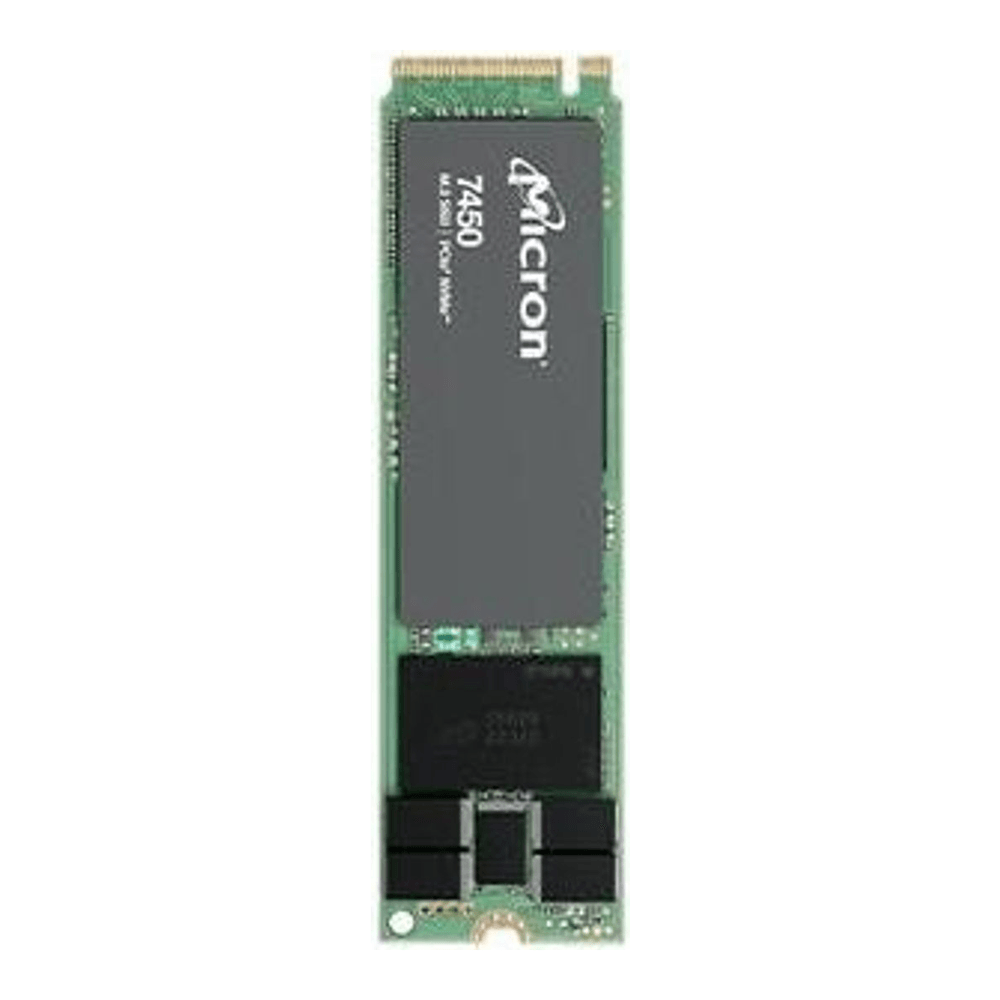
The 960GB M.2 2280 listing costs $749 from CorteseInc, the same price this seller asked in September. That’s $780 per terabyte, more than four times what you’d pay for the consumer picks above.
Micron’s 7450 technical product specification lists full power-loss protection and rates the 960GB at 1,700 TB of 4K random writes, with 5,000 MB/s read and 1,400 MB/s write on the M.2 form factor.
Why pay that? With power-loss protection, the drive can acknowledge a sync write from its cache because capacitors finish the flush if the power drops. ZFS sync writes, Ceph journals and databases with fsync on every commit run much faster on that kind of drive, and they don’t lose acknowledged data in an outage. For the full trade-off, see our SLOG and special vdev drive picks.
- Buy it for a ZFS SLOG, a Ceph OSD, or a Proxmox pool that runs databases with sync writes.
- Skip it if your workload is async. A consumer drive plus a UPS covers most homelabs for a quarter of the price.
Two other PLP drives are worth knowing about. Kingston’s DC2000B 960GB has hardware PLP and 700 TBW on its datasheet, but Amazon shows no public price for it, only Amazon Business offers, so it is not linked here.
If you have a SATA bay, the Samsung PM893 960GB costs $798.77 from a third-party seller with few units left, close to the $799 a different seller asked in October. If you need the M.2 drive, open the Micron 7450 PRO 960GB listing and confirm the seller before you pay.
5. Silicon Power A55 2TB: the cheapest SATA terabyte
The A55 did not move a cent since October, but it’s still the cheapest new terabyte on the whole tracker, and it ships now.

About $235 buys 2TB at $117.48 per terabyte, $21 under the SATA median and less than half the 870 EVO’s cost per terabyte. The seller is Silicon Power’s own store on Amazon, new and in stock. The Ace A55 spec page lists 500 MB/s read, 450 MB/s write and a 3-year warranty bounded by TBW, and Silicon Power’s TBW table puts the 2TB at 600 TBW. It says 3D NAND with an SLC cache and does not mention DRAM.
The PNY CS900 2TB costs two cents more from Amazon itself, with a 540 TBW rating in PNY’s warranty document, but its listing shows a delivery date rather than stock today, so it is not linked here.
- Buy it for a NAS read cache, an all-flash media share, or reviving an old server’s 2.5-inch bays.
- Skip it if it’s going into a write-heavy pool. 600 TBW is half the 870 EVO’s rating, and nothing on the spec page promises steady writes once the SLC cache fills.
If you need SATA with more endurance than 600 TBW, there is no good deal this week. The 870 EVO 2TB is rated for 1,200 TBW, but it costs more than twice as much per terabyte, which the next section covers. Check the A55 2TB price before buying.
Not a real deal: drives to skip this week
These listings carry a badge, a “limited time” label or a familiar name, and each one fails at least one of the three checks. SATA is where the shortage shows most, because SATA prices kept climbing while NVMe prices levelled off, as the tracker recorded in October.
| Listing | Nov 20 | Why it fails |
|---|---|---|
| Samsung 870 EVO 2TB | $487.19 | “53% off” a $1,039.99 list, yet $243.60 per TB is 76% over the SATA median |
| Crucial BX500 4TB | $699.00 | Up 16.5%, now from a third-party seller instead of Amazon |
| Crucial P310 2TB | $319.00 | Up 3.2%, and the Kingston NV3 2TB is $39 cheaper, though its listing currently shows a delivery date, not stock |
| WD_BLACK SN850X 4TB | $750.49 | The buy-box offer is used (Amazon Resale), so it is not linked |
The 870 EVO is the one that catches people. It’s a good drive with a DRAM cache and 1,200 TBW at 2TB, and Amazon is the seller, so the listing looks trustworthy. But at $243.60 per terabyte you’re paying an NVMe premium for a SATA drive. Unless the bay can only take 2.5-inch SATA and you need 1,200 TBW, buy the A55 for capacity or move to NVMe. The 4TB model read $1,020.00 on November 21, 2.6% under its October price, but a third-party seller with few units now holds the buy box and $255 per TB is still 84% over the SATA median.
The Crucial MX500 1TB passes the flag rules on paper, since it fell 4.2%, but $362 per terabyte from a reseller with one unit left makes it the worst value in the table. Leave it alone unless a laptop needs exactly that drive.
Each slot needs a different drive
A homelab box rarely needs one kind of SSD. Match the drive to the job it does, starting with the job that does the most damage when it fails:
| Job | What matters | Pick this week |
|---|---|---|
| ZFS SLOG, Ceph OSD, sync-heavy database | Power-loss protection, endurance | Micron 7450 PRO 960GB |
| Proxmox boot plus VM store | DRAM cache, TBW per dollar | Samsung 9100 PRO 2TB or 990 PRO 4TB |
| Bulk VM disks, L2ARC, media cache | Cost per TB, TLC NAND | WD_BLACK SN7100 4TB |
| NAS SATA bay, read cache, flash share | Cost per TB | Silicon Power A55 2TB |
Do you need PLP for a boot drive? Usually you do not. Proxmox boots fine from a consumer drive in a mirror, and our NVMe vs SATA datastore comparison shows where the interface matters for you and where it does not. For servers that aren’t running Proxmox, the SSD and NVMe picks for servers and homelabs cover U.2 and 2.5-inch enterprise drives this page leaves out.
If the SSD is going into a NAS you have not bought yet, the Black Friday NAS and hard drive deals track the boxes and the spinning drives the same way. The homelab deals roundup links every other category we’re watching this week.
Check a deal in three numbers
Prices on this page will change before Black Friday, and a drive that’s a deal today can be flat tomorrow. You can rerun the test on any listing yourself in under a minute:
- Divide the price by the capacity in TB and compare it with the class median in the table above.
- Compare the price with the October 27 reading for the same model and capacity on the SSD prices per TB tracker.
- Open the offer and read who sells it and in what condition, ignoring the badge.
A drop of 10% or more from a new offer sold by Amazon or the maker is a real deal. A flat price under the class median is a fair buy if you need the drive now, with a warning when a reseller holds the buy box. A price rise or a used buy box means skip it: the badge is measuring a list price nobody pays, and the drive will most likely be the same price on Cyber Monday and into December.