

A 128GB Strix Halo mini PC costs about half what a DGX Spark does, and for one person running one model it decodes nearly as fast. The Spark earns its price elsewhere: CUDA, prompt processing and serving several users at once. The Mac Studio beats both on raw generation speed and is the only one of the three that goes past 128GB.
This guide picks a machine for each job you would buy one for: the largest model that fits, tokens per second per dollar, a quiet box on the desk, and work that needs CUDA. Every pick below was in stock or orderable when we checked Amazon and the Apple Store in November 2026.
Which one to buy
Buy a 128GB Strix Halo box unless you have a reason not to. It runs gpt-oss-120b at about 50 tokens per second for roughly $3,500 to $3,700, and it is a normal x86 PC that takes Linux or Windows. Here is when one of the others wins:
- Best value, 128GB: GMKtec EVO-X2, about $3,500 to $3,700
- Best budget, 64GB: GMKtec EVO-X2 64GB, about $2,150 to $2,400
- Best for CUDA: NVIDIA DGX Spark 128GB, about $6,900 to $7,100
- GB10 you can get now: HP ZGX Nano, about $6,900 to $7,200
- Best Strix for networking: Minisforum MS-S1 Max, about $3,900 to $4,000
- Fastest single user, quiet desk: Mac Studio M5 Max 128GB, about $5,000 to $5,200
- Largest model in one box: Mac Studio M5 Ultra 256GB, about $9,400 to $11,200
The M5 Max is the surprise on tokens per dollar. It costs more than Strix Halo, but it generates so much faster that you get more speed per $1,000 spent. The Spark comes last on that measure, so you should buy it for the software and the serving throughput rather than for chat speed.
Check memory, bandwidth and price
Memory decides which models you can load, and bandwidth sets how fast a single stream generates. Prices are the live Amazon or Apple figure on November 21, given as a band because they move.
| Machine | Memory | Bandwidth | Price band | Best for |
|---|---|---|---|---|
| NVIDIA DGX Spark (GB10) | 128GB | 273 GB/s | $6,900 to $7,100 | CUDA, fine-tuning, vLLM serving |
| HP ZGX Nano (GB10) | 128GB | 273 GB/s | $6,900 to $7,200 | Same as Spark, ships sooner |
| GMKtec EVO-X2 (Ryzen AI Max+ 395) | 128GB | 256 GB/s | $3,500 to $3,700 | Best value for 128GB |
| GMKtec EVO-X2 64GB | 64GB | 256 GB/s | $2,150 to $2,400 | Models up to about 30B to 70B |
| Minisforum MS-S1 Max (395) | 128GB | 256 GB/s | $3,900 to $4,000 | Dual 10GbE, PCIe slot |
| Mac Studio M5 Max, 40-core GPU | 128GB | 614 GB/s | $5,000 to $5,200 (Apple) | Fastest single stream |
| Mac Studio M5 Ultra, 64-core GPU | 256GB | 1.2 TB/s | $9,400 to $11,200 | Models past 128GB |
Strix Halo is the cheapest memory you can put behind a GPU right now, at under $30 per GB. A 128GB Spark costs about twice that per GB for nearly the same bandwidth, because NVIDIA raised it to $6,950 on October 2, a rise The Register tied to the memory crunch. NVIDIA also announced a 64GB Spark expected at around $4,999 through partners only, but no 64GB GB10 box was in stock on Amazon when we checked.
How we picked
Every speed in this guide comes from a published run, linked where it appears, so you can check the runtime and settings behind each number. Specs come from the DGX Spark hardware documentation, the Apple Mac Studio spec page, HP, GMKtec, Minisforum and AMD.
Amazon prices and stock were read from the Amazon product API on November 21, 2026. We kept only new units sold in stock or with a firm ship date, so the ASUS Ascent GX10 and MSI EdgeXpert dropped out because they were listed only as used, and the Gigabyte AI TOP Atom was unavailable. Mac Studio prices for builds Amazon does not stock come from the Apple configurator on the same day.
Read the tokens per second figures
On one chat stream the Mac generates fastest, the Spark and Strix Halo sit close together, and the Spark beats Strix Halo on prompt processing by a wide margin. Runtimes differ between columns, so you should read each figure as a trend rather than a head-to-head result.
| Workload | Strix Halo 395 | DGX Spark | M5 Max, 40-core |
|---|---|---|---|
| gpt-oss-120b, generate (tok/s) | 54.5 (Vulkan), 49.0 (ROCm) | 58.7 (llama.cpp), 41.1 (Ollama) | 87.9 (MLX, 4K context) |
| gpt-oss-120b, prompt (tok/s) | 459 (512 tokens) | 2,444 (2,048 tokens) | 1,325 (4K context) |
| Dense 70B class, generate | 4.1 (Qwen2.5 72B Q5_K_M) | 4.4 (70B, Ollama) | no published run |
| Generate per $1,000 | 13 to 16 | 6 to 8 | about 17 |
Strix Halo figures come from a Vulkan run on a Ryzen AI Max+ 395 box and a ROCm run on an EVO-X2. The Spark rows use the llama.cpp DGX Spark bench page and the Ollama Spark numbers. The M5 Max column is from Hardware Corner, measured on a MacBook Pro with the same chip, and the per-dollar row is our arithmetic.
Generation follows bandwidth, which is why the Mac, with about 2.25 times the bandwidth of the Spark, generates gpt-oss-120b roughly 1.5 times faster. Prompt processing follows compute, and there the GB10 ran about five times faster than Strix Halo. Long context changes the order against the Mac. At 16K tokens of context the M5 Max processed 2,710 tokens per second in MLX. The Spark managed 1,956 in llama.cpp, adding 2,048 tokens to a 16K context.
Ryzen AI Max+ 395 vs DGX Spark
For one user chatting with one model, the Ryzen AI Max+ 395 gets you within about 7 to 17 percent of the generation speed of the Spark in llama.cpp for roughly half the money. That gap is too small to pay $3,000 to $3,500 more for. If you work alone and don’t need CUDA, take the Strix box and stop there.
The picture flips once you serve several requests at once. A StorageReview test of the AMD Ryzen AI Halo, a 395 box with 128GB, found it trailed the Spark 2x to 4x in most vLLM serving scenarios at higher concurrency, and 8.8x on prefill-heavy gpt-oss-120b work. If you plan to share the box with a team or point several agents at it, that ratio matters more than single-stream speed.
Long prompts tell the same story on one stream. At 459 tokens per second, a 20,000-token codebase prompt keeps you waiting over 40 seconds on Strix Halo before the first word comes back, while the Spark gets through it in about 10. TensorRT-LLM runs only on NVIDIA hardware too, and our TensorRT-LLM vs vLLM benchmark shows how much that engine choice matters.
DGX Spark vs Mac Studio
A 128GB M5 Max Mac Studio costs about $1,800 to $2,000 less than a 128GB Spark and generates about 1.5 times faster on gpt-oss-120b. If you run models rather than build them, the Mac is the better buy, and it doubles as a quiet desk machine with no driver stack for you to maintain.
The Spark wins when your code is CUDA. DGX OS ships with CUDA and a container runtime, PyTorch and vLLM run from NGC containers, and Blackwell gives you NVFP4, which made Qwen3 8B 30 percent faster than FP8 in our TensorRT-LLM tests on an RTX 5090. On the Mac you run MLX or llama.cpp on Metal, so CUDA code does not come across.
Networking also splits them. The Spark has 10GbE plus a ConnectX-7 card with two QSFP ports for linking units together, while the Mac Studio has 10GbE and Thunderbolt 5.
Memory on the Mac is fixed at purchase, so buy the size you’ll need in two years, because you cannot add more later.
Keep models inside usable memory
None of these boxes hands a model all of its memory, and each caps it differently:
- DGX Spark: about 120GB usable for models, per Ollama, no tuning
- Strix Halo: 96GB from the BIOS on Windows, about 115 to 120GB on Linux with a kernel parameter
- Mac Studio: about 75 percent by default, raised with a sysctl that resets on reboot
All three 128GB designs run gpt-oss-120b, which needs about 63GB, but none runs a dense 70B fast because reading a 40GB file for every token at 256 to 273 GB/s caps out below 7 tokens per second, even in theory. Our best mini PC for local AI guide covers the kernel parameter and the sysctl, and the LLM VRAM calculator sizes a model against those limits. Past about 120GB, only the 256GB or 512GB M5 Ultra fits your model in one box.
Get a GB10 box for CUDA
Both GB10 picks use the same chip, so you choose between them on availability and seller rather than on speed. NVIDIA rates the platform for models up to 200B parameters and lists these shared specs:
- 20-core Arm CPU, 10 Cortex-X925 and 10 Cortex-A725
- Blackwell GPU with 6,144 CUDA cores
- 128GB LPDDR5x at 273 GB/s
- 10GbE plus ConnectX-7 with two QSFP ports
The Arm CPU is the catch you should check first. Any container image or Python wheel built only for x86 will not run, so confirm your stack has Arm builds before you order either box.
NVIDIA DGX Spark 128GB
This is the reference GB10 box from NVIDIA, the one most guides and containers are tested against first.

Who it’s for: developers whose stack is CUDA, people fine-tuning models, and teams serving several users from one box with vLLM or TensorRT-LLM. It draws from a 240W external power supply, and the GB10 is rated at 140W, so it runs from a normal desk outlet.
Skip it if you only chat with one model, because a Strix box does that for half the price. Micro Center sells it on Amazon in the $6,900 to $7,100 range, but it was listed with a later ship date rather than in stock. Check the DGX Spark price and ship date on Amazon.
HP ZGX Nano
The HP GB10 box is the one to buy when you want the same hardware as the Spark now rather than on a later ship date.

Who it’s for: the same buyer as the Spark who can’t wait. HP lists it with the 20-core Arm CPU, 128GB, a 2TB or 4TB SSD and ConnectX networking in a 150mm square chassis, with a 10GbE port next to the two QSFP ports.
Skip it if you would rather buy from NVIDIA or a large retailer. On November 21 it came from a third-party seller with only two left, in the $6,900 to $7,200 range.Check the HP ZGX Nano price on Amazon. RTX Spark, the NVIDIA platform for Windows PCs, is a different product, covered in our RTX Spark explainer.
Choose Strix Halo for value
Strix Halo boxes use the AMD Ryzen AI Max+ 395: 16 cores, 32 threads, Radeon 8060S graphics with 40 compute units and up to 128GB of LPDDR5X-8000. Windows, Ubuntu, Fedora and Proxmox all install on it, and llama.cpp runs over Vulkan or ROCm. Our Ryzen AI Max+ 395 mini PC comparison covers more of these boxes by ports and cooling.
GMKtec EVO-X2 128GB
The EVO-X2 is the cheapest 128GB Strix Halo that stays in stock, which makes it the default pick for most buyers.
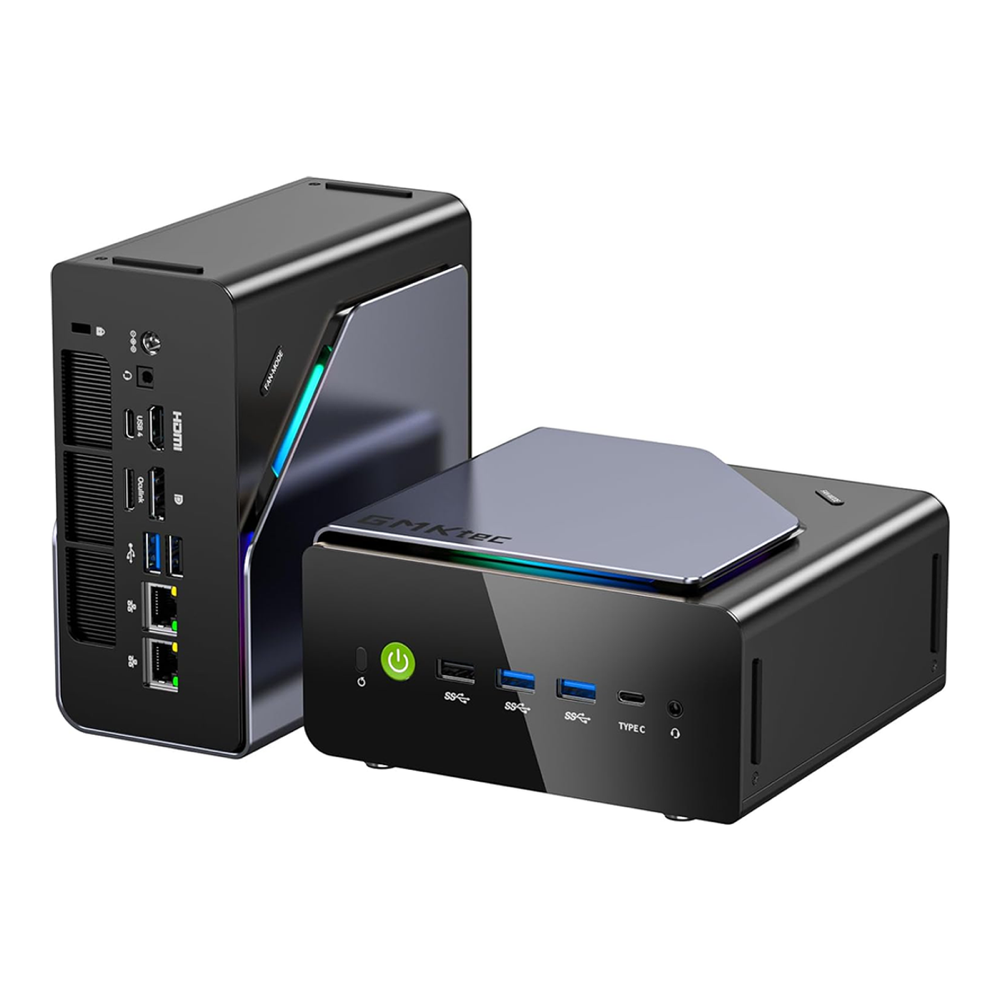
Who it’s for: one person running models up to gpt-oss-120b on Linux or Windows, on a budget. GMKtec rates it for peak performance at 140W, and you get 2.5GbE, USB4, Wi-Fi 7 and two M.2 slots. The 128GB, 2TB unit sold in the $3,500 to $3,700 range.
Skip it if you need fast networking or long-prompt speed. Check the EVO-X2 128GB price on Amazon. On a tighter budget, the EVO-X2 64GB with 1TB is about $2,150 to $2,400 and still runs 30B-class models comfortably, though it cannot hold gpt-oss-120b with room for context.
Minisforum MS-S1 Max
The MS-S1 Max is the Strix Halo to buy when the box has to sit on a real network or take an add-in card.

Who it’s for: homelab and small-team buyers who want dual 10GbE, USB4 V2 and a full-length PCIe slot wired as PCIe 4.0 x4. Minisforum builds the 320W power supply in. It rates the chip at 160W peak and 130W sustained, so you get more headroom than the EVO-X2, which GMKtec rates at 120W steady and 140W peak.
Skip it if 2.5GbE is enough for you, because the EVO-X2 runs the same chip for less. The 128GB, 2TB unit was in the $3,900 to $4,000 range with nine left. Check the MS-S1 Max 128GB price on Amazon, or the 64GB version at about $2,550 to $2,700.
Pick a Mac Studio for speed or size
Pick the chip by the model you’ll run. The 32-core M5 Max has 460 GB/s and only 36GB, so it is a different machine for this job. The 40-core M5 Max reaches 614 GB/s with up to 128GB, and the M5 Ultra reaches 1.2 TB/s with 96GB, 256GB or 512GB.
Mac Studio M5 Max, 40-core GPU, 128GB
This configuration generates tokens faster than any other machine here under $9,000, and it is the best tokens per dollar we found.
Who it’s for: one user who wants the fastest chat and coding-agent responses and a quiet desk box with nothing to maintain. Apple sells the 40-core chip with 128GB and a 512GB SSD for about $5,000 to $5,200 on its store. For smaller agent models, our Mac mini for AI agents guide covers the cheaper route.
Skip it if your work is CUDA or you’d rather run Linux. Amazon does not stock the 128GB build, but it sells the base M5 Max Mac Studio with 36GB for about $2,250 to $2,500, which suits models up to about 27B.
Mac Studio M5 Ultra, 256GB
The M5 Ultra is the only single box in this comparison that loads a model larger than about 120GB.

Who it’s for: anyone whose target model needs more than 128GB, such as large mixture-of-experts models at higher precision. Apple charges about $9,400 to $9,600 for the 64-core GPU with 256GB and 1TB. The 512GB option needs the 80-core chip, at about $22,000 to $22,500.
Skip it if your models fit in 128GB, because the M5 Max does that for about half the price. The in-stock Amazon unit, sold by Expercom with three left, pairs the 64-core GPU and 256GB with a 2TB SSD in the $10,800 to $11,200 range. That’s roughly $1,000 more than the same build from Apple. Check the M5 Ultra 256GB price on Amazon.
Start from your budget
Under $2,500, the 64GB EVO-X2 is the entry point, and the base Mac Studio is the alternative if you live in macOS. Around $3,500 to $4,000, a 128GB Strix Halo is the best value, and the MS-S1 Max is worth the extra only for its networking. If you want 192GB of Strix memory, the newer AMD chip costs roughly double, as our Ryzen AI Max+ 495 vs 395 comparison shows.
At about $5,000 to $5,200 the 128GB Mac Studio is the fastest single-user box and the best tokens per dollar here. The DGX Spark or HP ZGX Nano at $6,900 to $7,200 makes sense only when CUDA, fine-tuning or multi-user serving is the job. Past 128GB, the M5 Ultra is the only one-box answer. A discrete card is still an option, compared in our best GPU for LLMs guide. For most people running local models, though, the verdict stands: buy the 128GB Strix Halo.


