


Trigonometric functions

In mathematics, the trigonometric functions (also called circular functions, angle functions or goniometric functions)[1] are real functions which relate an angle of a right-angled triangle to ratios of two side lengths. They are widely used in all sciences that are related to geometry, such as navigation, solid mechanics, celestial mechanics, geodesy, and many others. They are among the simplest periodic functions, and are widely used for studying periodic phenomena through Fourier analysis.
| Trigonometry |
|---|
 |
| Reference |
| Laws and theorems |
| Calculus |
| Mathematicians |
The trigonometric functions most commonly used in modern mathematics are the sine, the cosine, and the tangent functions. Their reciprocals are respectively the cosecant, the secant, and the cotangent functions, which are less commonly used. Each of these six trigonometric functions has a corresponding inverse function and has an analog among the hyperbolic functions.
The oldest definitions of trigonometric functions, related to right-angle triangles, define them only for acute angles. To extend the sine and cosine functions to functions whose domain is the whole real line, geometrical definitions using the standard unit circle (i.e., a circle with radius 1 unit) are often used; then the domain of the other functions is the real line with some isolated points removed. Modern definitions express trigonometric functions as infinite series or as solutions of differential equations. This allows extending the domain of sine and cosine functions to the whole complex plane, and the domain of the other trigonometric functions to the complex plane with some isolated points removed.
Notation
[edit]Conventionally, an abbreviation of each trigonometric function's name is used as its symbol in formulas. Today, the most common versions of these abbreviations are "sin" for sine, "cos" for cosine, "tan" or "tg" for tangent, "sec" for secant, "csc" or "cosec" for cosecant, and "cot" or "ctg" for cotangent. Historically, these abbreviations were first used in prose sentences to indicate particular line segments or their lengths related to an arc of an arbitrary circle, and later to indicate ratios of lengths, but as the function concept developed in the 17th–18th century, they began to be considered as functions of real-number-valued angle measures, and written with functional notation, for example sin(x). Parentheses are still often omitted to reduce clutter, but are sometimes necessary; for example the expression would typically be interpreted to mean so parentheses are required to express


A positive integer appearing as a superscript after the symbol of the function denotes exponentiation, not function composition. For example and denote not This differs from the (historically later) general functional notation in which




In contrast, the superscript is commonly used to denote the inverse function, not the reciprocal. For example and denote the inverse trigonometric function alternatively written The equation implies not In this case, the superscript could be considered as denoting a composed or iterated function, but negative superscripts other than are not in common use.


Right-angled triangle definitions
[edit]

If the acute angle θ is given, then any right triangles that have an angle of θ are similar to each other. This means that the ratio of any two side lengths depends only on θ. Thus these six ratios define six functions of θ, which are the trigonometric functions. In the following definitions, the hypotenuse is the length of the side opposite the right angle, opposite represents the side opposite the given angle θ, and adjacent represents the side between the angle θ and the right angle.[2][3]
|
|
|
|
|
|
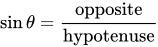
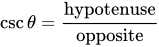
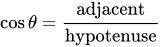
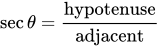
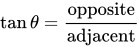
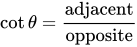
Various mnemonics can be used to remember these definitions.
In a right-angled triangle, the sum of the two acute angles is a right angle, that is, 90° or π/2 radians. Therefore and represent the same ratio, and thus are equal. This identity and analogous relationships between the other trigonometric functions are summarized in the following table.


Bottom: Graph of sine versus angle. Angles from the top panel are identified.
| Function | Description | Relationship | |
|---|---|---|---|
| using radians | using degrees | ||
| sine | opposite/hypotenuse | ||
| cosine | adjacent/hypotenuse | ||
| tangent | opposite/adjacent | ||
| cotangent | adjacent/opposite | ||
| secant | hypotenuse/adjacent | ||
| cosecant | hypotenuse/opposite | ||












Radians versus degrees
[edit]In geometric applications, the argument of a trigonometric function is generally the measure of an angle. For this purpose, any angular unit is convenient. One common unit is degrees, in which a right angle is 90° and a complete turn is 360° (particularly in elementary mathematics).
However, in calculus and mathematical analysis, the trigonometric functions are generally regarded more abstractly as functions of real or complex numbers, rather than angles. In fact, the functions sin and cos can be defined for all complex numbers in terms of the exponential function, via power series,[5] or as solutions to differential equations given particular initial values[6] (see below), without reference to any geometric notions. The other four trigonometric functions (tan, cot, sec, csc) can be defined as quotients and reciprocals of sin and cos, except where zero occurs in the denominator. It can be proved, for real arguments, that these definitions coincide with elementary geometric definitions if the argument is regarded as an angle in radians.[5] Moreover, these definitions result in simple expressions for the derivatives and indefinite integrals for the trigonometric functions.[7] Thus, in settings beyond elementary geometry, radians are regarded as the mathematically natural unit for describing angle measures.
When radians (rad) are employed, the angle is given as the length of the arc of the unit circle subtended by it: the angle that subtends an arc of length 1 on the unit circle is 1 rad (≈ 57.3°),[8] and a complete turn (360°) is an angle of 2π (≈ 6.28) rad.[9] Since radian is dimensionless, i.e. 1 rad = 1, the degree symbol can also be regarded as a mathematical constant factor such that 1° = π/180 ≈ 0.0175.[citation needed]
Unit-circle definitions
[edit]

The six trigonometric functions can be defined as coordinate values of points on the Euclidean plane that are related to the unit circle, which is the circle of radius one centered at the origin O of this coordinate system. While right-angled triangle definitions allow for the definition of the trigonometric functions for angles between 0 and radians (90°), the unit circle definitions allow the domain of trigonometric functions to be extended to all positive and negative real numbers.

Let be the ray obtained by rotating by an angle θ the positive half of the x-axis (counterclockwise rotation for and clockwise rotation for ). This ray intersects the unit circle at the point The ray extended to a line if necessary, intersects the line of equation at point and the line of equation at point The tangent line to the unit circle at the point A, is perpendicular to and intersects the y- and x-axes at points and The coordinates of these points give the values of all trigonometric functions for any arbitrary real value of θ in the following manner.


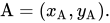


The trigonometric functions cos and sin are defined, respectively, as the x- and y-coordinate values of point A. That is, and [10]


In the range , this definition coincides with the right-angled triangle definition, by taking the right-angled triangle to have the unit radius OA as hypotenuse. And since the equation holds for all points on the unit circle, this definition of cosine and sine also satisfies the Pythagorean identity.



The other trigonometric functions can also be found along the unit circle; all together, they are:

By applying the Pythagorean identity and geometric proof methods, these definitions can readily be shown to coincide with the definitions of tangent, cotangent, secant and cosecant in terms of sine and cosine, i.e.


Since a rotation of an angle of does not change the position or size of a shape, the points A, B, C, D, and E are the same for two angles whose difference is an integer multiple of . Thus trigonometric functions are periodic functions with period . That is, the equalities and hold for any angle θ and any integer k. The same is true for the four other trigonometric functions. By observing the sign and the monotonicity of the functions sine, cosine, cosecant, and secant in the four quadrants, one can show that is the smallest value for which they are periodic (i.e., is the fundamental period of these functions). However, after a rotation by an angle , the points B and C already return to their original position, so that the tangent function and the cotangent function have a fundamental period of . That is, the equalities and hold for any angle θ and any integer k.


Algebraic values
[edit]
The algebraic expressions for some notable angles are as follows, beginning with the zero angle and ending with the right angle:

Writing the numerators as square roots of consecutive non-negative integers, with a denominator of 2, provides an easy way to remember the values.[12]
Such simple expressions generally do not exist for other angles which are rational multiples of a right angle.
- For an angle which, measured in degrees, is a multiple of three, the exact trigonometric values of the sine and the cosine may be expressed in terms of square roots. These values of the sine and the cosine may thus be constructed by ruler and compass.
- For an angle of an integer number of degrees, the sine and the cosine may be expressed in terms of square roots and the cube root of a non-real complex number. Galois theory allows a proof that, if the angle is not a multiple of 3°, non-real cube roots appear in the definition of their sine and cosine.
- For an angle which, expressed in degrees, is a rational number, the sine and the cosine are algebraic numbers, which may be expressed in terms of n-th roots. This results from the fact that the Galois groups of the cyclotomic polynomials are cyclic.
- For an angle which, expressed in degrees, is not a rational number, then either the angle or both the sine and the cosine are transcendental numbers. This is a corollary of Baker's theorem, proved in 1966.
- If the sine of an angle is a rational number then the cosine is not necessarily a rational number, and vice versa. However, if the tangent of an angle is rational then both the sine and cosine of the double angle will be rational.
Simple algebraic values
[edit]The following table lists the sines, cosines, and tangents of multiples of 15 degrees from 0 to 90 degrees.
| Angle, θ, in | ||||
|---|---|---|---|---|
| radians | degrees | |||
| undefined | ||||


Definitions in analysis
[edit]


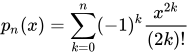
G. H. Hardy noted in his 1908 work A Course of Pure Mathematics that the definition of the trigonometric functions in terms of the unit circle is not satisfactory, because it depends implicitly on a notion of angle that can be measured by a real number.[clarification needed][13] Thus in modern analysis, trigonometric functions are usually constructed without reference to geometry.
Various ways exist in the literature for defining the trigonometric functions in a manner suitable for analysis; they include:
- Using the "geometry" of the unit circle, which requires formulating the arc length of a circle (or area of a sector) analytically.[13]
- By a power series, which is particularly well-suited to complex variables.[13][14]
- By using an infinite product expansion.[13]
- By inverting the inverse trigonometric functions, which can be defined as integrals of algebraic or rational functions.[13]
- As solutions of a differential equation.[15]
Definition by differential equations
[edit]Sine and cosine can be defined as the unique solution to the initial value problem:[16]

Differentiating again, and , so both sine and cosine are solutions of the same ordinary differential equation Sine is the unique solution with y(0) = 0 and y′(0) = 1; cosine is the unique solution with y(0) = 1 and y′(0) = 0.



One can then prove, as a theorem, that solutions are periodic, having the same period. Writing this period as is then a definition of the real number which is independent of geometry.

Applying the quotient rule to the tangent , so the tangent function satisfies the ordinary differential equation It is the unique solution with y(0) = 0.



Power series expansion
[edit]The basic trigonometric functions can be defined by the following power series expansions.[17]These series are also known as the Taylor series or Maclaurin series of these trigonometric functions: The radius of convergence of these series is infinite. Therefore, the sine and the cosine can be extended to entire functions (also called "sine" and "cosine"), which are (by definition) complex-valued functions that are defined and holomorphic on the whole complex plane.
![{\displaystyle {\begin{alignedat}{3}\sin x&=x-{\frac {x^{3}}{3!}}+{\frac {x^{5}}{5!}}-{\frac {x^{7}}{7!}}+\cdots &&{}=\sum _{n=0}^{\infty }(-1)^{n}{\frac {x^{2n+1}}{(2n+1)!}}\\[2pt]\cos x&=1-{\frac {x^{2}}{2!}}+{\frac {x^{4}}{4!}}-{\frac {x^{6}}{6!}}+\cdots &&{}=\sum _{n=0}^{\infty }(-1)^{n}{\frac {x^{2n}}{(2n)!}}\end{alignedat}}}](https://wikimedia.org/api/rest_v1/media/math/render/svg/17d455b025df89dfa1023c261add1505852103eb)
Term-by-term differentiation shows that the sine and cosine defined by the series obey the differential equation discussed previously, and conversely one can obtain these series from elementary recursion relations derived from the differential equation.
Being defined as fractions of entire functions, the other trigonometric functions may be extended to meromorphic functions, that is functions that are holomorphic in the whole complex plane, except some isolated points called poles. Here, the poles are the numbers of the form for the tangent and the secant, or for the cotangent and the cosecant, where k is an arbitrary integer.


Recurrences relations may also be computed for the coefficients of the Taylor series of the other trigonometric functions. These series have a finite radius of convergence. Their coefficients have a combinatorial interpretation: they enumerate alternating permutations of finite sets.[18]
More precisely, defining
- Un, the n-th up/down number,
- Bn, the n-th Bernoulli number, and
- En, is the n-th Euler number,
one has the following series expansions:[19]
![{\displaystyle {\begin{aligned}\tan x&{}=\sum _{n=0}^{\infty }{\frac {U_{2n+1}}{(2n+1)!}}x^{2n+1}\\[8mu]&{}=\sum _{n=1}^{\infty }{\frac {(-1)^{n-1}2^{2n}\left(2^{2n}-1\right)B_{2n}}{(2n)!}}x^{2n-1}\\[5mu]&{}=x+{\frac {1}{3}}x^{3}+{\frac {2}{15}}x^{5}+{\frac {17}{315}}x^{7}+\cdots ,\qquad {\text{for }}|x|<{\frac {\pi }{2}}.\end{aligned}}}](https://wikimedia.org/api/rest_v1/media/math/render/svg/d0de1a2399f8c3b723b71c5e24e8f0136fd4bb18)
![{\displaystyle {\begin{aligned}\csc x&=\sum _{n=0}^{\infty }{\frac {(-1)^{n+1}2\left(2^{2n-1}-1\right)B_{2n}}{(2n)!}}x^{2n-1}\\[5mu]&=x^{-1}+{\frac {1}{6}}x+{\frac {7}{360}}x^{3}+{\frac {31}{15120}}x^{5}+\cdots ,\qquad {\text{for }}0<|x|<\pi .\end{aligned}}}](https://wikimedia.org/api/rest_v1/media/math/render/svg/bd4b74fe732906b09b6205ecfa81326222ae0320)
![{\displaystyle {\begin{aligned}\sec x&=\sum _{n=0}^{\infty }{\frac {U_{2n}}{(2n)!}}x^{2n}=\sum _{n=0}^{\infty }{\frac {(-1)^{n}E_{2n}}{(2n)!}}x^{2n}\\[5mu]&=1+{\frac {1}{2}}x^{2}+{\frac {5}{24}}x^{4}+{\frac {61}{720}}x^{6}+\cdots ,\qquad {\text{for }}|x|<{\frac {\pi }{2}}.\end{aligned}}}](https://wikimedia.org/api/rest_v1/media/math/render/svg/1e8d1437d98b6b4d05d4da50fe2e18bd39a7ff9e)
![{\displaystyle {\begin{aligned}\cot x&=\sum _{n=0}^{\infty }{\frac {(-1)^{n}2^{2n}B_{2n}}{(2n)!}}x^{2n-1}\\[5mu]&=x^{-1}-{\frac {1}{3}}x-{\frac {1}{45}}x^{3}-{\frac {2}{945}}x^{5}-\cdots ,\qquad {\text{for }}0<|x|<\pi .\end{aligned}}}](https://wikimedia.org/api/rest_v1/media/math/render/svg/4c6645779d6fe606694a0ac157fcdee271c7e795)
Continued fraction expansion
[edit]The following continued fractions are valid in the whole complex plane:
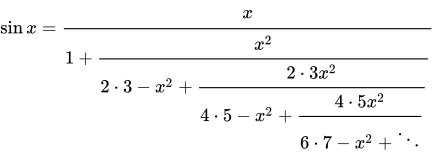
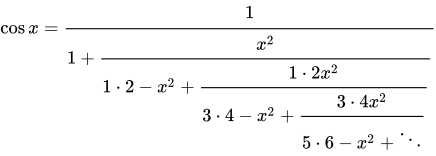
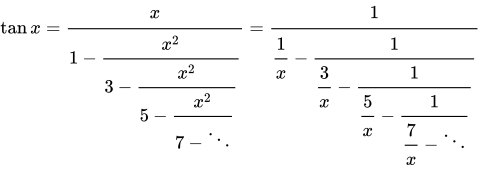
The last one was used in the historically first proof that π is irrational.[21]
There is a rapidly convergent continued fraction for : [22]

Let then the following continued fraction representation gives (asymptotically) 12.68 new correct decimal places per cycle:


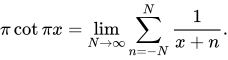
Partial fraction expansion
[edit]There is a series representation as partial fraction expansion where just translated reciprocal functions are summed up, such that the poles of the cotangent function and the reciprocal functions match:[23] This identity can be proved with the Herglotz trick.[24] Combining the (–n)-th with the n-th term lead to absolutely convergent series: Similarly, one can find a partial fraction expansion for the secant, cosecant and tangent functions: Those series can be deduced from the Mittag-Leffler expansion (using Mittag-Leffler's theorem).


Infinite product expansion
[edit]The following infinite product for the sine is due to Leonhard Euler, and is of great importance in complex analysis:[25] This may be obtained from the partial fraction decomposition of given above, which is the logarithmic derivative of .[26] From this, it can be deduced also that




Euler's formula and the exponential function
[edit]
Euler's formula relates sine and cosine to the exponential function: This formula is commonly considered for real values of x, but it remains true for all complex values.

Proof: Let and . One has for . The quotient rule implies thus that . Therefore, is a constant function, which equals 1 as . This proves the formula.




One has
![{\displaystyle {\begin{aligned}e^{ix}&=\cos x+i\sin x\\[5pt]e^{-ix}&=\cos x-i\sin x.\end{aligned}}}](https://wikimedia.org/api/rest_v1/media/math/render/svg/8d374fafbe34908c7766b67e4c51797589906940)
Solving this linear system in sine and cosine, one can express them in terms of the exponential function:
![{\displaystyle {\begin{aligned}\sin x&={\frac {e^{ix}-e^{-ix}}{2i}}\\[5pt]\cos x&={\frac {e^{ix}+e^{-ix}}{2}}.\end{aligned}}}](https://wikimedia.org/api/rest_v1/media/math/render/svg/590e4a1bbe3ccdb7521fe06a6e5b56e538d4e729)
When x is real, this may be rewritten as

Most trigonometric identities can be proved by expressing trigonometric functions in terms of the complex exponential function by using above formulas, and then using the identity for simplifying the result.

Euler's formula can also be used to define the basic trigonometric function directly, as follows, using the language of topological groups.[27] The set of complex numbers of unit modulus is a compact and connected topological group, which has a neighborhood of the identity that is homeomorphic to the real line. Therefore, it is isomorphic as a topological group to the one-dimensional torus group , via an isomorphism In simple terms, , and this isomorphism is unique up to taking complex conjugates.


For a nonzero real number (the base), the function defines an isomorphism of the group . The real and imaginary parts of are the cosine and sine, where is used as the base for measuring angles. For example, when , we get the measure in radians, and the usual trigonometric functions. When , we get the sine and cosine of angles measured in degrees.


Note that is the unique value at which the derivative becomes a unit vector with positive imaginary part at . This fact can, in turn, be used to define the constant .


Definition via integration
[edit]Another way to define the trigonometric functions in analysis is using integration.[13][28] For a real number , put where this defines this inverse tangent function. Also, is defined by a definition that goes back to Karl Weierstrass.[29]


On the interval , the trigonometric functions are defined by inverting the relation . Thus we define the trigonometric functions by where the point is on the graph of and the positive square root is taken.


This defines the trigonometric functions on . The definition can be extended to all real numbers by first observing that, as , , and so and . Thus and are extended continuously so that , . Now the conditions and define the sine and cosine as periodic functions with period , for all real numbers.


Proving the basic properties of sine and cosine, including the fact that sine and cosine are analytic, one may first establish the addition formulae. First, holds, provided , since after the substitution . In particular, the limiting case as gives Thus we have So the sine and cosine functions are related by translation over a quarter period .


Definitions using functional equations
[edit]One can also define the trigonometric functions using various functional equations.
For example,[30] the sine and the cosine form the unique pair of continuous functions that satisfy the difference formula and the added condition


In the complex plane
[edit]The sine and cosine of a complex number can be expressed in terms of real sines, cosines, and hyperbolic functions as follows:

![{\displaystyle {\begin{aligned}\sin z&=\sin x\cosh y+i\cos x\sinh y,\\[5pt]\cos z&=\cos x\cosh y-i\sin x\sinh y.\end{aligned}}}](https://wikimedia.org/api/rest_v1/media/math/render/svg/9839a3b0303fe86c9c4e2bb127e56a7a22baddb9)
By taking advantage of domain coloring, it is possible to graph the trigonometric functions as complex-valued functions. Various features unique to the complex functions can be seen from the graph; for example, the sine and cosine functions can be seen to be unbounded as the imaginary part of becomes larger (since the color white represents infinity), and the fact that the functions contain simple zeros or poles is apparent from the fact that the hue cycles around each zero or pole exactly once. Comparing these graphs with those of the corresponding hyperbolic functions highlights the relationships between the two.


 |
