


Portal:Mathematics


The Mathematics Portal

Mathematics is the study of representing and reasoning about abstract objects (such as numbers, points, spaces, sets, structures, and games). Mathematics is used throughout the world as an essential tool in many fields, including natural science, engineering, medicine, and the social sciences. Applied mathematics, the branch of mathematics concerned with application of mathematical knowledge to other fields, inspires and makes use of new mathematical discoveries and sometimes leads to the development of entirely new mathematical disciplines, such as statistics and game theory. Mathematicians also engage in pure mathematics, or mathematics for its own sake, without having any application in mind. There is no clear line separating pure and applied mathematics, and practical applications for what began as pure mathematics are often discovered. (Full article...)
Featured articles –
 Featured articles are displayed here, which represent some of the best content on English Wikipedia.
Archimedes of Syracuse (/ˌɑːrkɪˈmiːdiːz/ AR-kih-MEE-deez; c. 287 – c. 212 BC) was an Ancient Greek mathematician, physicist, engineer, astronomer, and inventor from the city of Syracuse in Sicily. Although few details of his life are known, based on his surviving work, he is considered one of the leading scientists in classical antiquity, and one of the greatest mathematicians of all time. Archimedes anticipated modern calculus and analysis by applying the concept of the infinitesimals and the method of exhaustion to derive and rigorously prove many geometrical theorems, including the area of a circle, the surface area and volume of a sphere, the area of an ellipse, the area under a parabola, the volume of a segment of a paraboloid of revolution, the volume of a segment of a hyperboloid of revolution, and the area of a spiral.
Archimedes' other mathematical achievements include deriving an approximation of pi (π), defining and investigating the Archimedean spiral, and devising a system using exponentiation for expressing very large numbers. He was also one of the first to apply mathematics to physical phenomena, working on statics and hydrostatics. Archimedes' achievements in this area include a proof of the law of the lever, the widespread use of the concept of center of gravity, and the enunciation of the law of buoyancy known as Archimedes' principle. In astronomy, he made measurements of the apparent diameter of the Sun and the size of the universe. He is also said to have built a planetarium device that demonstrated the movements of the known celestial bodies, and may have been a precursor to the Antikythera mechanism. He is also credited with designing innovative machines, such as his screw pump, compound pulleys, and defensive war machines to protect his native Syracuse from invasion. (Full article...)
Plots of logarithm functions, with three commonly used bases. The special points logb b = 1 are indicated by dotted lines, and all curves intersect in logb 1 = 0.
In mathematics, the logarithm of a number is the exponent by which another fixed value, the base, must be raised to produce that number. For example, the logarithm of 1000 to base 10 is 3, because 1000 is 10 to the 3rd power: 1000 = 103 = 10 × 10 × 10. More generally, if x = by, then y is the logarithm of x to base b, written logb x = y, so log10 1000 = 3. As a single-variable function, the logarithm to base b is the inverse of exponentiation with base b.
The logarithm base 10 is called the decimal or common logarithm and is commonly used in science and engineering. The natural logarithm has the number e ≈ 2.718 as its base; its use is widespread in mathematics and physics because of its very simple derivative. The binary logarithm uses base 2 and is widely used in computer science, information theory, music theory, and photography. When the base is unambiguous from the context or irrelevant it is often omitted, and the logarithm is written log x. (Full article...)- In algebraic geometry and theoretical physics, mirror symmetry is a relationship between geometric objects called Calabi–Yau manifolds. The term refers to a situation where two Calabi–Yau manifolds look very different geometrically but are nevertheless equivalent when employed as extra dimensions of string theory.
Early cases of mirror symmetry were discovered by physicists. Mathematicians became interested in this relationship around 1990 when Philip Candelas, Xenia de la Ossa, Paul Green, and Linda Parkes showed that it could be used as a tool in enumerative geometry, a branch of mathematics concerned with counting the number of solutions to geometric questions. Candelas and his collaborators showed that mirror symmetry could be used to count rational curves on a Calabi–Yau manifold, thus solving a longstanding problem. Although the original approach to mirror symmetry was based on physical ideas that were not understood in a mathematically precise way, some of its mathematical predictions have since been proven rigorously. (Full article...) - In classical mechanics, the Laplace–Runge–Lenz vector (LRL vector) is a vector used chiefly to describe the shape and orientation of the orbit of one astronomical body around another, such as a binary star or a planet revolving around a star. For two bodies interacting by Newtonian gravity, the LRL vector is a constant of motion, meaning that it is the same no matter where it is calculated on the orbit; equivalently, the LRL vector is said to be conserved. More generally, the LRL vector is conserved in all problems in which two bodies interact by a central force that varies as the inverse square of the distance between them; such problems are called Kepler problems.
Thus the hydrogen atom is a Kepler problem, since it comprises two charged particles interacting by Coulomb's law of electrostatics, another inverse-square central force. The LRL vector was essential in the first quantum mechanical derivation of the spectrum of the hydrogen atom, before the development of the Schrödinger equation. However, this approach is rarely used today. (Full article...)
Robert Hues (1553 – 24 May 1632) was an English mathematician and geographer. He attended St. Mary Hall at Oxford, and graduated in 1578. Hues became interested in geography and mathematics, and studied navigation at a school set up by Walter Raleigh. During a trip to Newfoundland, he made observations which caused him to doubt the accepted published values for variations of the compass. Between 1586 and 1588, Hues travelled with Thomas Cavendish on a circumnavigation of the globe, performing astronomical observations and taking the latitudes of places they visited. Beginning in August 1591, Hues and Cavendish again set out on another circumnavigation of the globe. During the voyage, Hues made astronomical observations in the South Atlantic, and continued his observations of the variation of the compass at various latitudes and at the Equator. Cavendish died on the journey in 1592, and Hues returned to England the following year.
In 1594, Hues published his discoveries in the Latin work Tractatus de globis et eorum usu (Treatise on Globes and Their Use) which was written to explain the use of the terrestrial and celestial globes that had been made and published by Emery Molyneux in late 1592 or early 1593, and to encourage English sailors to use practical astronomical navigation. Hues's work subsequently went into at least 12 other printings in Dutch, English, French and Latin. (Full article...)
The first 15,000 partial sums of 0 + 1 − 2 + 3 − 4 + ... The graph is situated with positive integers to the right and negative integers to the left.
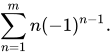
In mathematics, 1 − 2 + 3 − 4 + ··· is an infinite series whose terms are the successive positive integers, given alternating signs. Using sigma summation notation the sum of the first m terms of the series can be expressed as
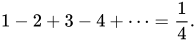
The infinite series diverges, meaning that its sequence of partial sums, (1, −1, 2, −2, 3, ...), does not tend towards any finite limit. Nonetheless, in the mid-18th century, Leonhard Euler wrote what he admitted to be a paradoxical equation:
(Full article...)
The regular triangular tiling of the plane, whose symmetries are described by the affine symmetric group S̃3
The affine symmetric groups are a family of mathematical structures that describe the symmetries of the number line and the regular triangular tiling of the plane, as well as related higher-dimensional objects. In addition to this geometric description, the affine symmetric groups may be defined in other ways: as collections of permutations (rearrangements) of the integers (..., −2, −1, 0, 1, 2, ...) that are periodic in a certain sense, or in purely algebraic terms as a group with certain generators and relations. They are studied in combinatorics and representation theory.
A finite symmetric group consists of all permutations of a finite set. Each affine symmetric group is an infinite extension of a finite symmetric group. Many important combinatorial properties of the finite symmetric groups can be extended to the corresponding affine symmetric groups. Permutation statistics such as descents and inversions can be defined in the affine case. As in the finite case, the natural combinatorial definitions for these statistics also have a geometric interpretation. (Full article...)
High-precision test of general relativity by the Cassini space probe (artist's impression): radio signals sent between the Earth and the probe (green wave) are delayed by the warping of spacetime (blue lines) due to the Sun's mass.
General relativity is a theory of gravitation developed by Albert Einstein between 1907 and 1915. The theory of general relativity says that the observed gravitational effect between masses results from their warping of spacetime.
By the beginning of the 20th century, Newton's law of universal gravitation had been accepted for more than two hundred years as a valid description of the gravitational force between masses. In Newton's model, gravity is the result of an attractive force between massive objects. Although even Newton was troubled by the unknown nature of that force, the basic framework was extremely successful at describing motion. (Full article...)
Leonhard Euler (/ˈɔɪlər/ OY-lər; 15 April 1707 – 18 September 1783) was a Swiss polymath who was active as a mathematician, physicist, astronomer, logician, geographer, music theorist and engineer. He founded the studies of graph theory and topology and made influential discoveries in many other branches of mathematics, such as analytic number theory, complex analysis, and infinitesimal calculus. He also introduced much of modern mathematical terminology and notation, including the notion of a mathematical function. He is known for his work in mechanics, fluid dynamics, optics, astronomy, and music theory. Euler has been called a "universal genius" who "was fully equipped with almost unlimited powers of imagination, intellectual gifts and extraordinary memory". He spent most of his adult life in Saint Petersburg, Russia, and in Berlin, then the capital of Prussia.
Euler is credited for popularizing the Greek letter (lowercase pi) to denote the ratio of a circle's circumference to its diameter, as well as first using the notation for the value of a function, the letter to express the imaginary unit , the Greek letter (capital sigma) to express summations, the Greek letter (capital delta) for finite differences, and lowercase letters to represent the sides of a triangle while representing the angles as capital letters. He gave the current definition of the constant , the base of the natural logarithm, now known as Euler's number. Euler made contributions to applied mathematics and engineering, such as his study of ships helping navigation, his three volumes on optics, which contributed to the design of microscopes and telescopes, and his studies of beam bending and column critical loads. (Full article...)
Euclid's method for finding the greatest common divisor (GCD) of two starting lengths BA and DC, both defined to be multiples of a common "unit" length. The length DC being shorter, it is used to "measure" BA, but only once because the remainder EA is less than DC. EA now measures (twice) the shorter length DC, with remainder FC shorter than EA. Then FC measures (three times) length EA. Because there is no remainder, the process ends with FC being the GCD. On the right Nicomachus's example with numbers 49 and 21 resulting in their GCD of 7 (derived from Heath 1908:300).
In mathematics, the Euclidean algorithm, or Euclid's algorithm, is an efficient method for computing the greatest common divisor (GCD) of two integers, the largest number that divides them both without a remainder. It is named after the ancient Greek mathematician Euclid, who first described it in his Elements (c. 300 BC).
It is an example of an algorithm, and is one of the oldest algorithms in common use. It can be used to reduce fractions to their simplest form, and is a part of many other number-theoretic and cryptographic calculations.
The Euclidean algorithm is based on the principle that the greatest common divisor of two numbers does not change if the larger number is replaced by its difference with the smaller number. For example, 21 is the GCD of 252 and 105 (as 252 = 21 × 12 and 105 = 21 × 5), and the same number 21 is also the GCD of 105 and 252 − 105 = 147. Since this replacement reduces the larger of the two numbers, repeating this process gives successively smaller pairs of numbers until the two numbers become equal. When that occurs, that number is the GCD of the original two numbers. By reversing the steps or using the extended Euclidean algorithm, the GCD can be expressed as a linear combination of the two original numbers, that is the sum of the two numbers, each multiplied by an integer (for example, 21 = 5 × 10⁵ + (−2) × 252). The fact that the GCD can always be expressed in this way is known as Bézout's identity. (Full article...)
Shen Kuo (Chinese: 沈括; 1031–1095) or Shen Gua, courtesy name Cunzhong (存中) and pseudonym Mengqi (now usually given as Mengxi) Weng (夢溪翁), was a Chinese polymath, scientist, and statesman of the Northern Song dynasty. Shen was a master in many fields of study including mathematics, optics, and horology. In his career as a civil servant, he became a finance minister, governmental state inspector, head official for the Bureau of Astronomy in the Song court, Assistant Minister of Imperial Hospitality, and also served as an academic chancellor. At court his political allegiance was to the Reformist faction known as the New Policies Group, headed by Chancellor Wang Anshi (1021–1085).
In his Dream Pool Essays or Dream Torrent Essays (夢溪筆談; Mengxi Bitan) of 1088, Shen was the first to describe the magnetic needle compass, which would be used for navigation (first described in Europe by Alexander Neckam in 1187). Shen discovered the concept of true north in terms of magnetic declination towards the north pole, with experimentation of suspended magnetic needles and "the improved meridian determined by Shen's [astronomical] measurement of the distance between the pole star and true north". This was the decisive step in human history to make compasses more useful for navigation, and may have been a concept unknown in Europe for another four hundred years (evidence of German sundials made circa 1450 show markings similar to Chinese geomancers' compasses in regard to declination). (Full article...)
Émile Michel Hyacinthe Lemoine (French: [emil ləmwan]; 22 November 1840 – 21 February 1912) was a French civil engineer and a mathematician, a geometer in particular. He was educated at a variety of institutions, including the Prytanée National Militaire and, most notably, the École Polytechnique. Lemoine taught as a private tutor for a short period after his graduation from the latter school.
Lemoine is best known for his proof of the existence of the Lemoine point (or the symmedian point) of a triangle. Other mathematical work includes a system he called Géométrographie and a method which related algebraic expressions to geometric objects. He has been called a co-founder of modern triangle geometry, as many of its characteristics are present in his work. (Full article...)
Figure 1: A solution (in purple) to Apollonius's problem. The given circles are shown in black.
In Euclidean plane geometry, the problem of Apollonius (also called Apollonius's problem or the Apollonian problem) is to construct circles that are tangent to three given circles in a plane (Figure 1). Apollonius of Perga (c. 262 BC – c. 190 BC) posed and solved this famous problem in his work Ἐπαφαί (Epaphaí, 'Tangencies'); this work has been lost, but a 4th-century AD report of his results by Pappus of Alexandria has survived. Three given circles generically have eight different circles that are tangent to them (Figure 2), a pair of solutions for each way to divide the three given circles in two subsets (there are 4 ways to divide a set of cardinality 3 in 2 parts).
In the 16th century, Adriaan van Roomen solved the problem using intersecting hyperbolas, but this solution uses methods not limited to straightedge and compass constructions. François Viète found a straightedge and compass solution by exploiting limiting cases: any of the three given circles can be shrunk to zero radius (a point) or expanded to infinite radius (a line). Viète's approach, which uses simpler limiting cases to solve more complicated ones, is considered a plausible reconstruction of Apollonius's method. The method of van Roomen was simplified by Isaac Newton, who showed that Apollonius's problem is equivalent to finding a position from the differences of its distances to three known points. This has applications in navigation and positioning systems such as LORAN. (Full article...)
Josiah Willard Gibbs (/ɡɪbz/; February 11, 1839 – April 28, 1903) was an American mechanical engineer and scientist who made fundamental theoretical contributions to physics, chemistry, and mathematics. His work on the applications of thermodynamics was instrumental in transforming physical chemistry into a rigorous deductive science. Together with James Clerk Maxwell and Ludwig Boltzmann, he created statistical mechanics (a term that he coined), explaining the laws of thermodynamics as consequences of the statistical properties of ensembles of the possible states of a physical system composed of many particles. Gibbs also worked on the application of Maxwell's equations to problems in physical optics. As a mathematician, he created modern vector calculus (independently of the British scientist Oliver Heaviside, who carried out similar work during the same period) and described the Gibbs phenomenon in the theory of Fourier analysis.
In 1863, Yale University awarded Gibbs the first American doctorate in engineering. After a three-year sojourn in Europe, Gibbs spent the rest of his career at Yale, where he was a professor of mathematical physics from 1871 until his death in 1903. Working in relative isolation, he became the earliest theoretical scientist in the United States to earn an international reputation and was praised by Albert Einstein as "the greatest mind in American history". In 1901, Gibbs received what was then considered the highest honor awarded by the international scientific community, the Copley Medal of the Royal Society of London, "for his contributions to mathematical physics". (Full article...)
Zhang Heng (Chinese: 張衡; AD 78 – 139), courtesy name Pingzi, formerly romanized Chang Heng, was a Chinese polymathic scientist and statesman who lived during the Eastern Han dynasty. Educated in the capital cities of Luoyang and Chang'an, he achieved success as an astronomer, mathematician, seismologist, hydraulic engineer, inventor, geographer, cartographer, ethnographer, artist, poet, philosopher, politician, and literary scholar.
Zhang Heng began his career as a minor civil servant in Nanyang. Eventually, he became Chief Astronomer, Prefect of the Majors for Official Carriages, and then Palace Attendant at the imperial court. His uncompromising stance on historical and calendrical issues led to his becoming a controversial figure, preventing him from rising to the status of Grand Historian. His political rivalry with the palace eunuchs during the reign of Emperor Shun (r. 125–144) led to his decision to retire from the central court to serve as an administrator of Hejian Kingdom in present-day Hebei. Zhang returned home to Nanyang for a short time, before being recalled to serve in the capital once more in 138. He died there a year later, in 139. (Full article...)




.jpg)


.jpg)


Selected image –

Good articles –

In mathematics, the Borromean rings are three simple closed curves in three-dimensional space that are topologically linked and cannot be separated from each other, but that break apart into two unknotted and unlinked loops when any one of the three is cut or removed. Most commonly, these rings are drawn as three circles in the plane, in the pattern of a Venn diagram, alternatingly crossing over and under each other at the points where they cross. Other triples of curves are said to form the Borromean rings as long as they are topologically equivalent to the curves depicted in this drawing.
The Borromean rings are named after the Italian House of Borromeo, who used the circular form of these rings as an element of their coat of arms, but designs based on the Borromean rings have been used in many cultures, including by the Norsemen and in Japan. They have been used in Christian symbolism as a sign of the Trinity, and in modern commerce as the logo of Ballantine beer, giving them the alternative name Ballantine rings. Physical instances of the Borromean rings have been made from linked DNA or other molecules, and they have analogues in the Efimov state and Borromean nuclei, both of which have three components bound to each other although no two of them are bound. (Full article...)- Paterson's worms are a family of cellular automata devised in 1971 by Mike Paterson and John Horton Conway to model the behaviour and feeding patterns of certain prehistoric worms. In the model, a worm moves between points on a triangular grid along line segments, representing food. Its turnings are determined by the configuration of eaten and uneaten line segments adjacent to the point at which the worm currently is. Despite being governed by simple rules the behaviour of the worms can be extremely complex, and the ultimate fate of one variant is still unknown.
The worms were studied in the early 1970s by Paterson, Conway and Michael Beeler, described by Beeler in June 1973, and presented in November 1973 in Martin Gardner's "Mathematical Games" column in Scientific American. (Full article...)
The Elements (Ancient Greek: Στοιχεῖα Stoikheîa) is a mathematical treatise written c. 300 BC by the Ancient Greek mathematician Euclid.
The Elements is the oldest extant large-scale deductive treatment of mathematics. Drawing on the works of earlier mathematicians such as Hippocrates of Chios, Eudoxus of Cnidus, and Theaetetus, the Elements is a collection in 13 books of definitions, postulates, geometric constructions, and theorems with their proofs that covers plane and solid Euclidean geometry, elementary number theory, and incommensurability. These include the Pythagorean theorem, Thales' theorem, the Euclidean algorithm for greatest common divisors, Euclid's theorem that there are infinitely many prime numbers, and the construction of regular polygons and polyhedra. (Full article...)
Numbers written with Cistercian numerals. From left to right: 1 in units place, 2 in tens place (20), 3 in hundreds place (300), 4 in thousands place (4,000), then compound numbers 5,555, 6,789, 9,394.
The medieval Cistercian numerals, or "ciphers" in nineteenth-century parlance, were developed by the Cistercian monastic order in the early thirteenth century at about the time that Arabic numerals were introduced to northwestern Europe. They are more compact than Arabic or Roman numerals, with a single glyph able to indicate any integer from 1 to 9,999.
Digits are based on a horizontal or vertical stave, with the position of the digit on the stave indicating its place value (units, tens, hundreds or thousands). These digits are compounded on a single stave to indicate more complex numbers. The Cistercians eventually abandoned the system in favor of the Arabic numerals, but marginal use outside the order continued until the early twentieth century. (Full article...)
Walton in Pomona College's Walker Lounge c. 1957
Jean Brosius Walton (March 6, 1914 – July 5, 2006) was an American academic administrator and women's studies scholar. She spent the bulk of her career at Pomona College in Claremont, California.
Born to a Pennsylvania Quaker family, Walton grew up at George School and studied mathematics at Swarthmore College, Brown University and the University of Pennsylvania. She joined Pomona College in 1949 as the Dean of Women, and was promoted to dean of students in 1969 and vice president for student affairs in 1976, three years before her formal retirement. During her tenure, she advocated for women's education, engaged with student protests against the Vietnam War, oversaw reform of residential life policies to eliminate parietal rules, and co-founded the Claremont Colleges' Intercollegiate Women's Studies Program. She earned widespread recognition for her work and was praised by colleagues for her independent and dignified personality. (Full article...)
A Doyle spiral of type (8,16) printed in 1911 in Popular Science as an illustration of phyllotaxis. One of its spiral arms is shaded.
In the mathematics of circle packing, a Doyle spiral is a pattern of non-crossing circles in the plane in which each circle is surrounded by a ring of six tangent circles. These patterns contain spiral arms formed by circles linked through opposite points of tangency, with their centers on logarithmic spirals of three different shapes.
Doyle spirals are named after mathematician Peter G. Doyle, who made an important contribution to their mathematical construction in the late 1980s or early 1990s. However, their study in phyllotaxis (the mathematics of plant growth) dates back to the early 1900s. (Full article...)
Alan Mathison Turing (/ˈtjʊərɪŋ/; 23 June 1912 – 7 June 1954) was an English mathematician and logician widely regarded as the father of theoretical computer science. He formalised the concepts of algorithm and computation with the Turing machine, a model of a general-purpose computer, and his contributions to cryptanalysis helped the Allies of World War II decipher messages encrypted by the German Enigma machine. He also contributed the Turing test to philosophy of artificial intelligence and the Turing pattern concept to mathematical and theoretical biology.
Born in London and raised in southern England, Turing graduated from King's College, Cambridge, and earned a doctorate from Princeton University in 1938. During World War II, he worked at the Government Code and Cypher School at Bletchley Park, Britain's codebreaking centre, and focused on decrypting German naval messages as the head of Hut 8. His techniques improved on the pre-war Polish bomba method and hastened cryptanalysis of the Enigma ciphering system. The resulting intelligence, known as Ultra, proved helpful in the Battle of the Atlantic. After the war, Turing joined the National Physical Laboratory, where he designed the Automatic Computing Engine, an early stored-program computer. (Full article...)
Anania Shirakatsi (Old Armenian: Անանիա Շիրակացի, Anania Širakac’i, anglicized: Ananias of Shirak) was a 7th-century Armenian polymath and natural philosopher, author of extant works covering mathematics, astronomy, geography, chronology, and other fields. Little is known for certain of his life outside of his own writings, but he is considered the father of the exact and natural sciences in Armenia—the first Armenian mathematician, astronomer, and cosmographer.
A part of the Armenian Hellenizing School and one of the few secular scholars in medieval Armenia, Anania was educated primarily by Tychicus, in Trebizond. He composed science textbooks and the first known geographic work in classical Armenian (Ashkharhatsuyts), which provides detailed information about Greater Armenia, Persia and the Caucasus (Georgia and Caucasian Albania). (Full article...)- In the mathematical theory of reflection groups, the parabolic subgroups are a special kind of subgroup. In the symmetric group of permutations of the set , which is generated by the set of adjacent transpositions, a subgroup is a standard parabolic subgroup if it is generated by a subset of S; equivalently, they are the groups of permutations that come from partitioning the set into parts , , etc., each consisting of a subset of one or more consecutive values, and permuting the entries of each set among itself. The parabolic subgroups of the symmetric group include the standard parabolic subgroups as well as all of their conjugates.
The symmetric group belongs to a larger family of reflection groups called Coxeter groups, each of which comes with a special generating set S (generalizing the adjacent transpositions). In this larger family, a subgroup is a standard parabolic subgroup if it is generated by a subset of the special generating set S. Separately, the symmetric group belongs to a larger family of reflection groups called complex reflection groups, which are defined in terms of their action on certain geometric spaces (finite dimensional complex vector spaces). In this family, a subgroup is parabolic if it consists of all elements of the group that fix a given subset of the space pointwise. In the case of groups that are both Coxeter groups and complex reflection groups, the parabolic subgroups (in the second sense) consist of the standard parabolic subgroups (in the first sense) and all of their conjugates. (Full article...)
In three-dimensional hyperbolic geometry, an ideal polyhedron is a convex polyhedron all of whose vertices are ideal points, points "at infinity" rather than interior to three-dimensional hyperbolic space. It can be defined as the convex hull of a finite set of ideal points. An ideal polyhedron has ideal polygons as its faces, meeting along lines of the hyperbolic space.
The Platonic solids and Archimedean solids have ideal versions, with the same combinatorial structure as their more familiar Euclidean versions. Several uniform hyperbolic honeycombs divide hyperbolic space into cells of these shapes, much like the familiar division of Euclidean space into cubes. However, not all polyhedra have ideal versions – a polyhedron can be ideal only when it can be represented in Euclidean space with all its vertices on a circumscribed sphere. Using linear programming, one can test whether a polyhedron has an ideal version, in polynomial time. (Full article...)
A well-covered graph, the intersection graph of the nine diagonals of a hexagon. The three red vertices form one of its 14 equal-sized maximal independent sets, and the six blue vertices form the complementary minimal vertex cover.
In graph theory, a well-covered graph is an undirected graph in which the minimal vertex covers all have the same size. Here, a vertex cover is a set of vertices that touches all edges, and it is minimal if removing any vertex from it would leave some edge uncovered. Equivalently, well-covered graphs are the graphs in which all maximal independent sets have equal size. Well-covered graphs were defined and first studied by Michael D. Plummer in 1970.
The well-covered graphs include all complete graphs, balanced complete bipartite graphs, and the rook's graphs whose vertices represent squares of a chessboard and edges represent moves of a chess rook. Known characterizations of the well-covered cubic graphs, well-covered claw-free graphs, and well-covered graphs of high girth allow these graphs to be recognized in polynomial time, but testing whether other kinds of graph are well-covered is a coNP-complete problem. (Full article...)- In particle physics, quantum electrodynamics (QED) is the relativistic quantum field theory of electrodynamics. In essence, it describes how light and matter interact and is the first theory where full agreement between quantum mechanics and special relativity is achieved. QED mathematically describes all phenomena involving electrically charged particles interacting by means of exchange of photons and represents the quantum counterpart of classical electromagnetism giving a complete account of matter and light interaction.
In technical terms, QED can be described as a perturbation theory of the electromagnetic quantum vacuum. Richard Feynman called it "the jewel of physics" for its extremely accurate predictions of quantities like the anomalous magnetic moment of the electron and the Lamb shift of the energy levels of hydrogen. It is the most precise and stringently tested theory in physics. However, the prediction of vacuum zero energy made by QED has 10^120 magnitude of difference compared to experimental observation value. This is called the cosmological constant problem or vacuum catastrophe. (Full article...)
.png)


.jpg)


In the news
- 6 October 2026 – OpenAI bulk release of mathematical papers
- OpenAI releases 377 results on open problems in mathematics in areas such as algebra, number theory, combinatorics and theoretical computer science. (The New York Times)
Did you know (auto-generated) –

- ... that Pamela Ball was prouder of her mathematics degrees than of being the first Jamaican woman to be a fellow of the Royal College of Surgeons of England?
- ... that Caltech students called their calculus books "Tommy 1" and "Tommy 2"?
- ... that Livingstone Luboobi claimed that he chose to teach himself double mathematics at A-level because there was no teacher available?
- ... that people in Madagascar perform algebra on tree seeds in order to tell the future?
- ... that the identity of Cleo, who provided online answers to complex mathematics problems without showing any work, was revealed over a decade later in 2025?
- ... that you should "hang a gone fishin' notice on your office door" before reading Geometry of Quantum States?
- ... that Eugene Parker described the mathematics behind his theory of solar wind as just "four lines of algebra"?
- ... that the father of Lithuanian scientific forestry also directed theatre, organized a school, compiled maps, and wrote a dictionary of plants, a mathematics textbook, and a collection of poetry?
More did you know –
- ...properties of Pascal's triangle have application in many fields of mathematics including combinatorics, algebra, calculus and geometry?
- ...work in artificial intelligence makes use of swarm intelligence, which has foundations in the behavioral examples found in nature of ants, birds, bees, and fish among others?
- ...that statistical properties dictated by Benford's Law are used in auditing of financial accounts as one means of detecting fraud?
- ...that modular arithmetic has application in at least ten different fields of study, including the arts, computer science, and chemistry in addition to mathematics?
- ... that according to Kawasaki's theorem, an origami crease pattern with one vertex may be folded flat if and only if the sum of every other angle between consecutive creases is 180º?
- ... that, in the Rule 90 cellular automaton, any finite pattern eventually fills the whole array of cells with copies of itself?
- ... that, while the criss-cross algorithm visits all eight corners of the Klee–Minty cube when started at a worst corner, it visits only three more corners on average when started at a random corner?
Selected article –
 |
| A dodecahedron, one of the five Platonic solids Image credit: User:DTR |
A regular polytope is a geometric figure with a high degree of symmetry. Examples in two dimensions include the square, the regular pentagon and hexagon, and so on. In three dimensions the regular polytopes include the cube, the dodecahedron, and all other Platonic solids. Other Platonic solids include the tetrahedron, the octahedron, the icosahedron. Examples exist in higher dimensions also, such as the 5-dimensional hendecatope. Circles and spheres, although highly symmetric, are not considered polytopes because they do not have flat faces. The strong symmetry of the regular polytopes gives them an aesthetic quality that interests both non-mathematicians and mathematicians.
Many regular polytopes, at least in two and three dimensions, exist in nature and have been known since prehistory. The earliest surviving mathematical treatment of these objects comes to us from ancient Greek mathematicians such as Euclid. Indeed, Euclid wrote a systematic study of mathematics, publishing it under the title Elements, which built up a logical theory of geometry and number theory. His work concluded with mathematical descriptions of the five Platonic solids. (Full article...)
| View all selected articles |
Subcategories

Algebra | Arithmetic | Analysis | Complex analysis | Applied mathematics | Calculus | Category theory | Chaos theory | Combinatorics | Dynamical systems | Fractals | Game theory | Geometry | Algebraic geometry | Graph theory | Group theory | Linear algebra | Mathematical logic | Model theory | Multi-dimensional geometry | Number theory | Numerical analysis | Optimization | Order theory | Probability and statistics | Set theory | Statistics | Topology | Algebraic topology | Trigonometry | Linear programming
Mathematics | History of mathematics | Mathematicians | Awards | Education | Literature | Notation | Organizations | Theorems | Proofs | Unsolved problems
Topics in mathematics
 General
 Foundations
 Number theory
 Discrete mathematics
 Algebra
 Analysis
 Geometry and topology

Index of mathematics articles
| ARTICLE INDEX: | |
| MATHEMATICIANS: |
Related portals


WikiProjects
 The Mathematics WikiProject is the center for mathematics-related editing on Wikipedia. Join the discussion on the project's talk page.
|
Project pages Essays Subprojects Related projects
|
Things you can do
|
In other Wikimedia projects
The following Wikimedia Foundation sister projects provide more on this subject:
-
 Commons
Free media repository -
 Wikibooks
Free textbooks and manuals -
 Wikidata
Free knowledge base -
 Wikiquote
Collection of quotations -
 Wikisource
Free-content library -
 Wikiversity
Free learning tools -
 Wiktionary
Dictionary and thesaurus


