


Space elevator


A space elevator, also referred to as a space bridge, star ladder, and orbital lift, is a proposed type of planet-to-space transportation system,[1] often depicted in science fiction. The main component would be a cable (also called a tether) anchored to the surface and extending into space. An Earth-based space elevator would consist of a cable with one end attached to the surface near the equator and the other end attached to a counterweight in space beyond geostationary orbit (35,786 km altitude). The competing forces of gravity, which is stronger at the lower end, and the upward centrifugal force due to the Earth's rotation (i.e., the inertia of the counterweight that creates a tension on the space side), which is stronger at the upper end, would result in the cable being held up, under tension, and stationary over a single position on Earth. With the tether deployed, climbers (crawlers) could repeatedly climb up and down the tether by mechanical means, releasing their cargo to and from orbit.[2] The design would permit vehicles to travel directly between a planetary surface, such as the Earth's, and orbit, without the use of large rockets.
History
[edit]Early concept
[edit]The idea of the space elevator appears to have developed independently in different times and places. The earliest models originated with two Russian scientists in the late nineteenth century. In his 1895 collection Dreams of Earth and Sky,[3] Konstantin Tsiolkovsky envisioned a massive sky ladder to reach the stars as a way to overcome gravity,[4][5][6] although Tsiolkovsky's concept was a tower, supported by the ground in compression, rather than the more recent space elevator concept, which is suspended from above in the form of a strong cable held in tension.
Decades later, in 1960, Yuri Artsutanov independently developed the concept of a "Cosmic Railway", a space elevator tethered from an orbiting satellite to an anchor on the equator, aiming to provide a safer and more efficient alternative to rockets.[7][8][9] In 1966, engineer and oceanographer John D. Isaacs and his colleagues developed the concept of the "Sky-Hook", proposing a satellite in geostationary orbit with a cable extending to Earth.[10][11]
Innovations and designs
[edit]The space elevator concept was reinvented and advanced further in 1975, when Jerome Pearson began studying the idea, inspired by Arthur C. Clarke's 1969 speech before Congress. After working as an engineer for NASA and the Air Force Research Laboratory, he developed a design for an "Orbital Tower", intended to harness Earth's rotational energy to transport supplies into low Earth orbit. In his publication in Acta Astronautica,[12] the cable would be thickest at geostationary orbital altitude, where tension is greatest, and narrowest at the tips to minimize weight. He proposed extending a counterweight to 144,000 kilometers (89,000 miles), as without a large counterweight, the upper cable would need to be longer due to the way gravitational and centrifugal forces change with distance from Earth. His analysis included the Moon's gravity, wind, and movable payloads as factors. Building the elevator would have required thousands of Space Shuttle trips, though material could be transported once a minimum strength strand reached the ground or could be manufactured in space from asteroidal or lunar ore. Pearson's findings, published in Acta Astronautica, caught Clarke's attention and led to technical consultations for Clarke's science fiction novel The Fountains of Paradise (1979),[13] which features a space elevator.[14][15] Pearson also pointed out that the portion of the space elevator beyond geosynchronous orbit will be moving faster than orbital velocity, and hence could be used to launch spacecraft onto interplanetary orbits, using the Earth's rotational energy.[12] A later paper by Pearson pointed out that a space elevator could be built on the moon, to the Earth-moon Lagrange Points EM L1 or EM L2. Such a lunar space elevator would be longer than the Earth space elevator, but would not require as high tensile-strength material.[16][17]
The first gathering of multiple experts who wanted to investigate this alternative to space flight took place at the 1999 NASA conference "Advanced Space Infrastructure Workshop on Geostationary Orbiting Tether Space Elevator Concepts" in Huntsville, Alabama, discussing the issues in making and deploying such a space elevator[4][18] In August 2000, D.V. Smitherman, Jr., published the findings under the title Space Elevators: An Advanced Earth-Space Infrastructure for the New Millennium,[19] concluding that the space elevator could not be built for at least another 50 years due to concerns about the cable's material, deployment, and upkeep.
Bradley Edwards suggested that a paper-thin ribbon of a carbon nanotube composite material could solve the strength of materials issue, due to its high tensile strength and low weight.[20] The proposed wide-thin ribbon-like cross-section shape, instead of earlier circular cross-section concepts, would increase survivability against meteoroid impacts. With support from the NASA Institute for Advanced Concepts (NIAC), his work involved more than 20 institutions and 50 participants.[21]: 2 His Phase II Final Report, in combination with the book The Space Elevator: A Revolutionary Earth-to-Space Transportation System [22] summarized issues in design of a space elevator, including deployment scenario, climber design, power delivery system, orbital debris avoidance, anchor system, surviving atomic oxygen, avoiding lightning and hurricanes by locating the anchor in the western equatorial Pacific, construction costs, construction schedule, and environmental hazards.[2] Additionally, he researched the structural integrity and load-bearing capabilities of space elevator cables, emphasizing their need for high tensile strength and resilience.
21st-century advancements
[edit]To speed space elevator development, proponents had organized several competitions, similar to the Ansari X Prize, for relevant technologies.[23][24] Among them are Elevator:2010, which organized annual competitions for climbers, ribbons and power-beaming systems from 2005 to 2009, the Robogames Space Elevator Ribbon Climbing competition,[25] as well as NASA's Centennial Challenges program, which, in March 2005, announced a partnership with the Spaceward Foundation (the operator of Elevator:2010), raising the total value of prizes to US$400,000.[26][27] The first European Space Elevator Challenge (EuSEC) to establish a climber structure took place in August 2011.[28]
In 2005, "the LiftPort Group of space elevator companies announced that it will be building a carbon nanotube manufacturing plant in Millville, New Jersey, to supply various glass, plastic, and metal companies with these strong materials. Although LiftPort hopes to eventually use carbon nanotubes in the construction of a 100,000 km (62,000 mi) space elevator, this move will allow it to make money in the short term and conduct research and development into new production methods."[29] Their announced goal was a space elevator launch in 2010. On 13 February 2006, the LiftPort Group announced that, earlier the same month, they had tested a mile of "space-elevator tether" made of carbon-fiber composite strings and fiberglass tape measuring 5 cm (2.0 in) wide and 1 mm (0.039 in) (approx. 13 sheets of paper) thick, lifted with balloons.[30] In April 2019, Liftport CEO Michael Laine admitted little progress had been made on the company's lofty space elevator ambitions, even after receiving more than $200,000 in seed funding. The carbon nanotube manufacturing facility that Liftport announced in 2005 was never built.[31]
In 2007, Elevator:2010 held the 2007 Space Elevator games, which featured US$500,000 awards for each of the two competitions ($1,000,000 total), as well as an additional $4,000,000 to be awarded over the next five years for space elevator-related technologies.[32] No teams won the competition, but a team from MIT entered the first 2-gram (0.07 oz), 100-percent carbon nanotube entry into the competition.[33] Japan held an international conference in November 2008 to draw up a timetable for building the elevator.[34]
In 2012, the Obayashi Corporation announced that it could build a space elevator by 2050 using carbon nanotube technology.[35] The design's passenger climber would be able to reach the level of geosynchronous equatorial orbit (GEO) after an 8-day trip.[36] Further details were published in 2016.[37]
In 2013, the International Academy of Astronautics published a technological feasibility assessment, which concluded that the critical capability improvement needed was the tether material, which was projected to achieve the necessary specific strength within 20 years. The four-year-long study examined multiple facets of space elevator development, including missions, development schedules, financial investments, revenue flow, and benefits. It was reported that it would be possible to operationally survive smaller impacts and avoid larger impacts, with meteors and space debris, and that the estimated cost of lifting a kilogram of payload to GEO and beyond would be $500.[38]: 10–11, 207–208 [39][page needed]
In 2014, Google X's Rapid Evaluation R&D team began designing a Space Elevator, eventually finding that no one had yet manufactured a perfectly formed carbon nanotube strand longer than a meter. They thus put the project in "deep freeze" and also keep tabs on any advances in the carbon nanotube field.[40]
In 2019, the International Academy of Astronautics published "Road to the Space Elevator Era",[41] a study report summarizing the assessment of the space elevator as of summer 2018. The essence is that a broad group of space professionals gathered and assessed the status of the space elevator development, each contributing their expertise and coming to similar conclusions: that Earth space elevators seem feasible, reinforcing the IAA 2013 study conclusion, and that space elevator development initiation is nearer than most think. This last conclusion is based on a potential process for manufacturing macro-scale single crystal graphene[42] with higher specific strength than carbon nanotubes.
Also in 2019, astrophysicists Penoyre and Sandford proposed an already-feasible elevator design anchored on the moon, running through a Lagrange point, and reaching to earth's geosynchronous orbit[43].
Materials
[edit]One of the most significant challenges in manufacturing a space elevator for Earth is the strength of the materials utilized for its construction. Considering the structure must be designed to be sufficiently strong to hold up not only its own weight but also the payload it may carry, the strength-to-weight ratio, or specific strength, of the elevator's construction material needs to be extremely high.
Since 1959, most ideas for space elevators have focused on purely tensile structures, with the weight of the system held up from above by centrifugal forces. In the tensile concepts, a space tether reaches from a large mass (the counterweight) beyond geostationary orbit to the ground. This structure is held in tension between Earth and the counterweight like an upside-down plumb bob. The cable thickness is tapered based on tension; it has its maximum at a geostationary orbit and the minimum on the ground.
The concept is applicable to other planets and celestial bodies. For locations in the Solar System with weaker gravity than Earth's (such as the Moon or Mars), the strength-to-density requirements for tether materials are not as problematic. Currently available materials (such as Kevlar) are strong and light enough that they could be practical as the tether material for elevators there.[44]
Currently available materials are not sufficiently strong and light enough to make the construction of an Earth space elevator practically feasible in the near future.[45][46][47] Some sources expect that future advances in carbon nanotubes (CNTs) could lead to a practical design.[2][19][page needed][29] Other sources believe that CNTs will never be strong enough.[48][49][50] Possible future alternatives to carbon nanotubes include materials like boron nitride nanotubes, diamond nanothreads,[51][52] and macro-scale single-crystal graphene.[42]
In fiction
[edit]In 1979, space elevators were introduced to a broader audience with the simultaneous publication of Arthur C. Clarke's novel, The Fountains of Paradise,[53] in which engineers construct a space elevator on top of a mountain peak in the fictional island country of "Taprobane" (loosely based on Sri Lanka, albeit moved south to the Equator), and Charles Sheffield's first novel, The Web Between the Worlds, also featuring the building of a space elevator. Three years later, in Robert A. Heinlein's 1982 novel Friday, the principal character mentions a disaster at the "Quito Sky Hook" and makes use of the "Nairobi Beanstalk" in the course of her travels.
In Kim Stanley Robinson's 1993 novel Red Mars, colonists build a space elevator on Mars that allows both for more colonists to arrive and also for natural resources mined there to be able to leave for Earth. Larry Niven's book Rainbow Mars describes a space elevator built on Mars. In David Gerrold's 2000 novel, Jumping Off The Planet, a family excursion up the Ecuador "beanstalk" is actually a child-custody kidnapping. Gerrold's book also examines some of the industrial applications of a mature elevator technology.
The concept of a space elevator, called the Beanstalk, is also depicted in John Scalzi's 2005 novel Old Man's War. In a biological version, Joan Slonczewski's 2011 novel The Highest Frontier depicts a college student ascending a space elevator constructed of self-healing cables of anthrax bacilli. The engineered bacteria can regrow the cables when severed by space debris.
In Andy Weir's 2021 novel Project Hail Mary, the Eridians use a space elevator to reach orbit because their home planet's atmosphere makes conventional spacecraft launches and landings nearly impossible. The elevator is how the Eridians access their exploratory ship, the Blip-A, as well as the Earth ship Hail Mary.
In the 2021 science fiction show Foundation, the Galactic Empire has constructed a space elevator called the "Star Bridge" on their home world of Trantor.
The 2023 science fiction film The Wandering Earth 2 features scenes where a functioning space elevator is attacked by terrorists.
Physics
[edit]Apparent gravitational field
[edit]An Earth space elevator cable rotates along with the rotation of the Earth. Therefore, the cable, and objects attached to it, would experience upward centrifugal force in the direction opposing the downward gravitational force. The higher up the cable the object is located, the less the gravitational pull of the Earth, and the stronger the upward centrifugal force due to the rotation, so that more centrifugal force opposes less gravity. The centrifugal force and the gravity are balanced at geosynchronous equatorial orbit (GEO). Above GEO, the centrifugal force is stronger than gravity, causing objects attached to the cable there to pull upward on it. Because the counterweight, above GEO, is rotating about the Earth faster than the natural orbital speed for that altitude, it exerts a centrifugal pull on the cable and thus holds the whole system aloft.
The net force for objects attached to the cable is called the apparent gravitational field. The apparent gravitational field for attached objects is the (downward) gravity minus the (upward) centrifugal force. The apparent gravity experienced by an object on the cable is zero at GEO, downward below GEO, and upward above GEO.
The apparent gravitational field can be represented this way:[54]: Table 1
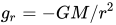

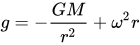
where
At some point up the cable, the two terms (downward gravity and upward centrifugal force) are equal and opposite. Objects fixed to the cable at that point put no weight on the cable. This altitude (r1) depends on the mass of the planet and its rotation rate. Setting actual gravity equal to centrifugal acceleration gives:[54]: p. 126
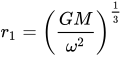
This is 35,786 km (22,236 mi) above Earth's surface, the altitude of geostationary orbit.[54]: Table 1
On the cable below geostationary orbit, downward gravity would be greater than the upward centrifugal force, so the apparent gravity would pull objects attached to the cable downward. Any object released from the cable below that level would initially accelerate downward along the cable. Then gradually it would deflect eastward from the cable. On the cable above the level of stationary orbit, upward centrifugal force would be greater than downward gravity, so the apparent gravity would pull objects attached to the cable upward. Any object released from the cable above the geosynchronous level would initially accelerate upward along the cable. Then gradually it would deflect westward from the cable.
Cable section
[edit]Historically, the main technical problem has been considered the ability of the cable to hold up, with tension, the weight of itself below any given point. The greatest tension on a space elevator cable is at the point of geostationary orbit, 35,786 km (22,236 mi) above the Earth's equator. This means that the cable material, combined with its design, must be strong enough to hold up its own weight from the surface up to 35,786 km (22,236 mi). A cable which is thicker in cross section area at that height than at the surface could better hold up its own weight over a longer length. How the cross section area tapers from the maximum at 35,786 km (22,236 mi) to the minimum at the surface is therefore an important design factor for a space elevator cable.

To maximize the usable excess strength for a given amount of cable material, the cable's cross section area would need to be designed for the most part in such a way that the stress (i.e., the tension per unit of cross sectional area) is constant along the length of the cable.[54][55] The constant-stress criterion is a starting point in the design of the cable cross section area as it changes with altitude. Other factors considered in more detailed designs include thickening at altitudes where more space junk is present, consideration of the point stresses imposed by climbers, and the use of varied materials. To account for these and other factors, modern detailed designs seek to achieve the largest safety margin possible, with as little variation over altitude and time as possible.[22] In simple starting-point designs, that equates to constant-stress.
For a constant-stress cable with no safety margin, the cross-section-area as a function of distance from Earth's center is given by the following equation:[54]
![{\displaystyle A(r)=A_{s}\exp \left[{\frac {\rho gR^{2}}{T}}\left({\frac {1}{R}}+{\frac {R^{2}}{2R_{g}^{3}}}-{\frac {1}{r}}-{\frac {r^{2}}{2R_{g}^{3}}}\right)\right]}](https://wikimedia.org/api/rest_v1/media/math/render/svg/2faccd127a8849f6dd878b215391810a2d589e15)
where