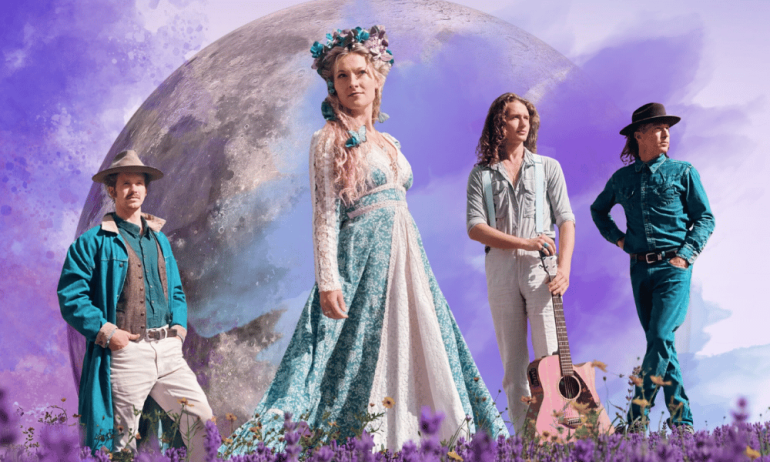

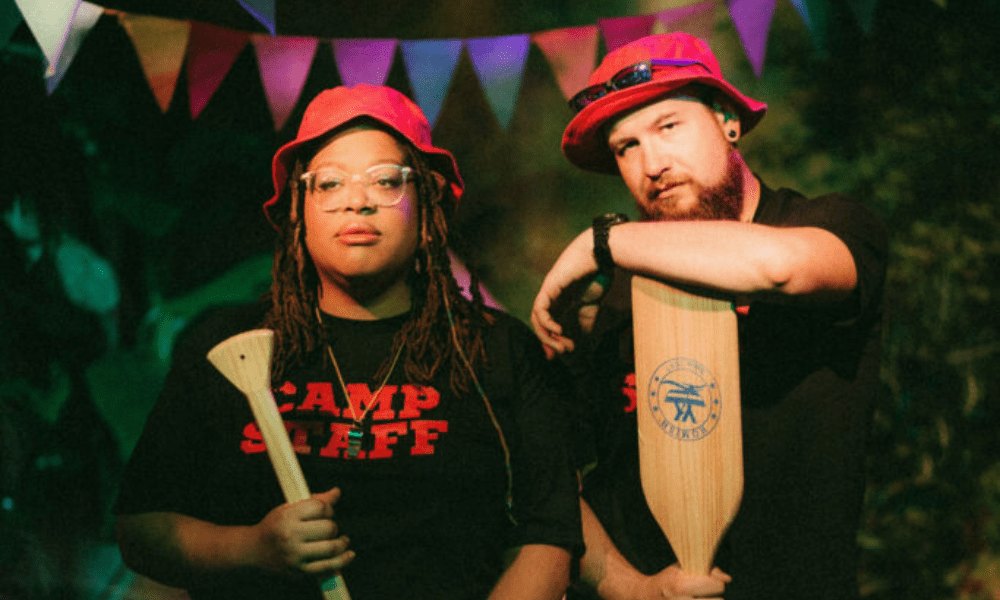
Denver artist Jenèe Donelson of Macheté Mouth joins KGNU’s Bruce Trujillo to discuss the band’s forthcoming album, Grimoire. Donelson describes the record as a collection of spells exploring ancestry, survival, transformation, and resistance. She talks about the evolution of the songs “Solomon” and “Abacus,” the making of the “Solomon” music video, and her approach to combining music with visual art and filmmaking. Donelson also reflects on Machéte Mouth’s deep connections to Denver’s creative community and shares a preview of the band’s upcoming vinyl release and album celebration (Air Date 8/13/26).
Listen to the interview here:
Transcript:
Bruce Trujillo: That is brand new music from Denver’s own Macheté Mouth right here on KGNU’s Afternoon Sound Alternative. That is “Solomon,” the lead single from the upcoming album Grimoire, coming out this November. And I’ve got Jenèe Donelson from Macheté Mouth right here in the studio. Jenèe, thank you so much for joining me.
Macheté Mouth: Thank you for having me.
Bruce Trujillo: Absolutely. I’m so excited to talk about this music. I am such a fan already, and this new album sounds, from this one, like it’s a little bit of a sonic shift. It’s a little bit of an exploration. It’s a little bit of honoring. Tell me a little bit more about putting this album together. What does it feel like with this a couple of months out?
Macheté Mouth: For me, I feel like it’s kind of a bit of a haunted house, ancestral revenants, familial curses being broken in certain ways, and also just kind of honoring the fact that we survived because of a curse in a certain way. It’s the dichotomy of surviving with specific tools and also no longer needing those tools. Those show up in the album.
And at the same time, sticking it to the man in certain aspects, too. So yeah, it’s a collection of spells. Grimoire, by definition, is a collection of spells or incantations that are passed down from different… I don’t want to say a cult, but technically the Bible is a grimoire if you really think about it.
There’s this… I feel like songs are spells, and the way this came about was in attempts, or I guess… Yeah, writing a spell book.
Bruce Trujillo: Beautiful. So this first one, “Solomon,” you released this as a single before with Joseph Lamar and some other pals.
Macheté Mouth: Yeah.
Bruce Trujillo: How has this evolved since that first release?
Macheté Mouth: Well, okay, so “Solomon” is actually our oldest song. That’s me and Dave back when we were in Port Bodie. We wrote that song like 13 years ago. We just kind of reclaimed it for ourselves.
As far as it evolving, we added strings from Brady Gaynor and Allison Sheldon, shout-out to them, and Joseph Lamar on the piano. When we were first playing it, it was just me, breath, and the bass, and then it just kept adding new pieces to it.
It became this really beautiful Southern Gothic anthem for revenge.
Bruce Trujillo: I love the different layers on it, especially if you’re listening to it in headphones. You can kind of hear all of these things being added into it. But this new layer also includes a music video.
Macheté Mouth: Yes.
Bruce Trujillo: I am obsessed with this video. Everybody is in a mask, everybody’s kind of hidden, and I think it really fits the vibe of the song. I just happen to know a couple of the folks that were involved in the process of this. So can you tell me a little bit about making the music video for “Solomon”?
Macheté Mouth: Oh, hell yeah. Okay. So the place that we rented was called the Gothic Cholo House, and I was like, “I have to have that somewhere.”
Bruce Trujillo: This has to be involved.
Macheté Mouth: And it was massive. You just have no idea what people are doing inside their homes. But it was beautifully decorated, very Gothic. There’s a lot of Catholic imagery there.
The call for folks to be in it was really surprising. I didn’t realize how many folks were really gonna be interested in it.
Tashina Threesticks, shout-out to them. They did the camera work for that. Amazing, amazing director. Gabe Giles was there. Brie was there. There was a few folks. Bad Boy Bug, shout-out to Bad Boy Bug. They were there.
It was just a collection of friends. Also, Harmony helped out with the food. What do you call it? The apples and stuff. Craft services. Harmony did the craft services. It was really great. Of Milk Blossoms.
We started at like 9:00 a.m. and we didn’t end until like 7:00, and it was a huge ordeal for all of us because we’re all doing something very new, and our brains are trying to figure out different camera angles, what’s the story that we’re telling.
I did a lot of the storyboarding beforehand, which was also a really new thing for me, to think about camera angles and how I want things to be lit as much as I could possibly do with $32 in my pocket.
All of that plus found footage from the Internet Archive. Shout-out to the Internet Archive.
And Dave also helped a lot with trying to create a harmonious space while we were shooting. It was pretty dope.
Oh, also, Annie from Slowpoke Studios was there. Really great. They were the Frog King, and really did up the Frog King. They’re one of my favorites.
Bruce Trujillo: All right, I’m not gonna say any more on this music video because I think there’s plenty of little bites that you just mentioned. If you haven’t seen this music video, maybe wait until after we’re done with our interview with Macheté Mouth, but go and check it out because it’s so good.
And tell me a little bit more about placing visuals to your music, because you’re also a visual artist and a chef and so many… You’re so creative in a lot of different ways. And so then going into this medium of music video for a song that has evolved so much, what’s the process like to then add this visual component?
Macheté Mouth: I watch a lot of movies. It’s one of my first favorite things. I can sit down and watch three movies at a time.
Especially when you’re Black and you’re getting your hair done at your homegirl’s house, it’s movie time and you’re watching all types of shit while you’re getting your hair braided. So I think it’s just one of those things that I tie a lot of soundtrack to visions or movies that I’ve seen.
Like the way a hand grabs at a crescendo, or a car driving down the street during a breakbeat, stuff like that. Those types of things have always kind of been part of the reason why I get chills when I listen to music, because I’m hearing and seeing at the same time what I would be doing for…
This song sounds like a bank robbery. I can do that. You could put…
But I feel, though, that it’s just one of those things. It’s like mise en place, which means having all of your ingredients in the right space when you’re cooking. The same thing goes down for when you are creating music. What are you visually trying to convey here, and how do you do that later in the process?
Bruce Trujillo: Absolutely, and you said mise en place for cooking, but there’s also mise en scène for filmmaking. And so it is… I feel like this is kind of what you’re doing, placing the things where they need to be at the right time.
So the new album, Grimoire, comes out in November, and we have some very exciting news, which we’ll get to after hearing the album opener. Can you tell me a little bit about “Abacus” before we get into it?
Macheté Mouth: “Abacus” is spell number one, and that is a confirmation of your power. It is a confirmation of where you came from and the tools that you’re bringing into whatever space.
It’s also an old song. “Abacus” is 13 years old too. It was hard really trying to get a punk band together to do shit. But this song has had so many iterations, you wouldn’t even recognize it from the first. So it is spell number one. It changes and morphs.
Bruce Trujillo: “Abacus” on KGNU’s Afternoon Sound Alternative from Macheté Mouth.
Bruce Trujillo: Music from Macheté Mouth. That is the debut of the album opener, that is “Abacus” from Grimoire. Jenèe was just saying that this song has also taken on a lot of evolution, and it’s also 13 years old.
Macheté Mouth: Yeah.
Bruce Trujillo: How has this song changed since 13 years ago?
Macheté Mouth: I mean, we have a different drummer on it. I feel like it changed as far as having a guitar changing to a synth.
There are samples from Miriam Makeba, and that was really, really important to me to add, and Tyler is on the drums, so it’s just a little bit tighter, it feels like.
When we were first doing it, it was very math rocky. It was like 14 minutes long and we never knew when to stop. This one is a little more concise.
Bruce Trujillo: This is also the opener for the album Grimoire coming out in November.
Macheté Mouth: Yeah.
Bruce Trujillo: We can’t give away all the details just yet, but you have a pretty big announcement for the album release. What can you share?
Macheté Mouth: Okay, well, it’s like the first of its kind, the way it’s gonna be released and where it’s gonna be released. Where it’s gonna be sold is also the first of its kind.
It’s done through Unit-E. We are gonna be pressing vinyl for the record, and it is glow-in-the-dark, which is so cool, as a kid that grew up with glow-in-the-dark stars on their wall.
The art is done by a friend in New Orleans. They do really beautiful collage art. I am honored to have them as a part of the project.
I’m really, really excited. I can’t say too much. Let’s just say the week of the 20th, know where to be, at a very big Denver institution, one of the biggest Denver institutions.
Bruce Trujillo: This is so exciting. Congratulations.
Macheté Mouth: Thank you so much.
Bruce Trujillo: And I love having folks from Unit-E come in here on the Afternoon Sound Alternative. We’ve had… I’ve been able to interview quite a few. And tell me a little bit about working with the Denver pals on a lot of different levels, not just Unit-E, but you collaborate with folks from Wheelchair Sports Camp, Rare Birds. I mean, you’re in the mix in a lot of different ways.
Macheté Mouth: Yeah. Shout-out to Rare Birds. They’re the first people to show me how to record myself. It was in my apartment off of Yale Street, and we used to be on the floor of my living room, and they would teach me how to record myself in my bedroom closet.
Yeah, shout-out to them, and working with them is always an honor and a pleasure. Working with Wheelchair Sports Camp has always been an honor and a pleasure. I got to work with them on a song and kind of repurpose some lyrics from an old punk song that I wrote. That was really, really cool.
But Unit-E, the weird thing about Unit-E is that I was at Unit-E parties way back in the day. I just didn’t know who I was around. I was invited to these things and I’m just kind of like a potato, hanging out in the corner, like, “This is really fun. This is really cool.”
And then ended up living right across the street from them at the Denver Art Society, and I think that really just kind of launched how I engaged with art here in the city.
Living there, being around so many artists, and also kind of starting our first band there, that was pretty dope.
And Unit-E wasn’t always around in that area, but then seeing the resurgence of it, their first seven-inch was us, actually. The first seven-inch that Unit-E pressed was Macheté Mouth.
And now we’re about to be… Can’t tell you. But yeah, it’s been such an honor, and I do feel I can credit Denver for how deeply entrenched I’ve gotten into the art world because they get ahold of you and then they don’t let go unless you wanna let go, so that’s really cool.
Bruce Trujillo: Super supportive scene. Yeah. That is like my favorite thing about the Denver music scene.
Okay, you are tuned to KGNU FM 88.5 Boulder, KGNU 1390 Denver. This is the Afternoon Sound Alternative. I’m Bruce Trujillo with Jenèe Donalson from Macheté Mouth.
We are going into this upcoming album, Grimoire. Again, that week of November, keep your calendars clear for this album release and the show, and I’m super excited to hear more about it.
But we’ve got one more song that we are going to debut here this afternoon. What can you tell me about “I Hope the Crow You Eat Is Well Seasoned”?
Macheté Mouth: It’s like the longest title, but I mean it the most.
I genuinely feel like this country is in a status of eating its crow and eating the crow. And I really feel, I don’t know, this is kind of like… I don’t wanna seem like my… Because music is political, everything’s political.
But this is a letter to white supremacy, I believe, for me.
Bruce Trujillo: Let’s get into it. This is Macheté Mouth. Thank you so much for coming in, by the way. We’ll end our interview here with this song, just on the high note of this debut. Jenèe, it’s always a pleasure to talk with you.
Macheté Mouth: It’s always a pleasure to be in your presence.
Bruce Trujillo: This is Macheté Mouth on KGNU’s Afternoon Sound Alternative.