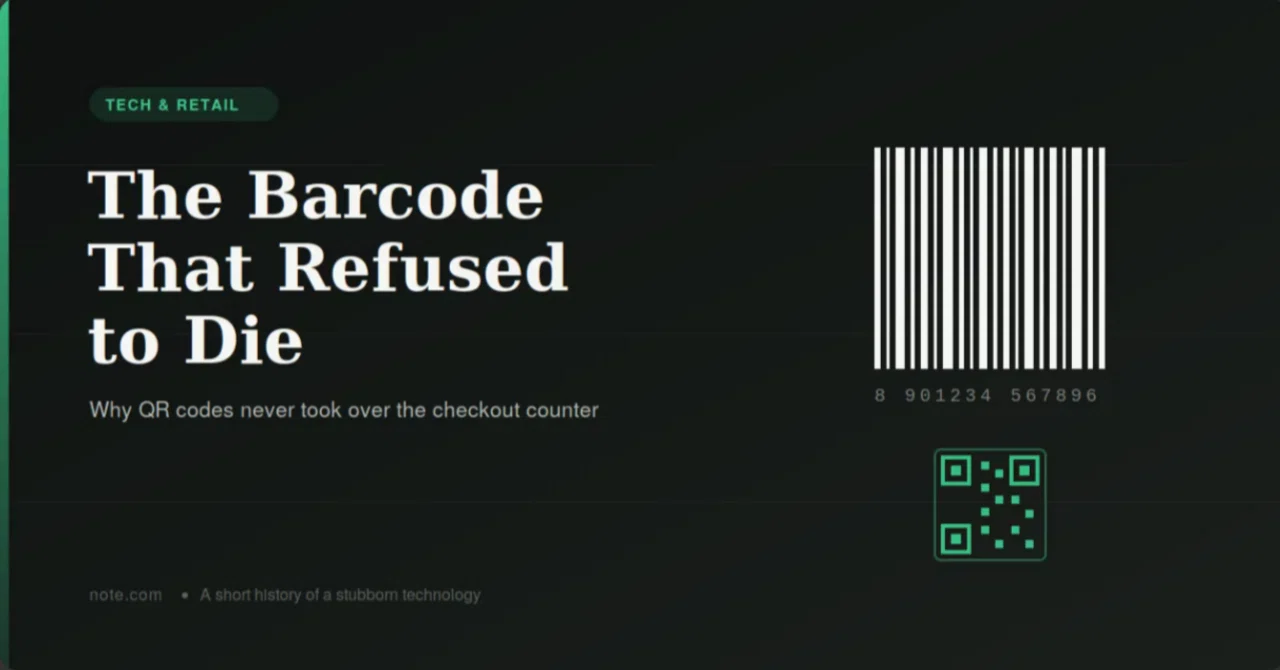
The Barcode That Refused to Die: Why QR Codes Never Took Over

Quick question. When was the last time a cashier scanned a QR code on your milk carton?
Never, right? And that's weird, if you think about it, because we've had a "better" version of the barcode sitting around since 1994.
Here's the story most people don't know. Back in the early 90s, an engineer named Masahiro Hara was working at Denso Wave, a Toyota Group company in Japan. His team kept hitting the same wall on the factory floor — the barcodes stuck on auto parts could only hold about 20 characters. That's it. Not nearly enough to track everything Toyota needed on a fast-moving assembly line.
So they built something new. Legend has it the pattern was inspired by the black and white stones on a Go board (a Japanese board game). Whatever the spark, the result could hold thousands of characters instead of a couple dozen, could be read from any angle, and still worked even if part of the code got scratched or smudged. They named it the QR code, short for "Quick Response." And then Denso Wave did something almost unheard of — they released it to the public for free and never enforced the patent.
That was over thirty years ago. Fast forward to today, and QR codes are basically everywhere — restaurant menus, payment apps, event tickets, the poster outside your neighbourhood cafe. But go to any supermarket on the planet and the thing beeping at checkout is still... the old barcode. Twenty characters and all.
So why didn't the objectively more powerful tech just win?
It's Not About Which Tech Is Better
This is where most "technology evolution" stories get lazy. We assume better tech simply replaces older tech, the way CDs replaced cassette tapes. But that's not really what happened here, because the fight was never actually about who can store more data. It came down to something a lot less exciting: infrastructure, standardization, and how painful it is to rip out a system that already works for billions of transactions every single day.
A few reasons the humble barcode never got dethroned:
There's a whole numbering system riding on it. Every barcode isn't just a pattern of lines — it's a number issued by GS1, the organization that assigns unique product IDs worldwide. That number is wired into manufacturer databases, store inventory systems, shipping logistics, pricing engines, you name it. Swapping out the barcode isn't swapping a symbol. It's touching the plumbing underneath global retail.
Speed matters more than people realize. A modern barcode scanner at a checkout counter often still relies on laser and photodiode technology, measuring reflected light rather than capturing a full image. That's what lets it scan a can of beans in a fraction of a second, at odd angles, under bad lighting, on a slightly crumpled label. QR reading generally leans on a camera and image processing — which for a long time was slower and far pickier about angle and light. Not ideal when a cashier is trying to move a few hundred items an hour.
It's already printed on basically everything. Every product on every shelf already has a barcode on it. Switching formats wouldn't just mean new store scanners — it would mean redesigning packaging and databases for nearly every consumer good on the planet. Even if QR were flawless on paper, the migration cost alone makes the switch a bad business decision for something that's already working fine.
Barcodes are cheap and forgiving to print. A 1D barcode is small, and printers can churn it out reliably even on something as tiny as a stick of gum. The tolerances are loose and the cost is basically nothing. QR codes need more surface area and cleaner printing to stay scannable — a real constraint when you're stamping codes onto millions of tiny, curved, irregular surfaces.
So Where Did QR Codes Actually Win?
Not at the checkout counter — but pretty much everywhere else. QR codes carved out a job that barcodes were never built for: linking a physical object to a website, a payment gateway, a Wi-Fi network, a menu. Places where the reader is your phone, not a dedicated retail scanner, and where what's being scanned isn't a manufactured product sitting inside a global supply-chain database.
COVID sped all of this up massively. QR menus and contactless payments went from "kind of gimmicky" to the default almost overnight. But notice what didn't happen — no supermarket ripped out its scanners to start reading QR codes on cereal boxes. The two technologies never really competed for the same job. They just quietly split the work between them.
The Actual Lesson Here
This pattern shows up way beyond barcodes. Old systems rarely die just because something better comes along. They die only when switching costs less than staying — and when there isn't a massive, tangled web of global infrastructure already built on top of them.
The barcode isn't still around because nobody built anything better. It's around because "better" was never really the thing deciding the outcome. Compatibility and infrastructure were.
So next time you hear that beep at checkout, you're not listening to outdated tech that somehow survived. You're listening to thirty years of global logistics infrastructure that nothing — not even a smarter, more capable successor — has managed to dislodge.

