The Missing Variable in AI Forecasts

One afternoon, I was casually browsing science magazines at a public library.
I wasn't conducting research. I wasn't looking for evidence to support an argument.
I simply picked up a magazine and started reading.
One article contained a familiar type of chart: a forecast of AI development.
The chart showed increasing model capabilities, the automation of research, and the possibility that AI systems might eventually outperform humans in many intellectual tasks.
It was thoughtful and well argued.
Yet something about it stayed with me.
Not because I disagreed with it.
But because I felt that one assumption remained unquestioned.
The chart assumed that AI changes.
What if humans change as well?
To make sense of that thought, I drew a simple diagram.
Most discussions about AI focus on the future of AI itself.
How capable will it become?
Will it surpass human intelligence?
Will it automate research, creativity, or decision-making?
These are important questions.
I am not dismissing them.
What I find difficult is something else.
Many of these discussions seem to assume a relatively fixed human being on the other side of the equation.
AI changes.
Humans react.
AI advances.
Humans are compared against it.
But is that really what is happening?
When people use AI every day to think, learn, write, create, and solve problems, are they remaining unchanged?
I am not sure.
In fact, I suspect we are already changing.
Not dramatically.
Not all at once.
But gradually.
To make sense of that thought, I sketched a simple model.
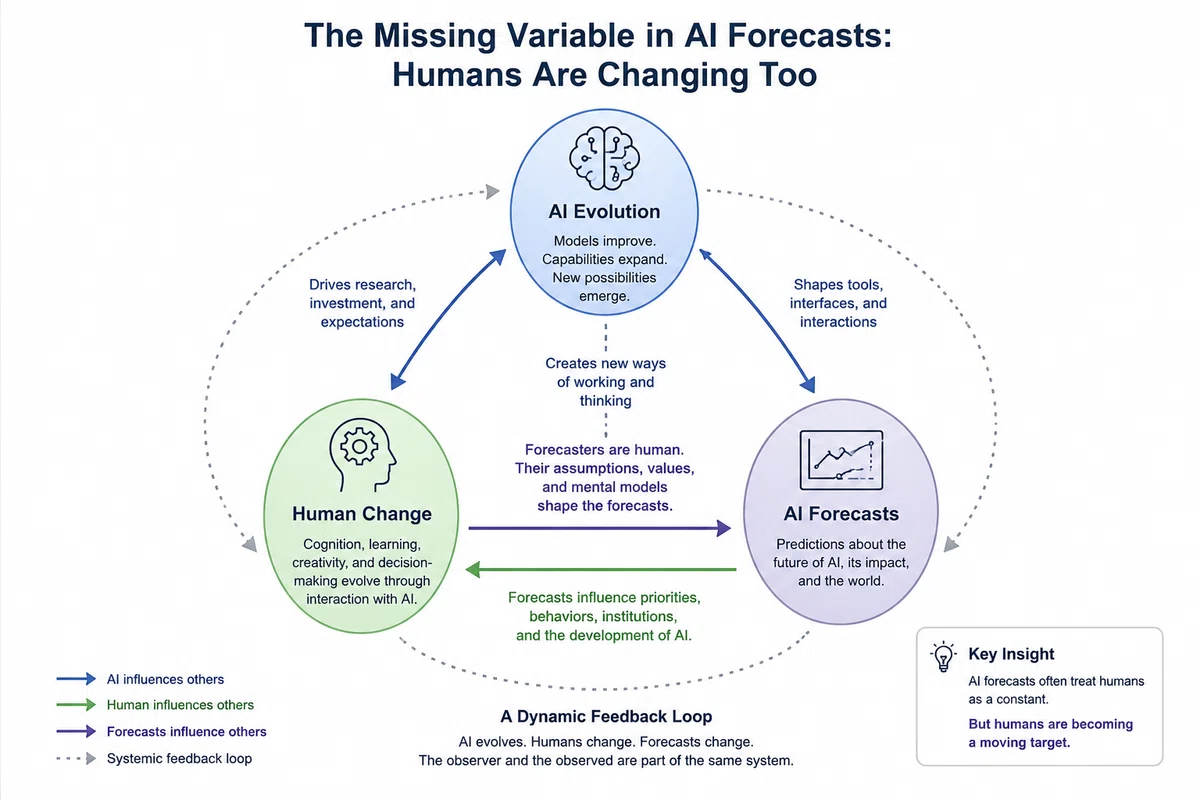
It may be us.
The difficulty is that I do not know how to measure that change.
And if we cannot yet describe that change clearly, I wonder how confidently we can forecast the outcome of the relationship.
This is not an argument against AI.
Nor is it an argument for optimism.
I am simply left with a question.
When people say that AI will eventually surpass humans, which humans are they talking about?
The humans of today?
Or the humans who will spend the next decade living and thinking alongside AI?
Those may not be the same people.
The more I think about AI forecasts, the more I feel that there may be a missing variable.
Not AI.
Human change.
And perhaps the most interesting thing about that variable is that we are living through it before we fully understand it.
I am thinking while conversing with AI.
So where does the boundary of "my" thinking actually lie?
Image courtesy of dongmu (from Photo Gallery).
Grateful to use this beautiful work.
© 2026 in the pilvi / Kyokuya Project
Please credit the source when quoting or referencing this article.
