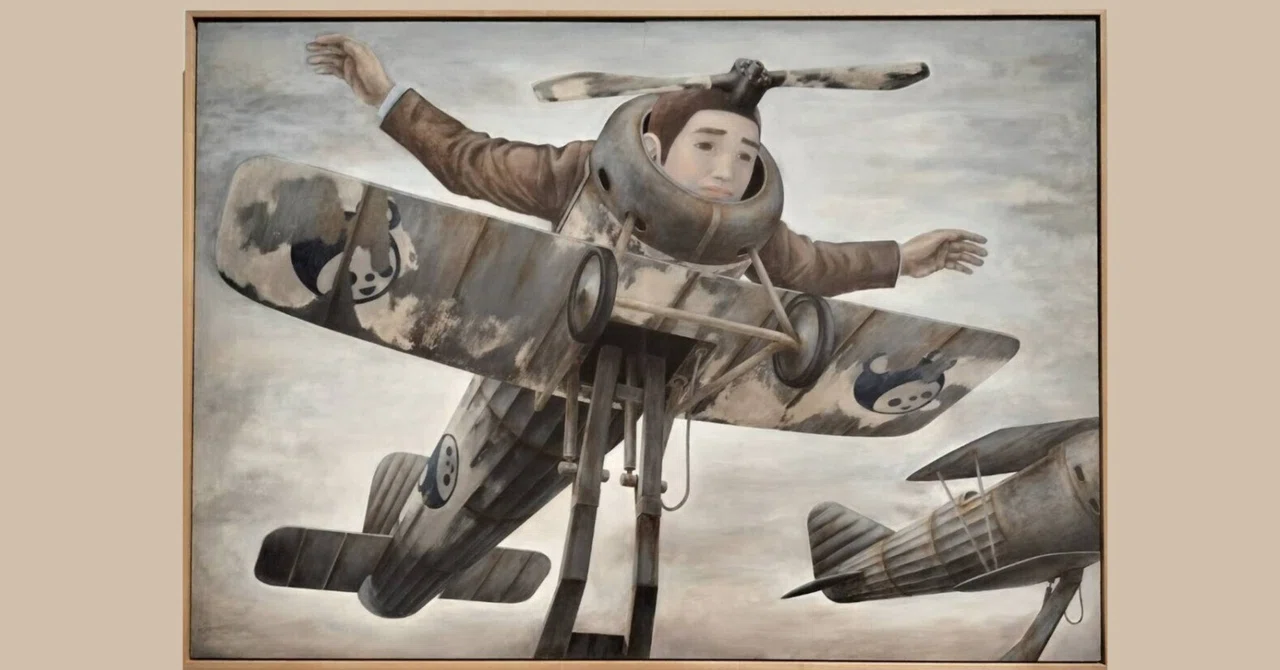
Tetsuya Ishida

Tetsuya Ishida (1973-2005) was a painter from Yaizu City, Shizuoka Prefecture. He graduated from Musashino Art University with a degree in Visual Communication Design. His painting "Untitled" (2001), exhibited at an auction in Hong Kong in November 2006, sold for 780,000 Hong Kong dollars, and his painting "Prisoner" (1999), exhibited at United Asian Auctions in May 2012, sold for 819,800 USD, more than three times the estimated price.
(Excerpted in part from Wikipedia)
I often visit famous art museums, but the first time I saw his paintings was not in a museum but in an art book. It was "Ishida Tetsuya Isakushu (The Posthumous Works of Tetsuya Ishida)", published by Kyuryudo in 2006, about a year after he was struck and killed by a train. I came across it while browsing at Kinokuniya in New York and was utterly stunned. I am, after all, an art school graduate, and if he had been a famous painter, I surely would have heard of him, yet I had never heard his name before. However, his paintings were so captivating that once seen, they were impossible to forget; technically, they were truly astonishing, and the motifs were unlike anything I had ever seen before.
After graduating from university, he began his career as a painter, and in 1995, his works "Sleeping Caterpillar Cocoon" and "Who Became a SL - A man transformed into a steam locomotive" each won the Grand Prix at the 6th Graphic Art "Hitotsubo Exhibition." In 1997, he won the Grand Prix at the JACA'97 Japan Visual Art Exhibition for "Exercise Equipment" and also held a solo exhibition. His most famous work is probably "Person Who Can No Longer Fly - A man who has lost the ability to fly" (1996), which he painted for this solo exhibition.
However, his career as a painter wasn’t exactly smooth sailing. His paintings weren’t the kind you’d hang on the walls of ordinary homes or shops. But he wasn’t aiming to be an illustrator; he was aiming to become a top-tier artist in the world of fine art. To succeed as a freelance artist without any good connections or wealthy patrons, you have to be both an artist and your own salesman. Surely being talkative and outgoing leads to more work than being taciturn and introverted, and he may have leaned more toward the latter. He worked night shifts at a manual labor job, lived in a one-room apartment, and ate convenience store food while painting every spare moment he could find, but art supplies aren’t cheap. And creating such meticulous paintings as he did must have required considerable physical and mental strength. No matter how young he was, living on convenience store food every day and working while cooped up in a tiny room was bound to take a toll on both his mind and body. He died at the age of 31, and some people believe it was a suicide. Looking at his last work ("Untitled," 2004), I can understand why some people might think that way. Personally, I can't say for sure; I get the feeling he was so engrossed in his work that he might not even have known it himself.
Alexandra Monroe, an Asian studies scholar and curator, notes that Tetsuya Ishida’s artistic style shares affinities with the themes of “Safe and sound, hysteria” explored by the renowned artist Takashi Murakami. These terms express an underlying sense of social anxiety that stands in stark contrast to outward appearances of normality.
Ishida’s works depict surreal scenes in which young men—presumably modeled after himself (all with identical faces)—are fused with machines and landscapes. For example, in convenience stores and fast-food restaurants, they appear to exist not as humans but as objects, or are tossed about by machines, much like in Chaplin’s “Modern Times.” This is clearly a critique of modern society, which has forgotten its humanity and prioritizes the pursuit of profit.
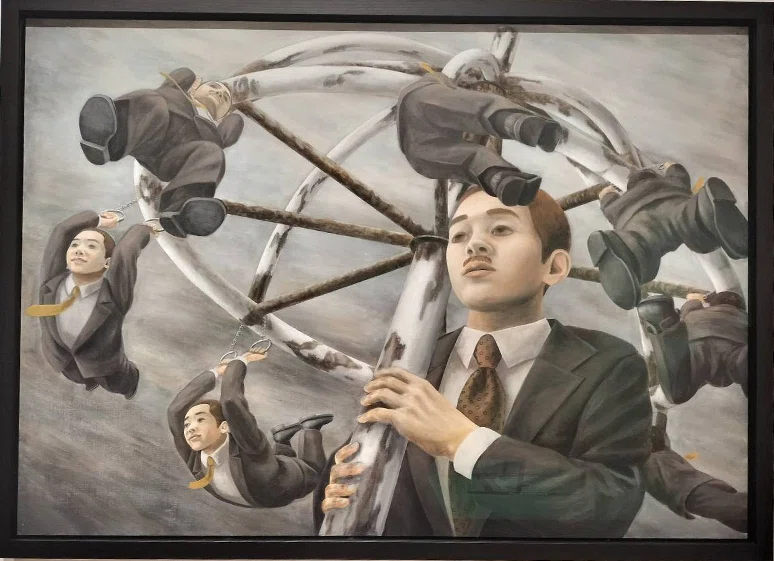
Even so, up until around 1999, while his paintings were nihilistic, many of them attempted to elicit a chuckle through humor. After that, his technical skill became frighteningly refined, and his motifs grew increasingly introspective. Starting around 2000 with his firefighter motifs, his work began to convey a sense of personal experience rather than mere social criticism or irony. In the 2001 work “Untitled,” a tombstone stands in a room, and a young man wearing headphones sits in front of it. Limbs—presumably those of a corpse—protrude from beneath the tombstone, while outside the window, a train runs as if floating in a dream.
Watching the interview video, it seems that an agent from the gallery representing his work advised him not to abandon his early, humorous motifs that fused machines and humans, but by around 2003–2004, the introspective tendency in his paintings had intensified, and some of these works—which lay bare his inner self—possess an unforgettable intensity, as if the viewer has caught a glimpse of something they should not have seen. This was a time when Japanese society was entering its second “lost” decade economically, contingent employment was surging, and the phrase “winners and losers” was beginning to gain traction. Back then, there were no NFTs or social media, so it must have been difficult to find anyone among Japan’s wealthy willing to buy works by an unknown artist. It seems he had planned to go to the United States to study painting, but ultimately he was unable to go; instead, it was his art that made the journey after his death.
A friend of mine who graduated from Musashino Art University once said, “He lived a life that was short but intense,” and that may well be true. His short life was passionate and sincere. His consistent, straightforward attitude is truly moving. After his death, the world recognized him as a top-tier artist. Reading the words in the concept notes he left behind, one is struck by the depth of his thought.
I am deeply drawn to artists who are like saints—people who genuinely believe that ‘with every stroke of the brush, the world is saved,’ or who can ‘hear the pain of all humanity in the face of a sheep.’
According to Masato Horikiri’s research note, “On the Works of Tetsuya Ishida - A Hesitant Image of the Self,” Ishida was influenced by Ben Shahn, a master of social realism. I was surprised to learn this, as I hadn’t known it before, but it seems Ben Shahn painted a picture depicting the radiation exposure of the Daigo Fukuryu Maru, an event that became a major catalyst for the anti-nuclear movement. The Daigo Fukuryu Maru, which had been fishing, was showered with radioactive fallout from a hydrogen bomb test and returned to Yaizu—which is also Tetsuya Ishida’s hometown. I wonder what he thought when he saw Ben Shahn’s painting.
Through various anecdotes, one can sense that the humor and irony in his paintings are underpinned by a deep love for humanity. It makes one wonder if he was, in fact, already a “saintly artist.”
