K Nearest Neighbor Classifier, Explained: A Visual Guide with Code Examples for Beginners
The friendly neighbor approach to machine learning
CLASSIFICATION ALGORITHM
⛳️ More CLASSIFICATION ALGORITHM, explained: · [Dummy Classifier](https://towardsdatascience.com/dummy-classifier-explained-a-visual-guide-with-code-examples-for-beginners-009ff95fc86e) ▶ [K Nearest Neighbor Classifier](https://towardsdatascience.com/k-nearest-neighbor-classifier-explained-a-visual-guide-with-code-examples-for-beginners-a3d85cad00e1) · [Bernoulli Naive Bayes](https://towardsdatascience.com/bernoulli-naive-bayes-explained-a-visual-guide-with-code-examples-for-beginners-aec39771ddd6) · [Gaussian Naive Bayes](https://towardsdatascience.com/gaussian-naive-bayes-explained-a-visual-guide-with-code-examples-for-beginners-04949cef383c) · [Decision Tree Classifier](https://towardsdatascience.com/decision-tree-classifier-explained-a-visual-guide-with-code-examples-for-beginners-7c863f06a71e) · [Logistic Regression](https://towardsdatascience.com/logistic-regression-explained-a-visual-guide-with-code-examples-for-beginners-81baf5871505) · [Support Vector Classifier](https://towardsdatascience.com/support-vector-classifier-explained-a-visual-guide-with-mini-2d-dataset-62e831e7b9e9) · [Multilayer Perceptron](https://towardsdatascience.com/multilayer-perceptron-explained-a-visual-guide-with-mini-2d-dataset-0ae8100c5d1c)
Imagine a method that makes predictions by looking at the most similar examples it has seen before. This is the essence of the Nearest Neighbor Classifier - a simple yet intuitive algorithm that brings a touch of real-world logic to machine learning.
While the dummy classifier sets the bare minimum performance standard, the Nearest Neighbor approach mimics how we often make decisions in daily life: by recalling similar past experiences. It's like asking your neighbors how they dressed for today's weather to decide what you should wear. In the realm of data science, this classifier examines the closest data points to make its predictions.

Definition
A K Nearest Neighbor classifier is a machine learning model that makes predictions based on the majority class of the K nearest data points in the feature space. The KNN algorithm assumes that similar things exist in close proximity, making it intuitive and easy to understand.
📊 Dataset Used
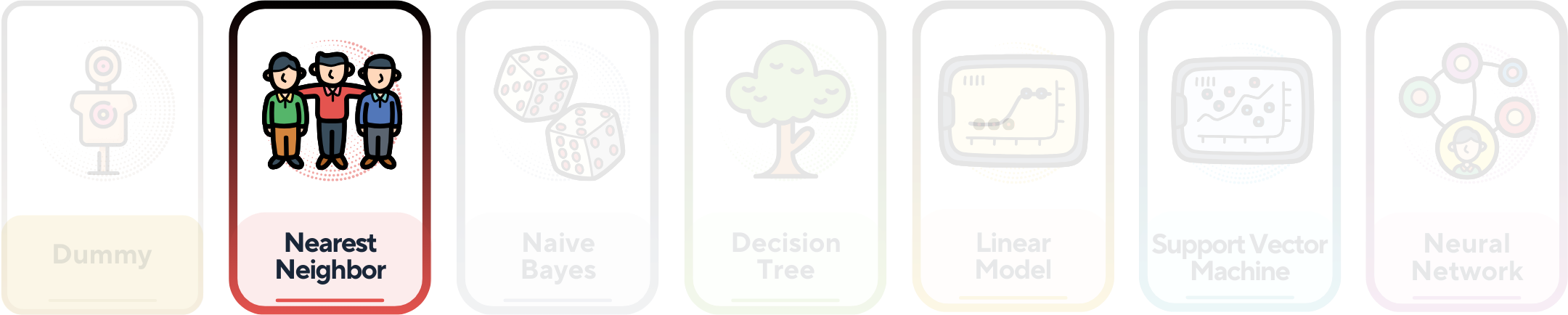
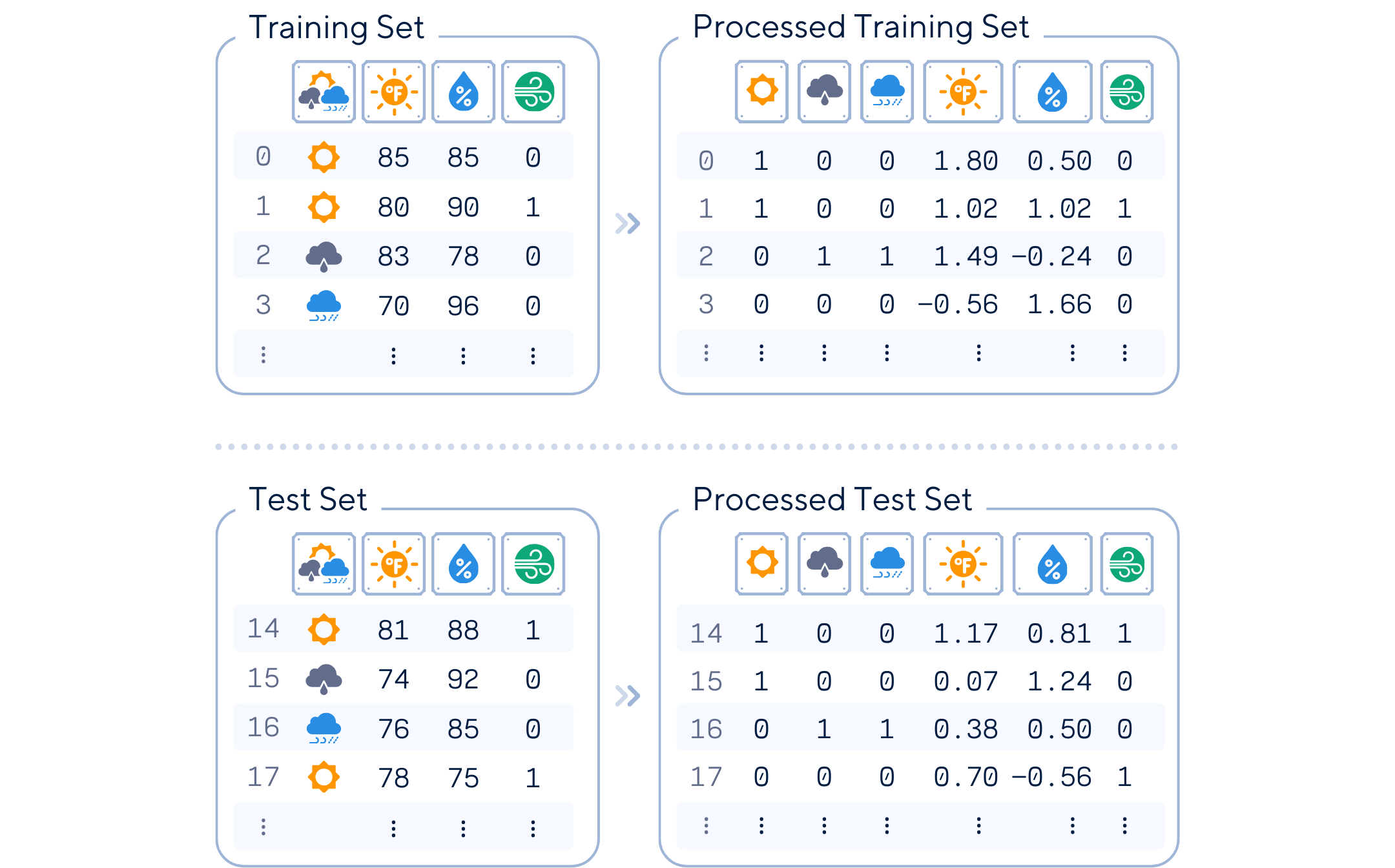
Throughout this article, we'll use this simple artificial golf dataset (inspired by [1]) as an example. This dataset predicts whether a person will play golf based on weather conditions. It includes features like outlook, temperature, humidity, and wind, with the target variable being whether to play golf or not.
KNN algorithm requires the data to be scaled first. Convert categorical columns into 0 & 1 and also scale the numerical features so that no single feature dominates the distance metric.
Main Mechanism
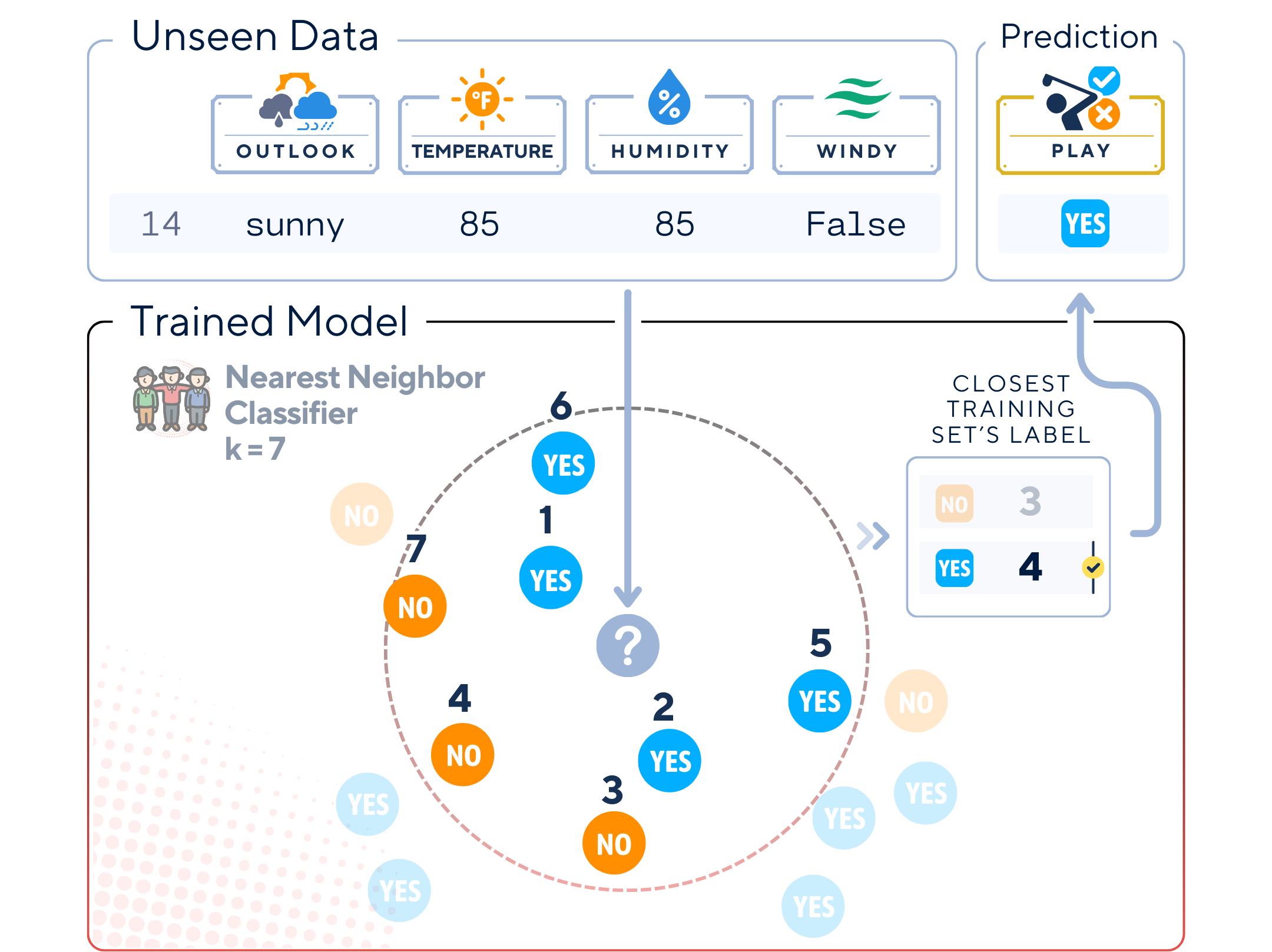
The KNN classifier operates by finding the K nearest neighbors to a new data point and then voting on the most common class among these neighbors. Here's how it works:
Calculate the distance between the new data point and all points in the training set.
Select the K nearest neighbors based on these distances.
Take a majority vote of the classes of these K neighbors.
Assign the majority class to the new data point.
Training Steps
Unlike many other algorithms, KNN doesn't have a distinct training phase. Instead, it memorizes the entire training dataset. Here's the process:
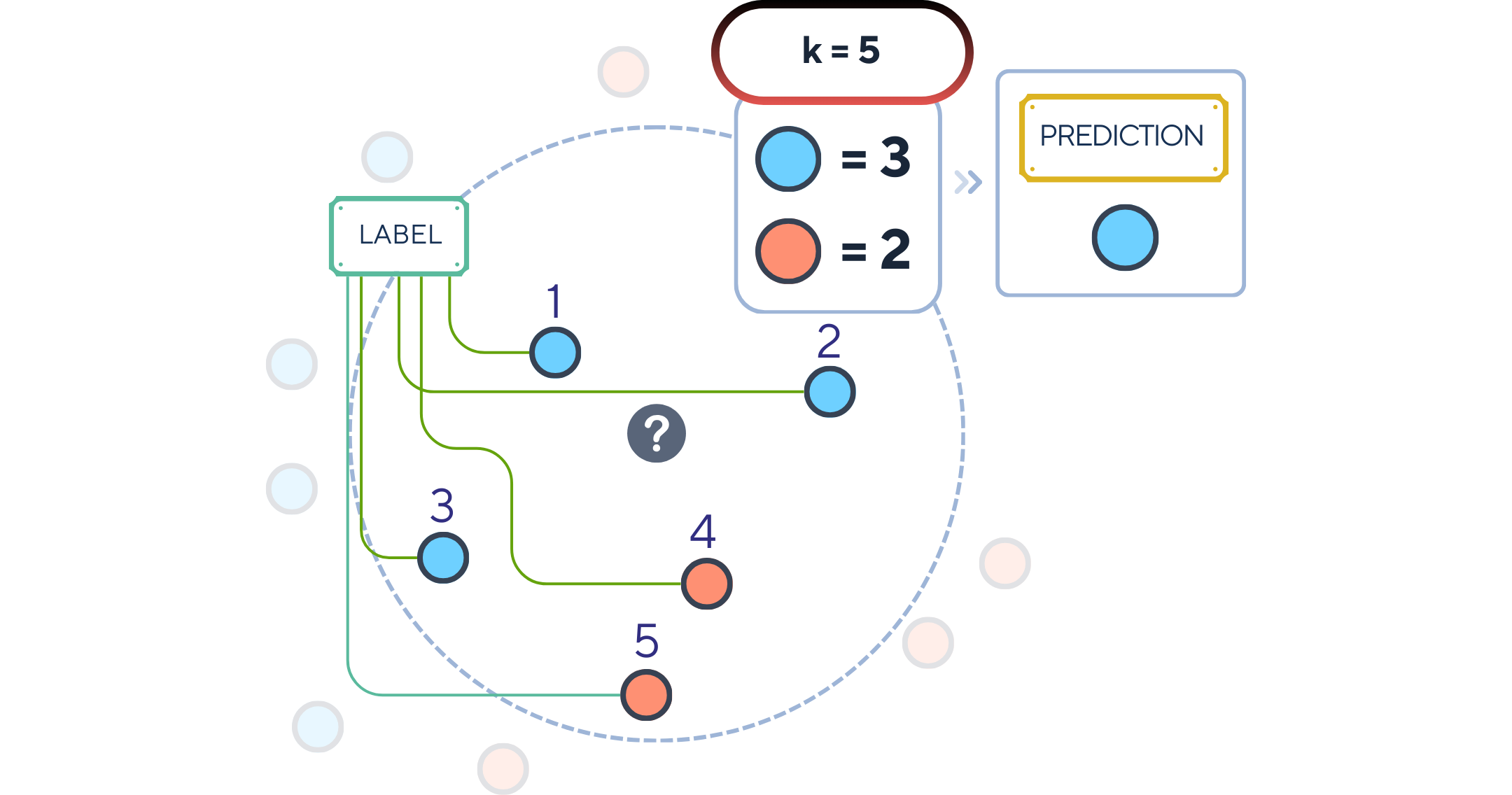
Choose a value for K (the number of neighbors to consider).
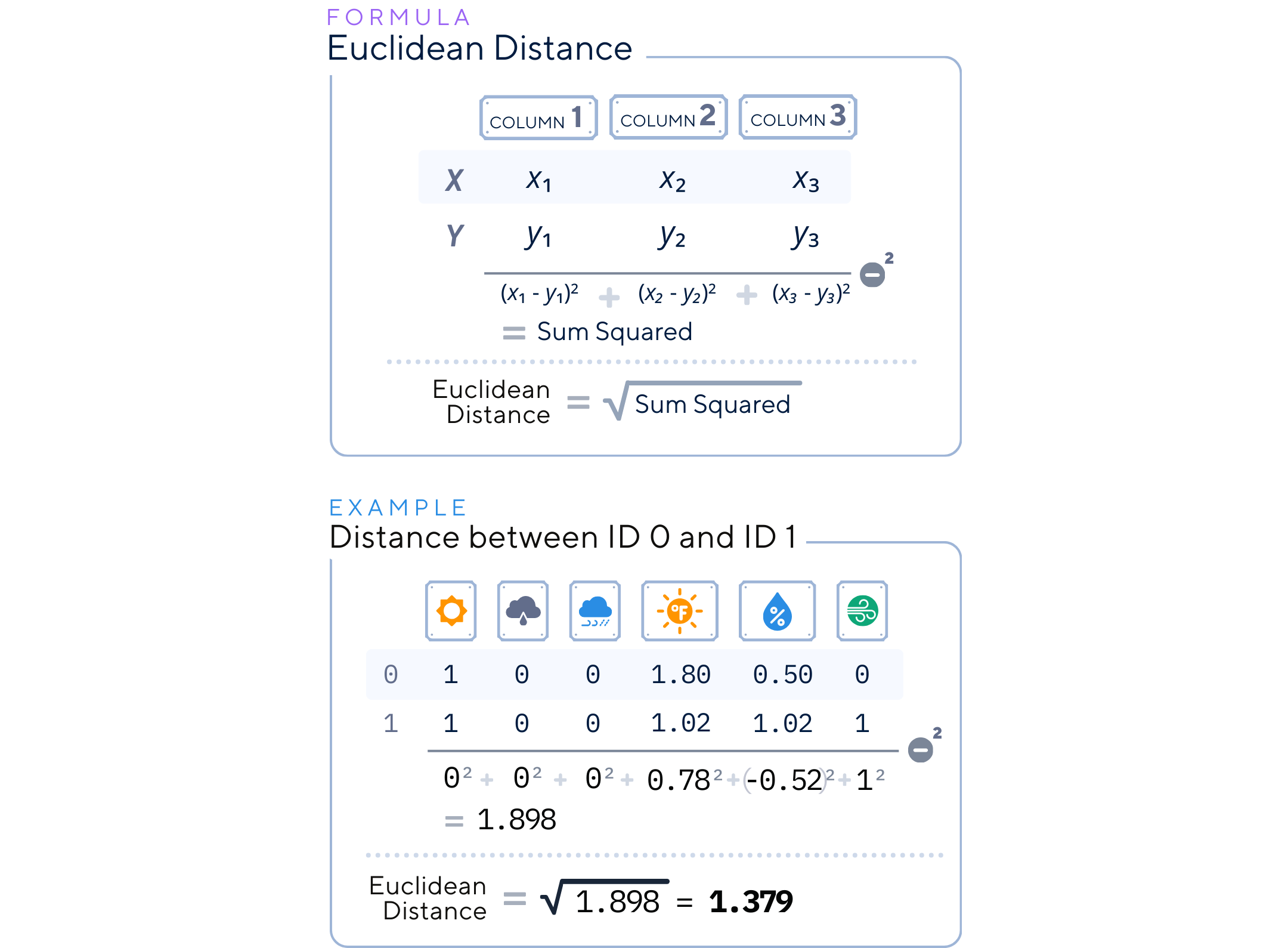
Select a distance metric (e.g., Euclidean distance, Manhattan distance).
Store/Memorize all the training data points and their corresponding labels.
Classification Steps
Once the Nearest Neighbor Classifier has been "trained" (i.e., the training data has been stored), here's how it makes predictions for new instances:
Distance Calculation: For the new instance, calculate its distance from all stored training instances using the chosen distance metric.
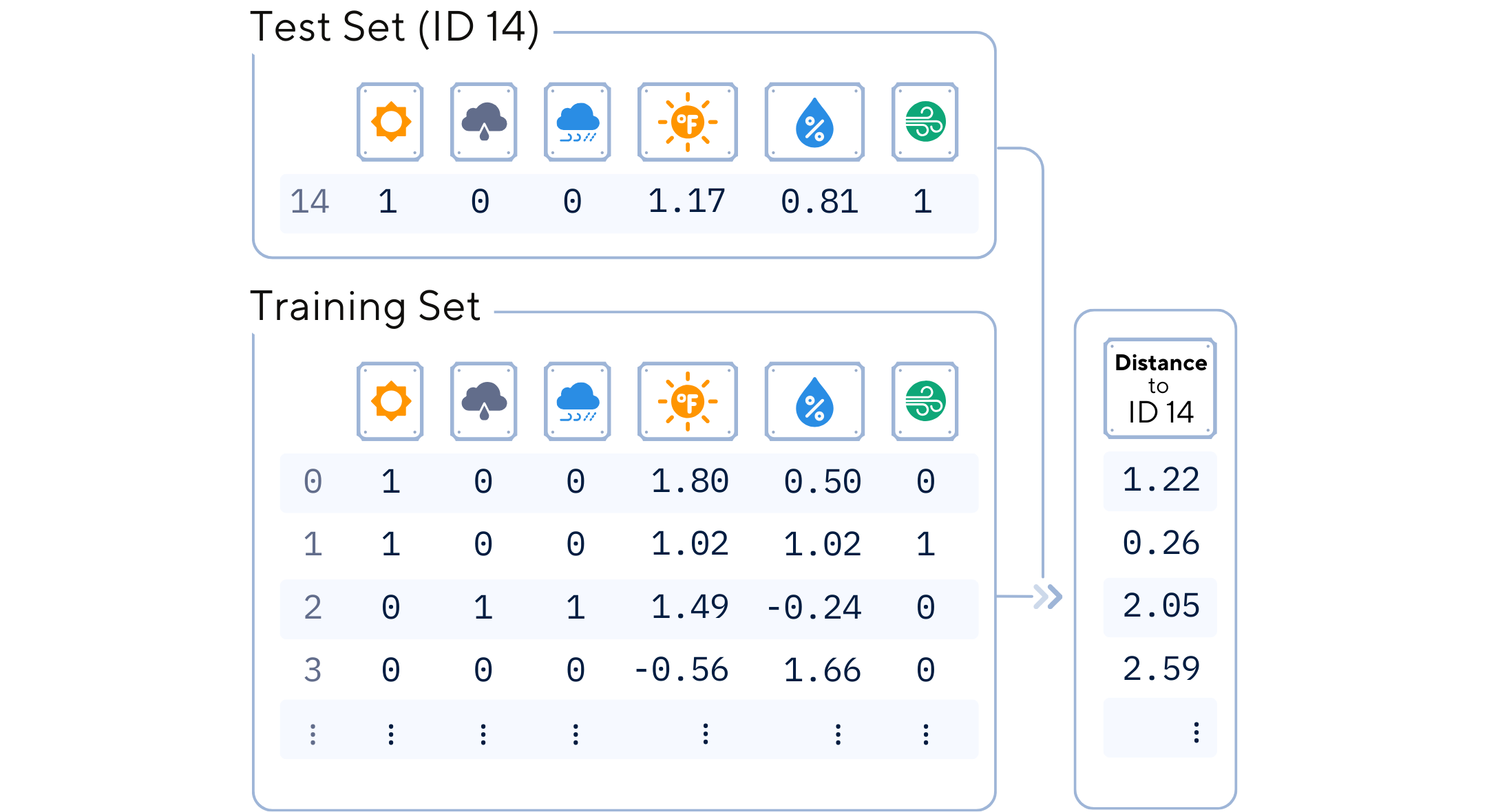
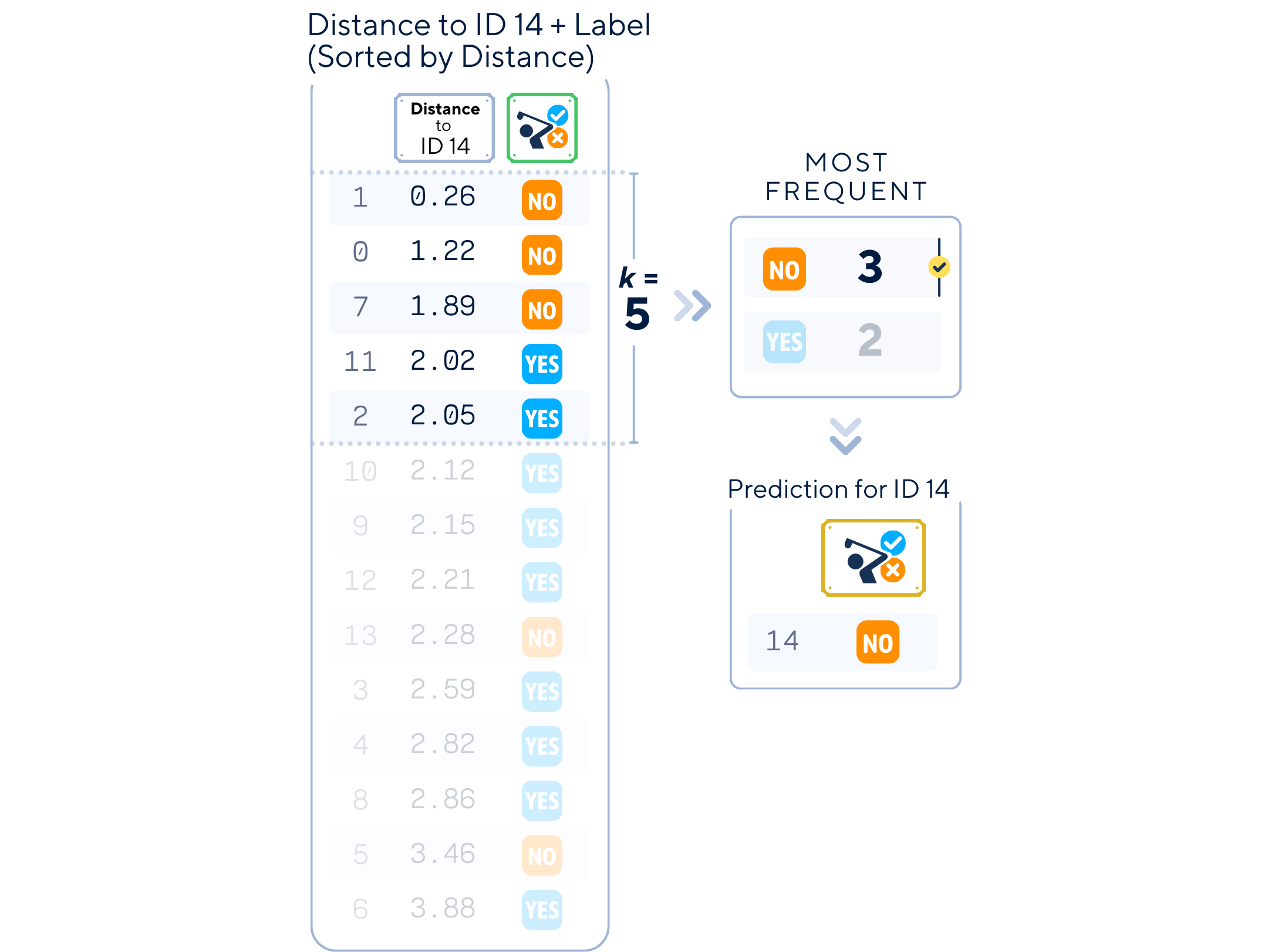
Neighbor Selection and Prediction: Identify the K nearest neighbors based on the calculated distances, then assign the most common class among these neighbors as the predicted class for the new instance.
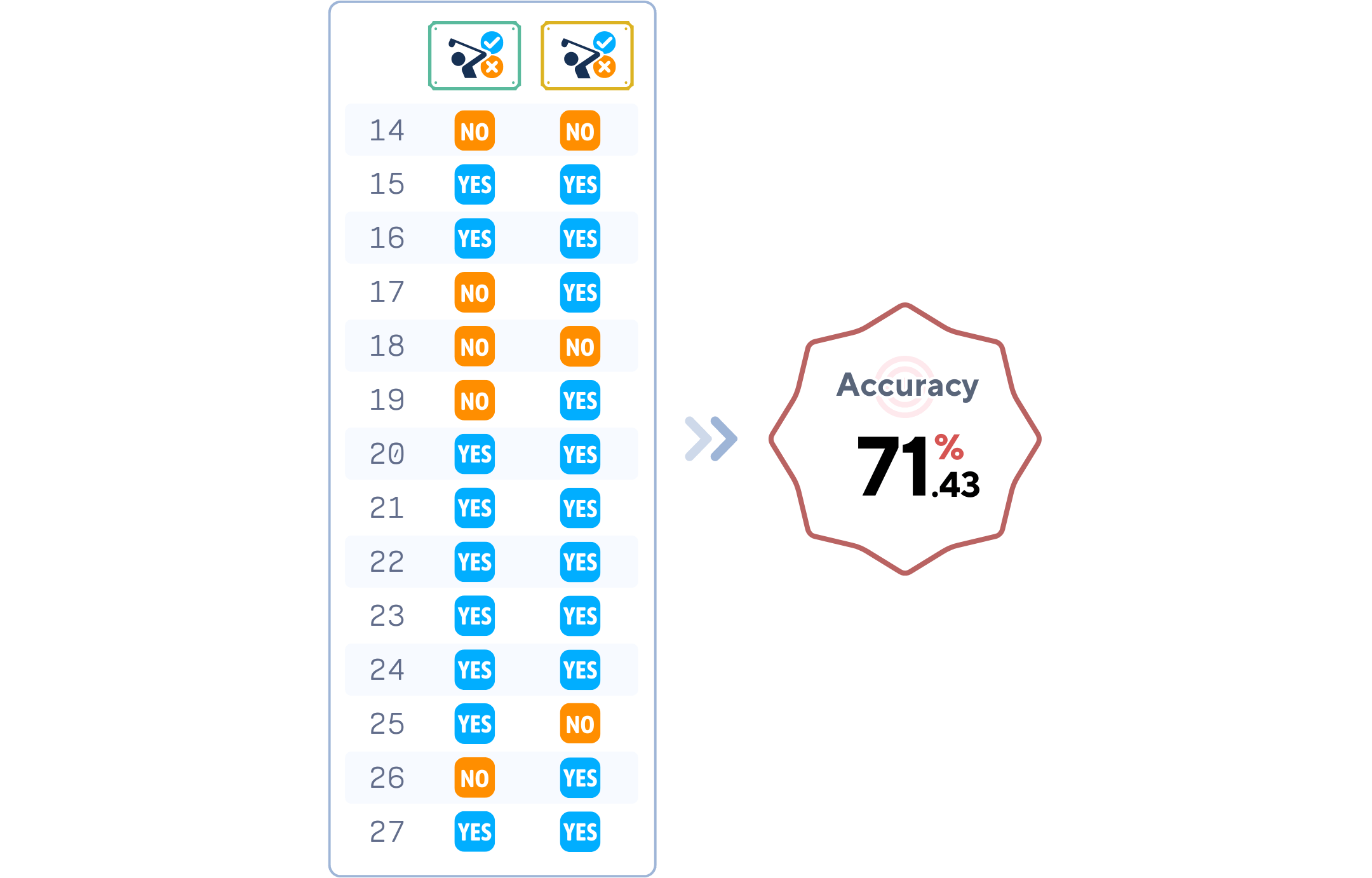
Evaluation Step
Key Parameters
While KNN is conceptually simple, it does have a few important parameters:
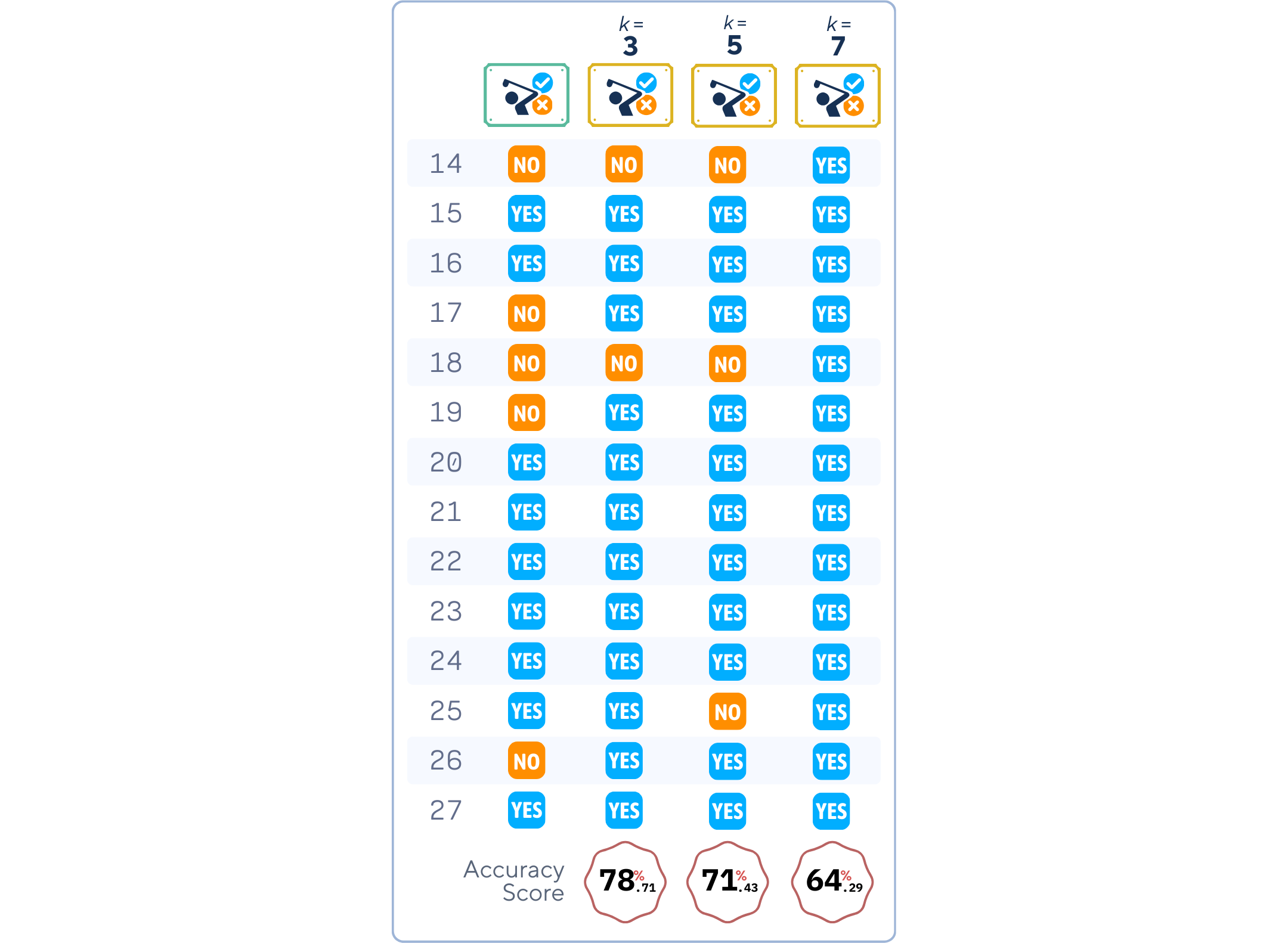
K: The number of neighbors to consider. A smaller K can lead to noise-sensitive results, while a larger K may smooth out the decision boundary.
Distance Metric: This determines how similarity between points is calculated. Common options include:
Euclidean distance (straight-line distance)
Manhattan distance (sum of absolute differences)
Minkowski distance (a generalization of Euclidean and Manhattan distances)
Weight Function: This decides how to weight the contribution of each neighbor. Options include:
'uniform': All neighbors are weighted equally.
'distance': Closer neighbors have a greater influence than those farther away.
Pros & Cons
Like any algorithm in machine learning, KNN has its strengths and limitations.
Pros:
Simplicity: Easy to understand and implement.
No Assumptions: Doesn't assume anything about the data distribution.
Versatility: Can be used for both classification and regression tasks.
No Training Phase: Can quickly incorporate new data without retraining.
Cons:
Computationally Expensive: Needs to compute distances to all training samples for each prediction.
Memory Intensive: Requires storing all training data.
Sensitive to Irrelevant Features: Can be thrown off by features that aren't important to the classification.
Curse of Dimensionality: Performance degrades in high-dimensional spaces.
Final Remarks
The K-Nearest Neighbors (KNN) classifier stands out as a fundamental algorithm in machine learning, offering an intuitive and effective approach to classification tasks. Its simplicity makes it an ideal starting point for beginners, while its versatility ensures its value for experienced data scientists. KNN's power lies in its ability to make predictions based on the proximity of data points, without requiring complex training processes.
However, it's crucial to remember that KNN is just one tool in the vast machine learning toolkit. As you progress in your data science journey, use KNN as a stepping stone to understand more complex algorithms, always considering your specific data characteristics and problem requirements when choosing a model. By mastering KNN, you'll gain valuable insights into classification techniques, setting a strong foundation for tackling more advanced machine learning challenges.
🌟 k Nearest Neighbor Classifier Code Summarized
Further Reading
For a detailed explanation of the KNeighborsClassifier and its implementation in scikit-learn, readers can refer to the official documentation [2], which provides comprehensive information on its usage and parameters.
Technical Environment
This article uses Python 3.7 and scikit-learn 1.5. While the concepts discussed are generally applicable, specific code implementations may vary slightly with different versions.
About the Illustrations
Unless otherwise noted, all images are created by the author, incorporating licensed design elements from Canva Pro.

Reference
[1] T. M. Mitchell, Machine Learning (1997), McGraw-Hill Science/Engineering/Math, pp. 59
[2] F. Pedregosa et al., Scikit-learn: Machine Learning in Python, Journal of Machine Learning Research, vol. 12, pp. 2825–2830, 2011. [Online]. Available: https://scikit-learn.org/stable/modules/generated/sklearn.neighbors.KNeighborsClassifier.html