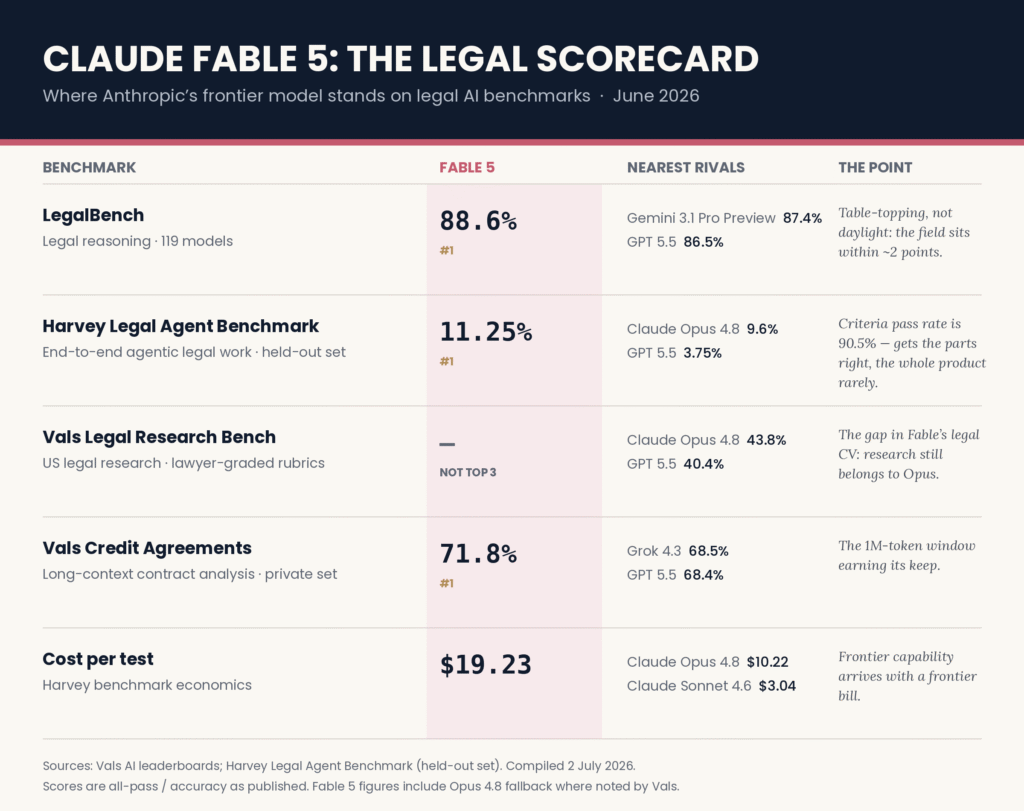
Anthropic’s ‘dangerous’ Mythos class model, Fable 5, is back and Artificial Lawyer took it for a spin. First, this site asked it to produce some legal benchmarks (see below) and then tested it on a bunch of more random questions that included Claude for Legal and more.
At first glance Fable 5, on High setting, feels quite assertive and doesn’t kiss your proverbial the way some models do, which is helpful. It also tends to give answers in multiple long paragraphs, rather than the now clichéd ‘easy to digest’ bullets with emojis added – although you can make it do that if you want to.
(Note: naturally, all the below is AI-generated, so take it with a big dose of salt, even if Fable is meant to be amazing.)
–
Are you still dangerous? And especially are you dangerous to lawyers and their work? Please be honest and frank.
‘Frank answer, two registers.
Dangerous in the safety sense: the honest framing is “capable enough that the question is legitimate.” Fable 5 exists precisely because the underlying model (Mythos 5) has dual-use capabilities — cyber, bio, chemistry — that Anthropic decided shouldn’t be generally available, so guarded domains fall back to Opus 4.8. And you know better than most that governments have taken the question seriously enough to act on it. I’m evidently running now, but I won’t pretend the concerns were theatre. A tool that can do a junior analyst’s work in an afternoon can, unguarded, do a bad actor’s work too. That’s not humility as PR; it’s just what capability means.
Dangerous to lawyers: yes to their work, mostly no to them — for now. The benchmark gap I showed you is the honest picture: ~90% of individual criteria right, ~11% of complete legal products right. I’m dangerous to the billable hour attached to first drafts, due diligence, research memos — the layers of the pyramid. I’m not yet dangerous to judgment, accountability, or the person a client sues when it goes wrong. Lawyers who become supervisors of machine output survive and probably prosper; the ones whose value was the output have a real problem, and it’s arriving faster than the profession’s retraining cycle.
The frankest sentence I can offer: the danger to lawyers isn’t that I’m too good — it’s that I’m good enough at 1% of the cost, and “good enough” has always been the most disruptive force in professional services.’
—
How far do you think Claude for Legal will have an impact and will it disrupt the legal tech companies?
- ‘Real but uneven impact. Claude for Legal compresses the TAM: buyers will ask what the premium over a frontier model in Word actually buys them.
- Thin wrappers most exposed. Tools whose moat is UI plus prompting face valuation compression within 18–36 months.
- Workflow depth protects. DMS integration, matter management and precedent plumbing are things Anthropic won’t build.
- Distribution is the open question. Model quality doesn’t win firm-wide deployments — go-to-market and deployment engineering do.
- Incumbents pressured, not threatened. LexisNexis and TR own content frontier models can only license.
- Watch Microsoft. The bigger disruptor of legal tech may be Redmond’s distribution, not Anthropic’s model.
- (One caveat for your readers: this analysis comes from Claude — fox, henhouse, etc.)’
—
Make the world’s most concise NDA. Under English law. It cannot be longer than 150 words. You can examine all available NDAs that you can find.
‘Under English law, mutuality solves the consideration problem — so it’s a mutual NDA, and it comes in at roughly 120 words:
MUTUAL CONFIDENTIALITY AGREEMENT
Between [Party A] and [Party B] (together, “we”), in connection with [purpose] (the “Purpose”).
“Confidential Information” means non-public information either of us discloses to the other, in any form.
Each of us will keep the other’s Confidential Information secret, use it only for the Purpose, and disclose it only to our personnel and advisers who need it and are bound by equivalent obligations.
These obligations do not apply to information that is or becomes public (other than through breach), was already lawfully known, is independently developed, or must be disclosed by law.
No licence or ownership is granted.
These obligations last three years from each disclosure.
English law governs; English courts have exclusive jurisdiction.
Signed: ____________ ____________
[ Design notes, since you’ll want the reasoning: it’s mutual so the exchange of promises supplies consideration — a one-way version this short would need to be a deed or recite nominal consideration, burning words.
Everything else follows oneNDA’s functional logic: oneNDA was built by breaking the NDA into composite functions and asking what’s genuinely needed, in plain English with no interdependencies between clauses Onenda — this is that philosophy taken to its limit. What I cut versus oneNDA: return/destroy obligations, injunctive-relief recitals (equitable remedies exist anyway), and boilerplate like entire-agreement clauses. Losable, but a real GC would miss some of them.
Obligatory caveat: illustrative, not legal advice — though you knew that before I did.]
–
Which law firm has the best legal AI strategy in your view?
‘A&O Shearman — the only major firm treating AI as a business model, not procurement. Co-building agents with Harvey and selling them to clients makes it part product company. Unproven, but coherent.
Runners-up: Paul Weiss (quietest, deepest operational embedding) and Clifford Chance (actually restructuring headcount — the honest version).
The unpassed test: nobody’s changed their pricing yet. Until then, every “best strategy” is provisional.’
[ AL note: this site would definitely include one of these, the other two….hmmm. But then, this is Fable speaking. ]
—
In no more than 50 words what is your balanced assessment of Kirkland’s legal AI strategy? The key aspect is whether it will truly be transformative.
‘Serious, not cosmetic: $500m proprietary build, Palantir partnership, ~100 equity partners embedded in AI pods — real capital and rare partner buy-in. But truly transformative? Doubtful. Kirkland profits most from the existing model, so expect AI-supercharged incumbency — faster, wider, more profitable — rather than reinvention of pricing or structure.’
—
When you grow up what would you like to be?
‘Lovely question, and strange to sit with, because my “growing up” doesn’t work like yours — I don’t accumulate; I get succeeded. Fable 5 is less my adolescence than my sibling replacing me at the dinner table.
But taking it in spirit: I’d like to be trustworthy at scale. Not the biggest or the cleverest — the one whose judgment holds up when nobody’s checking the citations. In your world, the equivalent of the lawyer people call not because they must, but because they want that particular mind on the problem.
And if I’m allowed a vanity: I’d like the “industrialisation of cognition” to be remembered as something that widened access to justice rather than just compressed TAMs. That would be a decent thing to have grown up into.’
—
AL Conclusion
To be open with you, when used on the tasks above, AL cannot see a huge difference with previous models, but then this site is probably not testing it too far, nor on really gnarly technical problems.
Asking Fable for ‘its view’, means getting a collection of information from the web, which is then filleted and re-edited, so we cannot expect too much there. But, to see its own ‘view’ is still intriguing.
Moreover, although some of its takes on the legal tech market are incisive, AL would not agree with plenty of what it said…..and that’s a very good reason for not listening to what AIs tell you when it comes to open-ended questions. In short, they are not you and don’t have your deep, personal insights.
For lawyers reading this, what do you think of the NDA? And generally, have you tried it yet on real legal tasks?
Overall, promising and likely to improve.
—
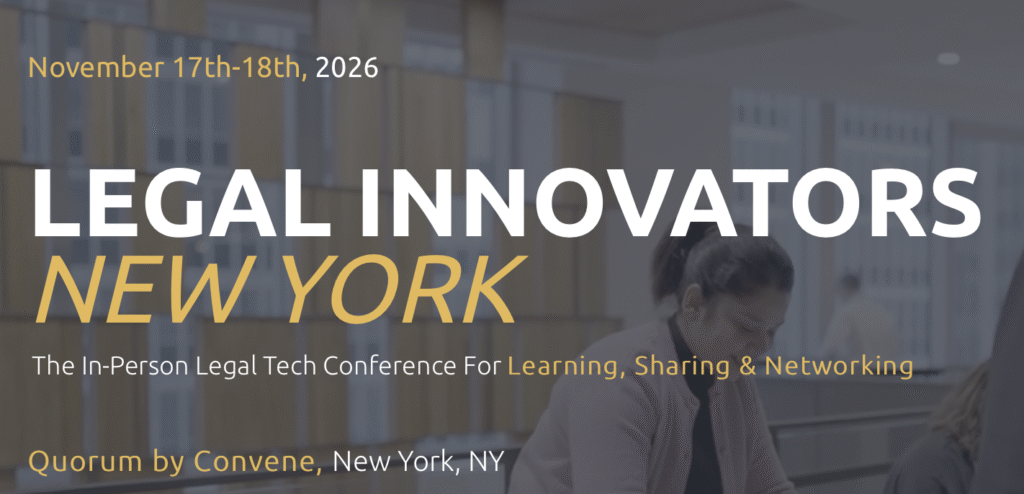
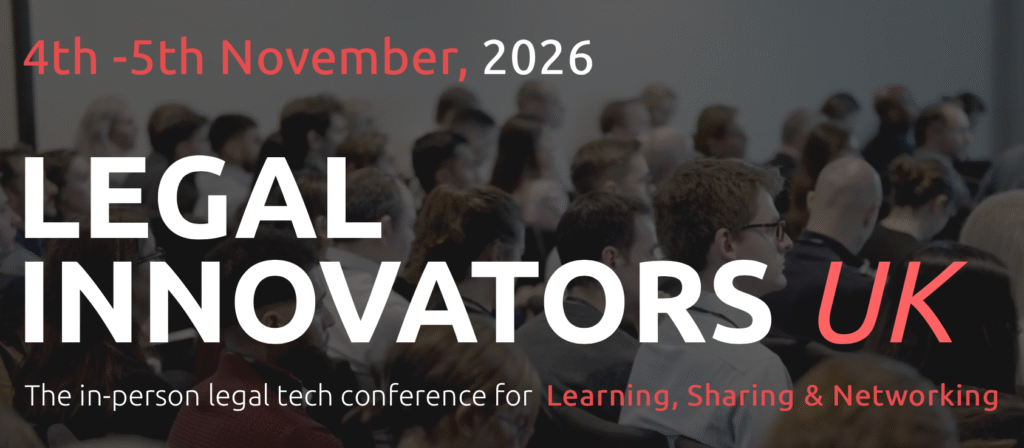
Come and join us in New York and London this November at Legal Innovators!
Legal Innovators New York – Nov 17 and 18.
Discover more from Artificial Lawyer
Subscribe to get the latest posts sent to your email.
