

A comparative income statement is a financial report that presents the results of multiple accounting periods side-by-side. For the estimation of an organisation's future progress, it is essential to look into its past performance, for which performing a comparative study of two or more years of company financial statements becomes necessary. A statement that helps in the comparative study of the components of a company's balance sheet and income statement over a period of two or more years, both in absolute and percentage form, is known as a Comparative Statement. It is a horizontal type of analysis and not only provides the absolute figures of various years but also, the columns to indicate any increase or decrease in these figures from one year to another in absolute and in percentage form. One can form an opinion on the progress of an enterprise based on the comparative statements.
Comparative Income Statement
A Statement of Profit & Loss or Income Statement shows the profit earned or loss incurred by an organisation during a particular accounting year by presenting its total income and expenses. In contrast, a Comparative Income Statement or Comparative Statement of Profit & Loss is an analytical form of the income statement that compares the financial results of more than one accounting period side by side. It is used for horizontal analysis, as it shows changes in operating results over time. In simple terms, it not only presents figures of different years but also highlights the absolute change and percentage change between them, helping in better understanding of business performance trends.
Objectives of Comparative Income Statement
Different objectives of a Comparative Income Statement are as follows:
1. The basic objective of a Comparative Income Statement or Statement of Profit & Loss is to analyse every item of Revenue and Expenses for two or more years.
2. It is also prepared to analyse the increase or decrease in every item of Revenue and Expenses in terms of rupees and percentages. With this increase or decrease, the trend of each item is determined.
3. A Comparative Statement of Profit & Loss or Income Statement also compares data of more than one year, showing the overall trend of profit.
4. Lastly, it is prepared to analyse and determine the reasons behind the change in the financial performance of the company.
Advantages of Comparative Income Statement
- Helps in Performance Analysis: It compares financial results of different years, making it easy to judge whether the business performance is improving or declining.
- Shows Profitability Trends: It clearly highlights changes in revenue, expenses, and net profit over time, helping to understand profitability trends.
- Assists in Decision-Making: Management can use it to make better decisions regarding cost control, pricing, expansion, and future planning.
- Easy Comparison: It presents financial data of multiple years in a simple and systematic format, making comparison easy and meaningful.
- Identifies Changes in Expenses and Revenue: It helps in detecting which expenses are increasing or decreasing and how sales are changing over time.
- Helps in Cost Control: By analysing expense trends, management can identify unnecessary costs and take corrective actions.
- Useful for Investors and Stakeholders: Investors, creditors, and other stakeholders can evaluate the company’s financial performance and stability.
Preparation of Comparative Income Statement
- First Column: In this column, all items of the Statement of Profit & Loss are recorded, including revenue and expenses. Revenue from Operations and Other Income are shown separately. Expenses such as Cost of Materials Consumed, Purchase of Stock-in-Trade, Changes in Inventories, Employee Benefit Expenses, Depreciation and Amortisation, Finance Cost, and Other Expenses are also included.
- Second Column: This column contains the Note Numbers corresponding to each item of the income statement, which help in referring to detailed explanations.
- Third Column: This column shows the amounts of each item for the previous accounting year.
- Fourth Column: This column records the amounts of each item for the current accounting year.
- Fifth Column: This column shows the absolute change (increase or decrease) between the current year and previous year figures.
Formula: Current Year Amount − Previous Year Amount - Sixth Column: This column expresses the absolute change in percentage form by taking the previous year’s amount as the base. It shows the extent of increase or decrease in percentage terms.
Formula:
Format of Comparative Income Statement (Statement of Profit & Loss)
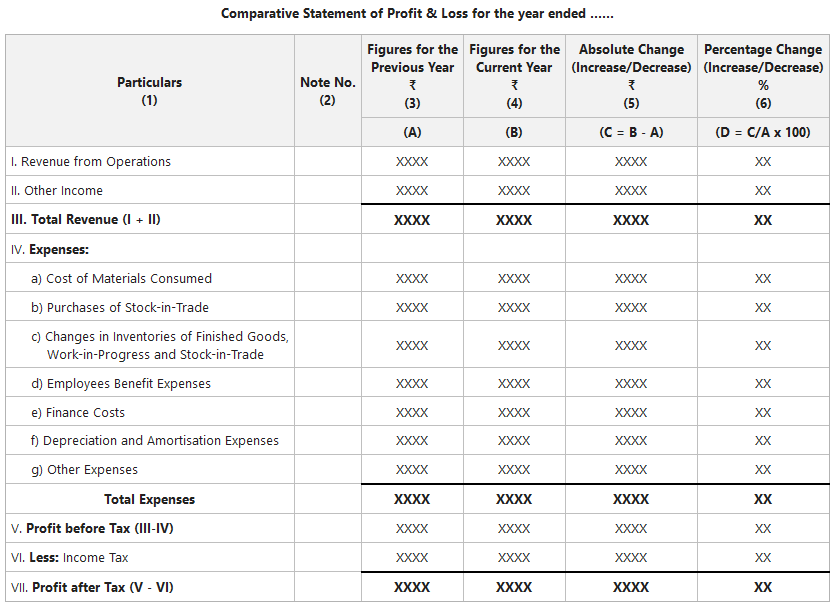
Note: If the current year's value of a company has decreased, then show the Absolute Change and Percentage Change in brackets to reflect the negative item.
Example of Comparative Income Statement
Prepare a Comparative Statement of Profit & Loss of Alex & Co. from the following information:
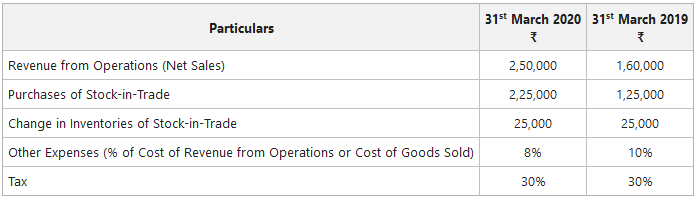
Solution:
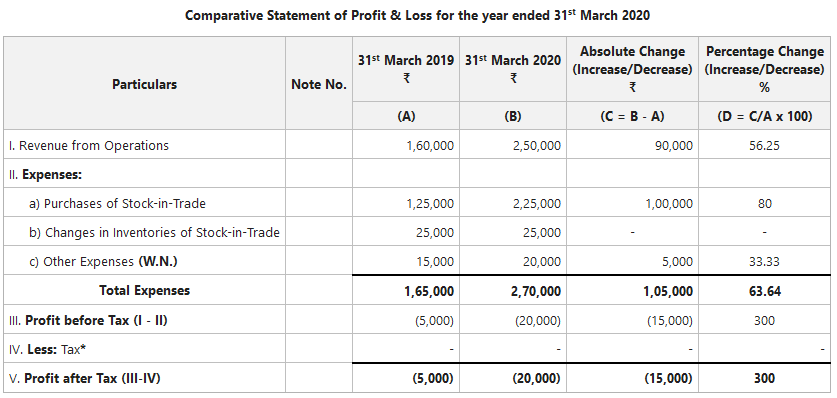
* As there is a loss, the tax will not be levied.
Working Note:

