

Gross Profit Ratio is a financial profitability ratio that shows the relationship between a company’s gross profit and its net revenue from operations. It measures how efficiently a firm generates profit after covering direct expenses related to production, such as cost of goods sold. This ratio helps assess the earning efficiency of a business and is an important part of profitability analysis in accounting. A higher gross profit ratio generally indicates better profit margins and efficient control over production costs. It can also be compared over different accounting periods or with similar firms to evaluate performance and competitiveness
- Gross Profit: It refers to the profit earned after deducting all the expenses directly related to production from the net revenue earned from operations. Such profit normally accounts for variable costs and not fixed ones.
- Net Sales: It refers to the revenue earned by the firm by selling its products after adjusting all kinds of sales returns, discounts, allowances to the customers, etc.
Formula:
where,
Gross Profit = Net Revenue from Operations - Cost of Goods Sold
Net Revenue from Operations = Gross Revenue - Sales Return - Discount - Allowances
or
Net Revenue from Operations = Cash Revenue from Operations + Credit Revenue from Operations - Return Revenue from Operations
Cost of Revenue from Operations (C.O.G.S.) = Cost of Material Consumed + Purchase of Stock-in-trade + Changes in Inventories of Finished Goods and Work-in-progress + Direct Expenses
Significance:
Gross Profit Ratio is used to ascertain the amount of profit available in hand to cover the firm's operating expenses. A higher gross profit ratio indicated an increase in the profit margin. Gross profit ratio can be compared with the previous year's ratio of the firm or with similar firms to ascertain the growth. This ratio is also an important measure to know how efficiently an establishment uses labour and supplies for manufacturing goods or offering services to clients. In other words, it is an important determinant of the profitability and financial performance of the business.
Illustration 1:
Compute the gross profit ratio of B Ltd. from the following information:
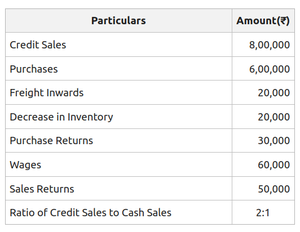
Solution:
Credit Sales = 8,00,000
Ratio of Credit Sales to Cash Sales = 2:1
Cash Sales =
= ₹4,00,000
Total Sales = Credit Sales + Cash Sales
= 8,00,000 + 4,00,000
= ₹12,00,000
Net Sales = Total Sales - Returns Inward
= 12,00,000 - 50,000
= ₹11,50,000
Cost of Goods Sold = Net Purchases + Freight + Wages + Decrease in Inventory
= 6,00,000 - 30,000 + 20,000 + 60,000 + 20,000
= ₹6,70,000
Gross Profit = Net Sales - Cost of Goods Sold
= 11,50,000 - 6,70,000
= ₹4,80,000
= 41.73%
Illustration 2:
Compute the gross profit ratio from the following information:
- Opening Inventory ₹4,00,000
- Closing Inventory ₹1,00,000
- Inventory Turnover Ratio 8 times
- Selling Price 25% above cost
Solution:
= ₹2,50,000
Cost of Goods Sold = 8 x 2,50,000
= ₹20,00,000
Gross Profit = 25% above cost
=
= ₹5,00,000
Net Sales = Cost of Goods Sold + Gross Profit
= 20,00,000 + 5,00,000
= ₹25,00,000
= 20%
