Surface area topic is an integral part of various competitive examinations. They are an important part of Geometry which is usually asked in Quantitative Aptitude.
Q1. A rectangular plot has its length and width ratio 4:1. At 10km/hr speed, Ankit was cycling along the plot's edge. In six minutes, he completes one round of the plot. Determine the plot's area.
A. 52000 m²
B. 51500 m²
C. 53500 m²
D. 52500 m²
Solution:
Distance covered by Rahul in 6 minutes = 10000/60 × 6 = 1000 m [10 km/hr = 10000/60 m/min] Therefore, perimeter = 1000m Length: Breadth = 4:1 Therefore, Length = 4x and breadth = x Then, Perimeter of the Rectangle= 2 (l +b) = 1000 2 (4x + x) = 1000 2 (5x) = 1000 10x = 1000 x = 100 Length = 4x = 4× 100 = 400 Breadth = x = 100 = 100 Therefore, Area = l × b = 400×100 = 40000 m²
Correct option: D
Q2. The height of a trapezium-shaped wall is 8 meters. The trapezium's parallel sides measure 4 and 6 meters. Find the cost of painting a whole wall if the price per square meter is Rs. 50.
A. Rs. 400
B. Rs. 420
C. Rs. 540
D. Rs. 450
Solution:
Area of trapezium =1/2 × (Sum of parallel sides) × Distance between them Area of trapezium = 1/2 × (4 + 6) + 8 Area of trapezium = 1/2 × (18) Area of trapezium = 9 square meter Rate of painting per square meter is Rs. 50 Therefore, to paint 9 square meter, total cost of painting = 9 × 50 = Rs. 450
Correct option: D
Q3. A rope makes 120 rounds of a cylinder with a base radius of 10 cm. How many times it can go around a cylinder with a base radius of 20 cm?
A. 70 cm B. 60 cm C. 45 cm D. 50 cm
Solution:
Let the round be x If radius is more, then rounds will be less as the length of the ropes remains the same L = 2×π×10×120 ----(1) Similarly, L = 2 × π × 20 × x ----(2) From (1) and (2) 10 × 120 = 20 × x => x = 60
Correct option: B
Q4. A 10 cm cube was divided into as n number of cubes of side lenght 1 cm cubes . Determine the total surface area ratio of the larger cube to the total surface areas of the smaller cubes.
A. 100:1 B. 10:1 C. 1:10 D. 1:100
Solution:
Volume of the original cube = 103 = 1000 cm3 Volume of each smaller cubes = 1 cm3. It means there are 1000 smaller cubes. Surface area of the cube = 6a2 Surface area of the larger cube = 6a2 = 6 × 102 = 6 × 100 = 600 Surface area of one smaller cubes = 6 (1²) = 6 Now, surface area of all 1000 cubes = 1000× 6 = 6000 Therefore, Required ratio = Surface area of the larger cube: Surface area of smaller cubes = 600: 6000 = 1:10
Correct option: C
Q5. After being submerged in water, a rectangular piece of cloth was found to have lost 20% of its length and 10% of its width. Calculate the overall percentage of the rectangular piece of cloth's area reduction.
A. 75% Decrease B. 28 % Increase C. 28 % Decrease D. 20% Decrease
Solution:
Let the original length = l Let the original breadth = b Original Area = l × b New length = 80/100 l New breadth =90/100 b Decrease in the area = lb – 80/100 l × 90/100 b Decrease in the area = 7/25 lb Decrease percentage = 7/25 lb × 7/lb × 100 Decrease percentage = 700/25 = 25%
Correct Option: C
Q6. ABCD is a square. AD is tangent to a circle with a radius r and OE = ED. What is the ratio of the area of a circle to the area of the square?
a) π/3 b) πr2/3 c) πr2/4 d) πr2/2
Solution:
OD2 = OA2+ AD2 (2r)2 = r2 + AD2 Thus PQ, which is also the side of square, is equal to r. The area of square becomes: 3r2 Hence, the ratio of the area of circle to square is: (area of circle)/(area of square)=(πr2)/(3r2 )=π/3
Correct Option: A
Q7. A kite is in the shape of a square with a diagonal 48cm attached to a triangle of the base 4 cm and height 6 cm. How much paper has been used to make it?
a) 200 cm2 b) 288 cm2 c) 300 cm2 d) 325 cm2
Solution:
Area of square = 1/2(diagonal)2 =1/2 × (48)2 =1152 cm2 Area of triangle = 1/2 × base × height = 1/2 × 4 × 6 = 12 cm2 Total area = 1152 + 12 = 1164 cm2
Correct Option: C
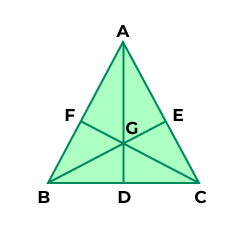
Q8. If G is the centroid and AD, BE, CF are three medians of triangle ABC with area 72 cm2, then the area of triangle BDG is:
a) 12 cm2 b) 16 cm2 c) 24 cm2 d) 8 cm2
Solution:
Given
G is the centroid and AD, BE, CF are three medians and the area of GE = 12 cm2 As, we know the median divides the triangle into 6 triangles of equal area Hence, area of the quadrilateral BDGF= 2×GE = 2×12 cm2 Area of the quadrilateral BDGF = 24 cm2
Correct Option: 24 cm2
Q9. If the perimeter of rhombus is 150 cm and length of one diagonal is 50 cm. Then find the length of second diagonal and area of rhombus.
(a) 425 cm² (b) 525 cm² (c) 625√5 cm² (d) 725 cm²
Solution:
Perimeter = 4a=150 cm a= 37.5 cm 4a2= d12 + d22 4×37.52=502 + d22 d2 = 25√5 cm Area = ½×d1×d2 = ½×50×25√5 = 625√5 cm2