

Living things are organisms that possess the characteristics of life, including growth, reproduction, metabolism, and responsiveness to their surroundings.
- They include a wide variety of organisms, from plants, animals, fungi, and algae to microscopic organisms such as protozoa, bacteria, and archaea.
- Despite differences in size, structure, and complexity, all living things share fundamental life processes that enable them to grow, survive, and reproduce.
To be categorized as a living thing, an organism possesses the following characteristics or processes necessary for life:
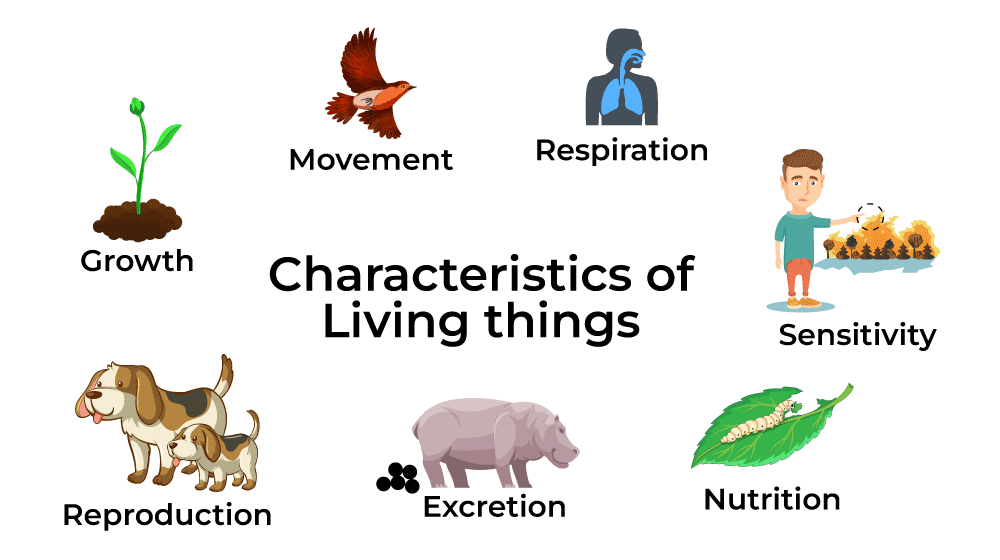
Movement
- They can move in one direction or another without outside help.
- Movement can be the flow of matter within an organism or the external movement of an organism or a part of an organism.
Sensitivity
- React to the conditions around them.
- For example, green plants grow toward the sunlight, some microorganisms shrink into globules when touched, and people blink when light shines in their eyes.
Respiration
- All living organisms can release the energy stored in food molecules through a chemical process known as cellular respiration.
- During aerobic respiration, oxygen is taken in, and carbon dioxide is released. In unicellular organisms, these gases are exchanged with the environment through the cell membrane of the organism.
- In multicellular organisms, gas exchange with the environment is somewhat more complex and usually takes place via organs specially adapted for this purpose.
Nutrition
- Need energy to survive. Energy comes from nutrients or food.
- Green plants, algae, and some archaea and bacteria can make food from water and carbon dioxide through photosynthesis.
- Legumes can produce protein by absorbing nitrogen provided by bacteria that live in the plant's root nodules.
- Animals, fungi, protozoa, and many archaea and bacteria require food from an external source.
Growth
- Grows by creating new parts and materials and changing old ones.
- It happens when a seed becomes a plant or a chick becomes a hen.
- As humans grow, they add new structures, such as teeth, and change the proportions of others.
Reproduction
- By the process of reproduction, living things create new organisms. This is the same even for the simplest microbes, which can multiply by simply dividing into two.
- Each new part can move, feed, grow, and perform other vital functions. This type of reproduction is called asexual reproduction because it does not require a mating partner.
- Asexual reproduction is more common in lower organisms, such as bacteria and some species of protozoa and fungi.
- Higher organisms like mammals and birds require partners for mating, which is called sexual reproduction.
Excretion
- The process by which living things remove waste products from the body is called excretion.
- Excretion in living organisms can be done with the help of the skin, Lungs, and Kidneys.
Chemical Composition of Living Cells
All living organisms are made up of cells, and cells are composed of various molecules. The major molecules present in living cells are carbon-based organic compounds, along with water and inorganic ions. These molecules are essential for the structure and functioning of cells.

All living things contain four major carbon-based molecules:
- Carbohydrates: Used inside cells mainly for quick energy, but also can be used in structure and cell signalling.
- Proteins: The building blocks of cells and carry out many important functions, from transport to catalysing chemical reactions to structure.
- Lipids: Used for long-term energy storage.
- Nucleic acids: contain the genetic information of the cell and include molecules like DNA and RNA.
Note: In addition to these four molecules, cells are also made of inorganic ions such as sodium or potassium and water.
Basic Needs of Living Things
- Water: The most basic need of all living things is water. Life could not exist without this important resource. Water is required for many chemical reactions in cells. It also helps transport nutrients and eliminate waste.
- Nutrients: All organisms require nutrients for energy, growth, and repair. Every organism has its own way of absorbing nutrients. Some organisms, such as animals and protozoa, get their nutrients from food. Plants and algae produce their own food through photosynthesis. Fungi gain nutrients by breaking down and absorbing decaying organic matter.
- Air and Light: Air and light are also basic needs of certain organisms. Air is a basic need of most living things, although some species of microorganisms cannot tolerate oxygen. For plants and other organisms that carry out photosynthesis, light is an essential requirement for life.
- Habitat: Space is another basic requirement; Organisms such as plants and fungi that are anchored in the substrate need space to grow and develop. Animals and other motile organisms need a place to live and a territory where they can find food and mates.
