

The classification of animals is the systematic arrangement of animals into groups based on their similarities, differences, and evolutionary relationships.
- This scientific method of grouping helps in the easy study, identification, and understanding of the vast diversity present in the animal kingdom.
- The animal classification system divides organisms based on shared traits and evolutionary history.
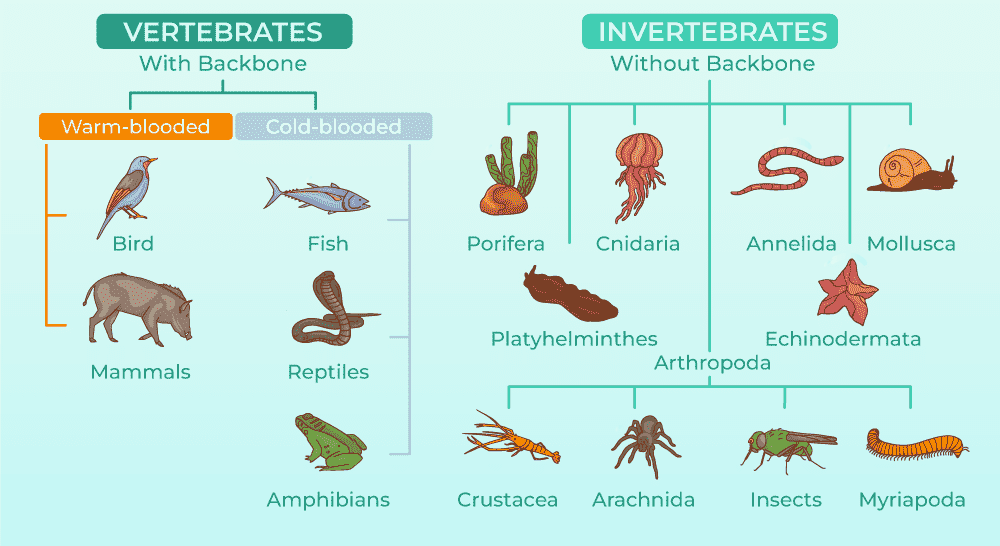
Non- Vertebrates
Non-vertebrates, or invertebrates, are animals that do not possess a vertebral column or backbone. It includes a variety of animals such as porifera, arthropods, Mollusca, annelids, cnidarians, etc. Different characteristics of invertebrates are given below.
- They lack a backbone or vertebral column.
- They show radial symmetry or bilateral symmetry depending on their evolution.
- They are cylindrical, triploblastic, coelomate, or pseudocoelomate animals.
- Respiration is either through gills, trachea or body surface.
- Mode of reproduction can be sexual or asexual.
- Fertilisation is external, though internal fertilisation also occurs in some species.
- An open type of circulatory system is present.
The important characteristic features of the different phyla are described below.
1. Phylum - Porifera
- The organisms belonging to this phylum are usually known as sponges.
- These sponges have the system of water transport system in their body.
- These are usually marine animals, which means most of them live in oceans and seas.
- These are multicellular organisms and have cellular levels.
- The skeleton of these organisms is made up of spicules.
- Reproduction in sponges is done asexually by the process of fragmentation and sexually by the process of gamete formation.
- Fertilisation in these organisms is internal.
Examples: Euspongia and Spongilla.

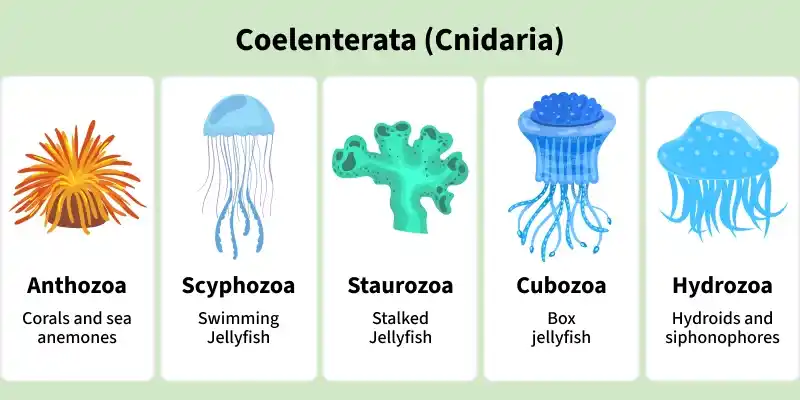
2. Phylum - Coelenterata (Cnidaria)
- These organisms are more symmetrical when compared to other organisms.
- These are mostly aquatic and free-swimming animals that live in marine environments, seas, and other aquatic places.
- These organisms have Cnidoblasts on their tentacles and bodies.
- These Cnidoblasts are used in their defence mechanism and to capture food.
- Cnidarians have mainly two body forms, known as polyp and medusa.
- Polyp produces medusae using asexual reproduction, and medusae produce polyps using sexual reproduction.
Examples: Gorgonia, Meandrina, and Physalia.
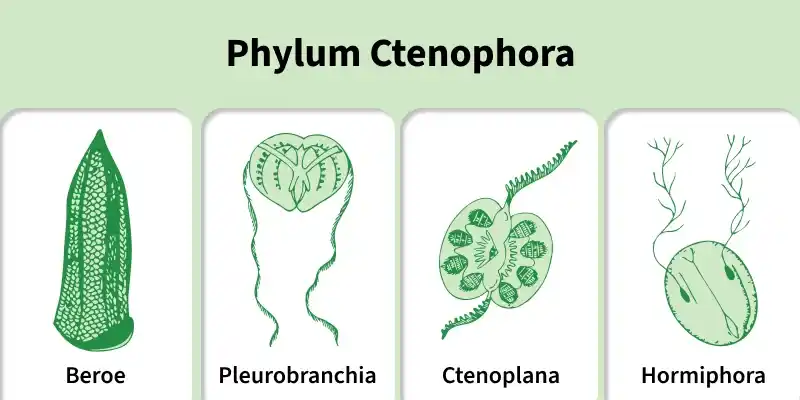
3. Phylum - Ctenophora
- Ctenophores are usually known by names such as Sea walnuts.
- These are diploblastic organisms that live in marine environments and are radially symmetric.
- The organisation in these organisms is of tissue-level organisation.
- The process of digestion takes place both intracellularly and extracellularly.
- In Ctenophores, reproduction takes place only by sexual reproduction.
- Fertilisation takes place externally.
Example: Pleurobrachia and Ctenoplana.
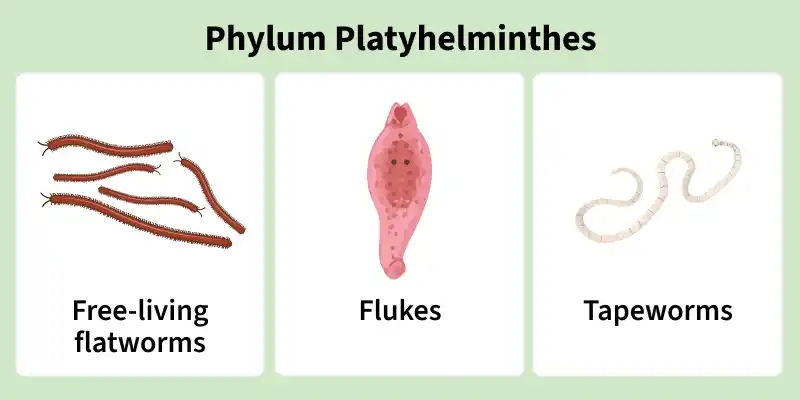
4. Phylum - Platyhelminthes
- They have flattened body-like structures. So, they are called flatworms.
- These organisms are found in many living organisms, including human beings.
- Parasitic worms have hooks and suckers on their body.
- Many of these flatworms absorb nutrients from their host's body directly to survive.
- These organisms have special cells named flame cells, which help in the process of excretion.
- Sexes are not separate in these worms.
- The process of fertilisation occurs internally, and development happens through several larval stages.
Example: Taenia (commonly known as tapeworm) and Fasciola.
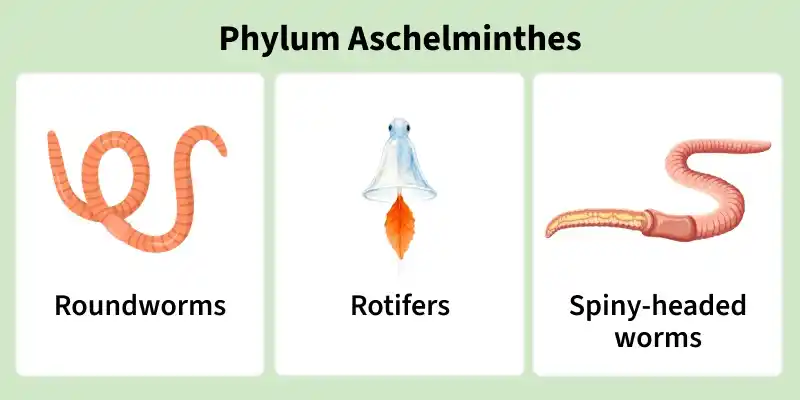
5. Phylum - Aschelminthes
- The shape of the body of Aschelminthes is circular.
- These organisms may be aquatic or terrestrial parasitic organisms that live in both plants and animals.
- These organisms choose either plants or other animals as their host and live. They have organs in their body.
- These organisms are bilaterally symmetrical in nature.
- Sexes are separate in these organisms, as we can distinguish male and female in Aschelminthes. Usually, females are longer than males.
- The process of fertilisation takes place internally, and the development of the organism may be direct or indirect.
Example: Ascaris (commonly known as roundworm) and Ancylostoma(Hookworm).
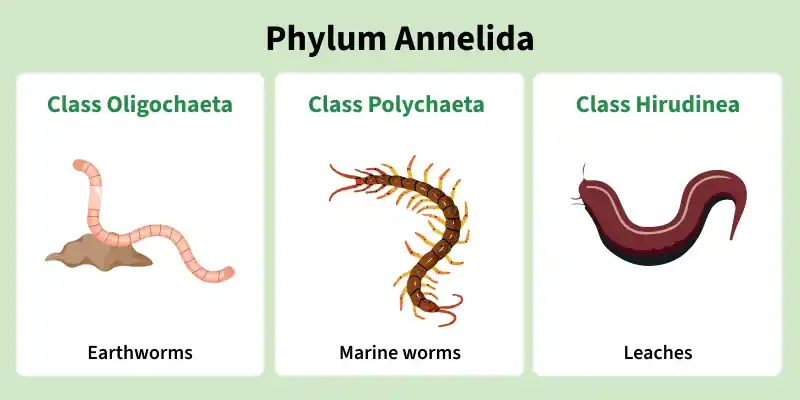
6. Phylum - Annelida
- These organisms can live in both water and on land.
- They can live in both salt and fresh water.
- The organisation of the body is organ level system.
- Their circular muscles and longitudinal muscles help in their locomotion.
- Their body surfaces consist of fragments.
- Nephridia help in excretion in these organisms.
- Reproduction in these organisms is sexual.
Example: Nereis and Pheretima (common name is Earthworm).
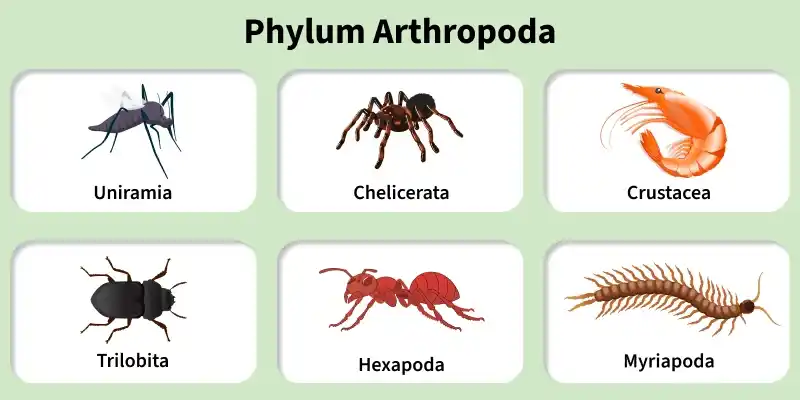
7. Phylum - Arthropoda
- The largest phylum among the Animalia is Arthropoda.
- This phylum includes insects. Almost 66 per cent of species on Earth belong to the phylum of Arthropoda.
- The organisms in this phylum have organs in their body.
- These organisms are bilaterally symmetrical. In these kinds of organisms, excretion takes place through Malpighian tubes.
- Their bodies consist of the head, eyes, thorax, abdomen, etc.
- Respiration in Arthropods takes place through the lungs and gills.
- Fertilisation is mostly internal, and development happens either directly or indirectly.
Examples: Apis(bee), Bombyx, Limulus, Locusta, and Anopheles.
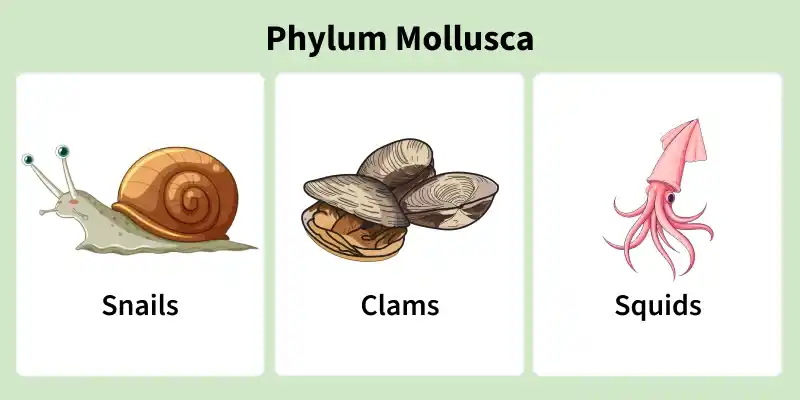
8. Phylum - Mollusca
- The second largest phylum after Arthropoda in the whole animal kingdom is the Mollusca phylum.
- The organisms that belong to this phylum are both aquatic and terrestrial animals.
- They can live in both fresh water and marine water.
- The body of these organisms is covered with a shell called a calcareous shell.
- With a muscular foot, visceral mass, and head, its body is unsegmented.
- The space between the mantle and visceral mass is usually known as the mantle cavity.
- They have gill-like structures to breathe. These are mostly unisexual.
Example: Octopus, Loligo, and pila
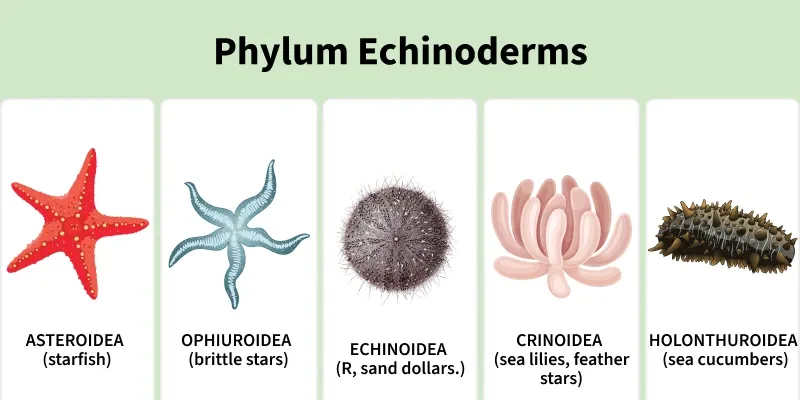
9. Phylum - Echinodermata
- Mostly, organisms belonging to the phylum Echinodermata are marine animals. They live in salt water.
- Fully grown echinoderms are radially symmetrical. But in the larva stage, they are bilaterally symmetrical.
- They possess a water vascular system for locomotion, the process of respiration, and capturing food.
- There are no specially defined excretory organs in these organisms.
- The nervous system and sense organs are poorly developed in echinoderms, and the brain is absent.
- Sexes are mostly separate, and the fertilisation process is external.
Example: Antedon, Cucumaria, and Ophiura
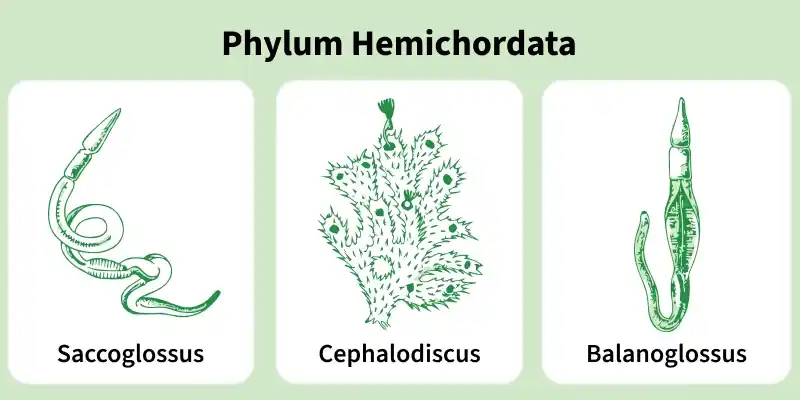
10. Phylum - Hemichordata
- The phylum Hemichordata was initially placed in the subphylum of Chordata. Now it is considered a separate phylum under non-chordates.
- These organisms are worm-like structures and mostly aquatic animals.
- They mostly live in marine water.
- Their body is in a cylindrical structure.
- Respiration in these creatures is done through gills that open into the pharynx. They have a dorsal heart.
Example: Saccoglossus and Balanoglossus
11. Phylum - Chordata
Animals belonging to the phylum Chordata are fundamentally characterised by the presence of a notochord, a dorsal hollow nerve cord and paired pharyngeal gill slits. These are bilaterally symmetrical, triploblastic, coelomate with an organ-system level of organisation. They possess a post-anal tail and a closed circulatory system.
Chordata vs Non-Chordata
Features | Chordata | Non-Chordata |
|---|---|---|
Notochord | Notochord present. | Notochord absent |
Central Nervous System | The central nervous system is dorsal, hollow and single. | The central nervous system is ventral, solid and double. |
Pharynx | Pharynx perforated by gill slits | Gill slits are absent. |
Heart | The heart is ventral. | Heart is dorsal (if present). |
Post-anal tail | A post-anal part (tail) is present. | Post-anal tail is absent. |
Chordates are further classified into three subphyla:
1. Subphylum - Urochordata or Tunicata
The organisms in the subphylum Urochordata are marine organisms, and we can find them from the surface to depths in the ocean. Their body is composed of a tunic, which is formed by cellulose, and their body is unsegmented. The circulatory system in their body is of a circular type. Activities like free swimming develop in their tadpoles. They have a ventral heart, which reverses the flow of blood. Example: Salpa, Pyrosoma, and Doliolum
2. Subphylum - Cephalochordata
Cephalochordates are aquatic animals. We can find these animals mostly in marine water. They possess a notochord, pharyngeal slits, and tubular nerve chords. Respiration occurs through their body surface. The circulatory system in their body is a closed type. Excretion in Cephalochordata is done through solenocytes. The process of fertilisation is external. Example: Branchiostoma
3. Subphylum - Vertebrata
The Subphylum Vertebrata is divided into many classes:
- Amphibia
- Reptilia
- Aves
- Mammalia
- Pisces
Vertebrates
Vertebrates are a subphylum of chordates that are characterised by the presence of a vertebral column or backbone. It encloses and protects the spinal cord. It includes animals such as fish, amphibians, reptiles, birds, and mammals. Different characteristics of vertebrates are given below.
- They are characterised by the presence of a vertebral column or backbone. It encloses and protects the spinal cord.
- They show bilateral symmetry.
- Vertebrates have an internal skeleton made of bone or cartilage, providing structural support and protection for internal organs.
- They are triploblastic and coelomate with the organ-system level of organisation.
- The body has a closed circulatory system.
- The notochord is present only in the larval tail, but in some, it is present throughout their life from head to tail region.
