

Spermatophyta includes all seed-bearing plants. It is divided into two subdivisions: Gymnosperms and Angiosperms.
- Gymnosperms are mostly woody, non-flowering seed plants. Seeds are exposed or naked and better adapted for a land habitat.
- Angiosperms are the most diverse and abundant group of plants. They are the most abundant and conspicuous plants. Range from tiny, almost microscopic Wolffia to tall trees of eucalyptus.
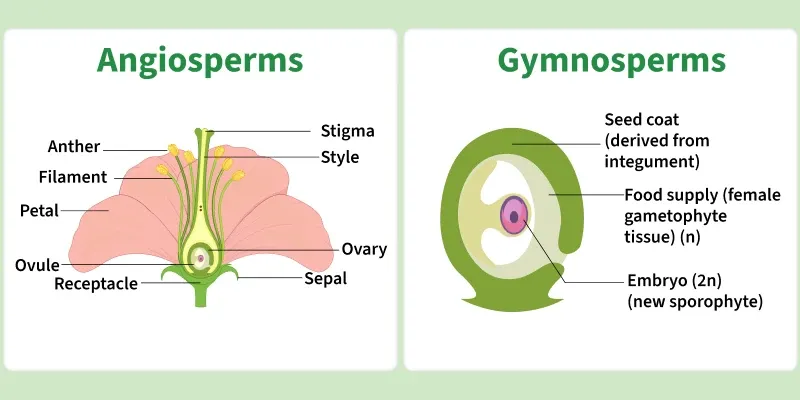
R.H. Whittaker gives 5 kingdom systems, which he stated are kingdoms like Monera, Protista, Fungi, Animalia, and Plantae. Kingdom Plantae has mainly 5 groups, i.e., Algae, Bryophytes, Pteridophytes, Gymnosperms, and Angiosperms.
The difference between gymnosperms and angiosperm:
Parameter | Angiosperms | Gymnosperms |
|---|---|---|
Definition | Angiosperms are seed-producing flowering plants whose seeds are enclosed within an ovary. | Gymnosperms are seed-producing non-flowering plants whose seeds are naked (not enclosed within an ovary or fruit). |
Flower | These are Flowering Plants, and thus, they have flowers | These are not flowering plants, and thus, they do not have flowers |
Embryo | The embryo contains one or two cotyledons | The embryo may contain one to several cotyledons. |
Xylem | Xylem forms Vessels | Xylem generally lacks vessels (except in Gnetales). |
Reproductive organs |
|
|
Endosperms | Triploid Endosperms | Haploid Endosperms |
Stem | Usually hardwood (dicots) or herbaceous | The stem is made up of Softwood |
Leaves | Flat-shaped leaves. | Scale-like and needle-like leaves. |
Dispersion | Seeds are dispersed by animals, wind, water, or explosive mechanisms. | Seeds are primarily dispersed by wind. |
Example | Monocots and Dicots | Cycas, Pinus (pines), Cedrus(deodar), Ginkgo, etc. |
