

Chromosomes and chromatids are important structures involved in DNA replication.
- Chromosomes are thread-like structures made of DNA and proteins. These structures are found in the nucleus of cells.
- Chromatids are identical halves of a replicated chromosome, not just DNA. During cell division, sister chromatids are pulled toward opposite poles of the cell by spindle fibers. The process ensures the equal distribution of genetic material in the replication process.
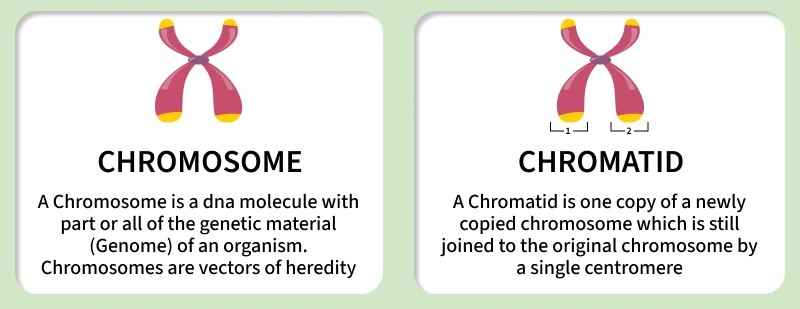
The table below lists the difference between chromosomes and chromatids:
| Feature | Chromosome | Chromatid |
|---|---|---|
| Definition | A complete DNA structure carrying genes | One of two identical halves of a replicated chromosome |
| Composition | DNA + proteins (histones) | DNA + proteins |
| Structure | May consist of one or two chromatids | Single chromatid (one DNA molecule with proteins) |
| Number | Fixed for each species | Doubles after DNA replication |
| Role | Carries genetic information | Helps in the equal distribution of DNA |
| Genetic Information | Contains genes for traits | Sister chromatids are genetically identical |
| Presence | Present throughout the cell cycle | Present after S phase until separation |
| Visibility | Visible during cell division | Visible as part of a duplicated chromosome |
| Replication | Replicates during the S phase | Formed after replication |
| Crossing Over | Occurs between homologous chromosomes | Occurs between non-sister chromatids |
| Meiosis | Homologous chromosomes pair | Non-sister chromatids exchange segments |
| Segregation | Separate into daughter cells | Separate to form new chromosomes |
| Cell Division Role | Align and segregate | Separate and become individual chromosomes |
