

Genetic code refers to the nucleotide sequence of the base on DNA or RNA, which is translated into sequences of amino acids and proteins. The sequence of nucleotides in deoxyribonucleic acid and ribonucleic acid, which determines the amino acid sequence of proteins, is known as the genetic code.
- DNA consists of information for protein sequences.
- RNA consists of four nucleotides: adenine (A), guanine (G), cytosine (C), and uracil (U).
- The genetic code is made up of three nitrogen bases, which are known as the triplet code.
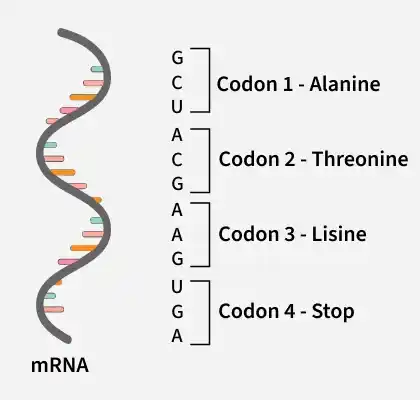
George Gamow, a physicist, said that there are only 4 bases, and if they code for 20 amino acids, then the code should consist of a combination of bases. Further, he suggested that to code for all 20 amino acids, the code should be made up of 3 nucleotides. This was the bold proposition because of the permutation combination 4×4×4=64 possible codons
43 = 64
- 4 nucleotides
- 3 positions in a codon
Features of the Genetic Code
- Some amino acids are coded by more than one codon; therefore, the code is degenerate.
- 61 codons code for amino acids and 3 codons that don't code for any amino acids.
- AUG has dual functions, which code for Methionine (met) and act as a start codon.
- The stop terminator codons are UAA, UGA, and UAG.
- The genetic code is nearly universal.
- The codon is read in mRNA in a contiguous fashion; therefore, no punctuation.
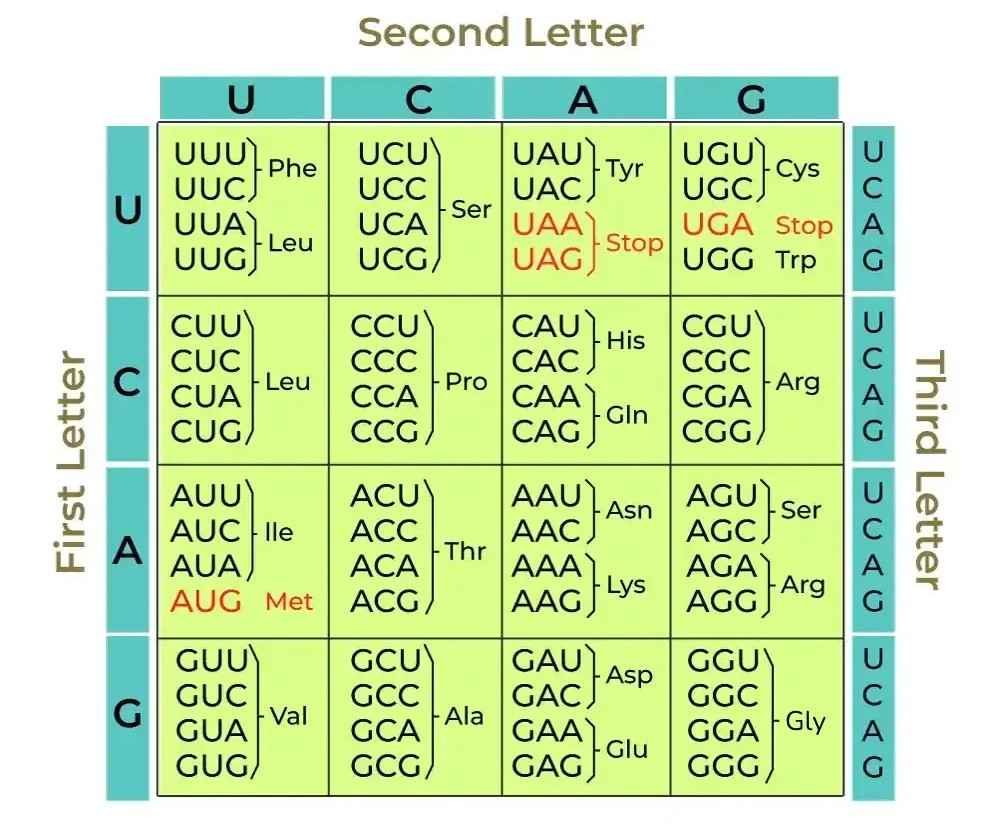
Genetic Code Table
The set of relationships between amino acids and codons is known as the genetic code. When a genetic code is summarised in a table, it is known as a Genetic Code Table. Amino acids are represented in the table by more than one codon. Example - In total, there are 6 ways to write leucine in mRNA language.
Properties
- Nonoverlapping Code: When a code is read in a group that initially becomes part of the triplet, which becomes a part of the triplet and can never again become a part of the next triplet is known as a nonoverlapping code.
- Degenerate Code: Except tryptophan and methionine, every amino acid is coded by other codons; therefore, some codons are synonyms, and this is known as the degeneracy of the genetic code.
- Triplet Code: Strong proof is available that sequences of three nucleotides code for an amino acid, which is known as a triplet. There are 64 codons for 20 amino acids, where every codon for an amino acid means that there exists more code for the same amino acid.
- Universal Nature: Same genetic codes are seen in all organisms, which means they are universal in nature.
- Non-ambiguous: the genetic code is non-ambiguous for a particular codon that will code for a particular amino acid.
- Comma-less Code: No room for punctuation is there in between them, which shows every codon is adjacent to the previous one without any nucleotides between them.
- Start and Stop Codons: The start codon is the AUG codon, whereas the stop codons are UAG, UGA, and UAA.
- Polarity: The triplet can read from 5' - 3' directions, the beginning base is 5', followed by the middle and last the last base, which is 3'. Therefore, these codons have fixed polarity.
Exceptions of the Genetic Code
Due to similar codons being seen in all organisms, the genetic code is universal, along with the same START and STOP signals in the genes of microorganisms and plants. Therefore, there are a few exceptions, which include one or two STOP codons of an amino acid.
Though GUG is meant for valine and AUG code for methionine as starting codons, which breaks the property of non-ambiguousness. Therefore, a few codes are different from the universal code or non-ambiguous code. In some bacteria, GUG acts as an alternative start codon.
