

In flowering plants, sexual reproduction is a complex process that involves the mating of male and female gametes to create seeds for the following generation.
The pistil, which is located in the center of the flower, is the female reproductive structure in flowering plants and plays a vital role in sexual reproduction, fertilization, seed formation, and fruit development.

Characteristics of Pistil
A pistil is primarily composed of the stigma, style, ovary, and ovule, which comprise the female component of a flower.
- Pollination and fertilization are primarily developed or adapted for pollination purposes.
- The female reproductive system is represented by this section of the flower, which is positioned in the center.
- The stigma is made up of a variable-shaped and adhesive stigma, an involucre, and an ovary (with potential seeds or ovules).
- The number of pistils in flowers normally varies depending on the species. Pistils are made up of a slew of structures that look like leaves, and their major job is to guard the ovules.
- During the process of pollination, a compatible pollen grain lands on the stigma, and then further, it germinates, forming a pollen tube.
- The pollen tube starts to grow down (tissues of the style) to deposit sperm for the process of fertilization with the ovules in the ovary. The pistil is a kind of collective sense of the female reproductive system to collect the male gametes from the male reproductive part, or androecium.
Structure of the Pistil
The pistil is the female reproductive part of a flower. It is usually found in the center of the flower and is made up of one or more carpels. When several carpels are fused, they form a single pistil.
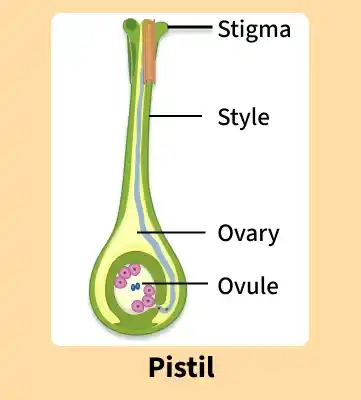
Stigma
- The stigma is the uppermost part of the pistil.
- It is usually sticky or hairy.
- Receives pollen grains during pollination
- Provides a suitable surface for pollen germination
Style
- The style is a slender stalk connecting the stigma and ovary.
- It may be long or short depending on the flower.
- Provides a passage for the pollen tube to grow from the stigma to the ovary
- Helps in the proper positioning of the stigma
Ovary
- The ovary is the swollen basal part of the pistil.
- It contains one or more ovules attached to the placenta.
- Protects the ovules
- After fertilisation: The ovary develops into a fruit, and the ovules develop into seeds
Functions
- The pistil's primary purpose is reproduction.
- It is the female reproductive component of the flower, which participates in the fertilization process.
- The stigma of the pistil is in charge of accepting pollen.
- The pistil style is in charge of carefully transferring suitable pollen to the ovule.
- The pistil preserves the ovule contained within it.
