

Microsporogenesis is the process by which diploid microspore mother cells (MMCs) present in the microsporangia or pollen sacs of the anther undergo meiosis to produce haploid microspores.
- These microspores later develop into pollen grains containing the male gametophyte.
- It is an essential step in the sexual reproduction of flowering plants.
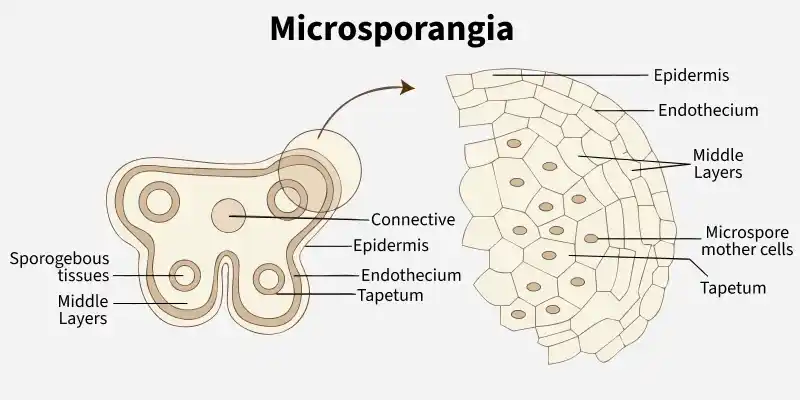
Structure
The microsporangium is present within the anther and consists of different layers and tissues that support pollen development.
- Epidermis: The epidermis forms the outermost protective layer of the microsporangium. It protects the inner tissues from injury and drying.
- Endothecium: The endothecium lies below the epidermis. The cells of this layer develop fibrous thickenings that help in the dehiscence or opening of the anther for pollen release.
- Middle Layers: One to three middle layers are present below the endothecium. These layers provide temporary support and later degenerate as the anther matures.
- Tapetum: The tapetum is the innermost nutritive layer surrounding the sporogenous tissue. It supplies nutrients and enzymes necessary for the development of microspores and pollen grains. The tapetum plays a very important role in pollen wall formation.
Process
The process of microsporogenesis occurs in several stages inside the microsporangium.
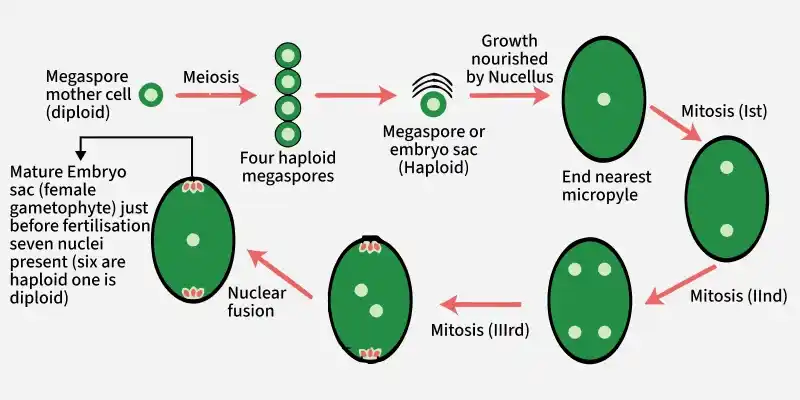
1. Formation of Sporogenous Tissue
In the young anther, the hypodermal cells divide repeatedly to form a mass of compact cells known as the sporogenous tissue. These cells are diploid (2n) and serve as the precursor cells for pollen formation.
2. Differentiation of Microspore Mother Cells
The cells of the sporogenous tissue enlarge and differentiate into microspore mother cells (MMCs) or pollen mother cells (PMCs). Each microspore mother cell is diploid (2n) and is capable of undergoing meiosis.
3. Meiosis I
Each microspore mother cell undergoes the first meiotic division (reductional division). During this stage, homologous chromosomes pair, crossing over occurs, and the chromosome number is reduced from diploid (2n) to haploid (n). As a result, two haploid daughter cells are formed.
4. Meiosis II
The two haploid cells immediately undergo the second meiotic division (equational division). This division separates the sister chromatids, resulting in the formation of four haploid microspores.
5. Formation of Microspore Tetrad
The four newly formed microspores remain temporarily attached, forming a microspore tetrad. The tetrad is enclosed within a callose wall, which protects the developing microspores during their early stages.
6. Separation of Individual Microspores
An enzyme called callase, secreted by the tapetal cells, dissolves the callose wall surrounding the tetrad. As a result, the four microspores separate from one another and become free individual microspores.
7. Development into Pollen Grains
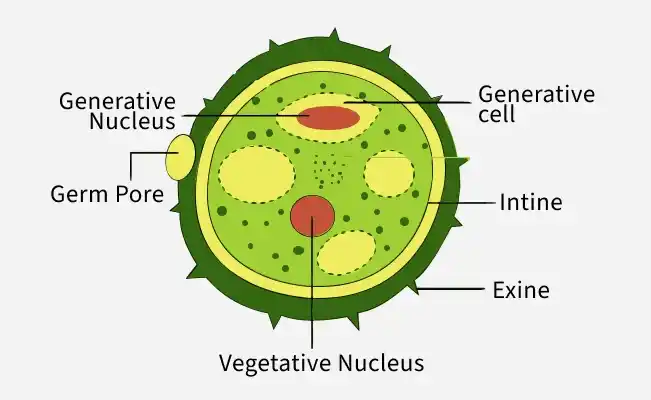
Each free microspore enlarges and undergoes further development through microgametogenesis. It develops a thick outer wall (exine) made of sporopollenin and a thin inner wall (intine). The nucleus divides mitotically to form a vegetative cell and a generative cell, producing a mature pollen grain capable of participating in fertilisation.
Structure of Pollen Grain
A mature pollen grain consists of:
- Exine: The outer protective wall made of sporopollenin. It contains thin regions called germ pores through which the pollen tube emerges.
- Intine: The inner wall is composed of cellulose and pectin.
- Vegetative Cell: A large cell with abundant cytoplasm that forms the pollen tube.
- Generative Cell: A smaller cell that divides to form two male gametes.
Importance
- Produces pollen grains: Forms haploid microspores that develop into mature pollen grains (male gametophytes).
- Maintains chromosome number: Meiosis reduces the chromosome number from diploid (2n) to haploid (n), ensuring the correct chromosome number after fertilisation.
- Creates genetic variation: Crossing over and independent assortment during meiosis produce genetically diverse pollen grains.
- Essential for fertilisation: Healthy pollen grains carry male gametes required for successful pollination and double fertilisation.
- Supports plant reproduction: Leads to seed and fruit formation, ensuring the continuation of plant species.
- Important in plant breeding: Helps develop improved crop varieties with desirable traits such as disease resistance and higher yield.
- Useful in biotechnology: Used in anther and microspore culture to produce haploid and doubled haploid plants for crop improvement.
- Increases agricultural productivity: Proper microsporogenesis ensures viable pollen, resulting in better seed set and higher crop yield.
