

Behavioral interview questions help employers understand how you handled situations in the workplace or during academic projects. They assess skills such as teamwork, leadership, communication, problem-solving, adaptability, and time management. There is no single correct answer. Interviewers focus on your approach, the actions you took, and the results you achieved.
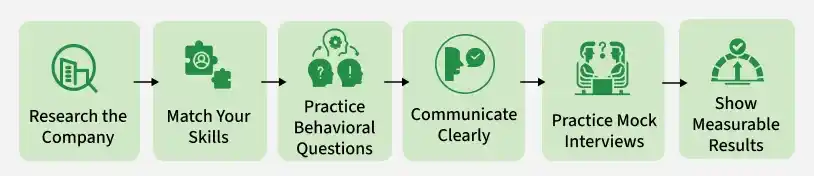
The STAR method is a widely used technique for answering behavioral interview questions in a clear and structured manner. It helps you explain your experience by focusing on the situation, the actions you took, and the outcome.
Behavioral Interview Questions and Answers
1. Tell me about a time you faced a challenge. How did you handle it?
During my internship, I was assigned a task that required skills I had little experience with. Instead of feeling overwhelmed, I spent time learning the required concepts through online resources and sought guidance from my mentor. After applying what I learned, I successfully completed the project on time. This experience taught me that continuous learning and asking for help when needed are key to overcoming challenges.
2. Can you work effectively under pressure? Give an example.
During a project, my manager became unavailable just before an important client presentation. I was asked to prepare and deliver the presentation using the available project notes. I prioritized the key points, verified the information with team members, and practiced beforehand. The presentation was well received, and I gained confidence in handling responsibilities under pressure.
3. Tell me about a time you made a mistake. How did you handle it?
While preparing a report, I accidentally entered incorrect data that affected the final analysis. As soon as I noticed the mistake, I informed my manager, corrected the report, and reviewed my work more carefully before submitting it again. Since then, I have adopted a checklist to reduce similar errors.
4. How do you set goals? Give an example.
Why interviewers ask this: This question evaluates your planning, organization, and ability to achieve objectives.
I usually follow the SMART goal-setting approach by making my goals specific, measurable, achievable, relevant, and time-bound. For example, I wanted to improve my programming skills, so I set a goal to solve five coding problems every day for three months. By following this plan consistently, I significantly improved my problem-solving skills and coding speed.
5. Tell me about a goal you set and successfully achieved.
Why interviewers ask this: Interviewers want to understand how you plan, stay committed, and achieve long-term goals.
I wanted to earn a professional certification related to my field within three months. I created a weekly study schedule, tracked my progress, and dedicated time every day to preparation. I successfully passed the certification exam on my first attempt, which improved both my knowledge and confidence.
6. Tell me about a decision that your team members disagreed with. How did you handle it?
Why interviewers ask this: This question evaluates your decision-making and conflict management skills.
During a project, I suggested changing our task allocation to meet a tight deadline. Initially, some team members disagreed because they were comfortable with the existing plan. I explained the reasoning, listened to their concerns, and adjusted the workload fairly. After implementing the changes, we completed the project on time.
7. Do you prefer working in a team or independently? Give an example.
Why interviewers ask this: Employers want to know whether you can collaborate effectively while also working independently when required.
I am comfortable working both independently and as part of a team. During a college project, each team member was responsible for a specific module. We completed our individual tasks and regularly discussed our progress to ensure everything worked together. This collaboration helped us complete the project successfully.
8. What do you do when your opinion differs from someone else's?
Why interviewers ask this: This question assesses your communication, professionalism, and conflict-resolution skills.
When I disagree with someone, I first try to understand their perspective. I then explain my viewpoint using facts and examples while remaining respectful. If a better solution emerges through discussion, I am always willing to support it because achieving the best outcome is more important than proving my point.
9. Tell me about a time you motivated a teammate or colleague.
Why interviewers ask this: Interviewers want to evaluate your leadership and teamwork skills.
During a project, one of my teammates lost confidence after facing repeated issues. I encouraged them by breaking the work into smaller tasks, offering assistance whenever needed, and recognizing their progress. As a result, they regained confidence and completed their part of the project successfully.
10. Describe a difficult situation you handled successfully.
Why interviewers ask this: This question helps interviewers understand how you deal with unexpected challenges and make decisions under pressure.
During an important project, a key team member became unavailable just before the deadline. I reorganized the remaining tasks, coordinated with the team, and focused on completing the highest-priority work first. We successfully delivered the project on time, and the experience improved my planning and leadership skills.
Practice More Behavioral Questions
- Describe a project or situation that best illustrates your analytical skills. What did you do?
- Describe a time when you had to analyze data and make a recommendation. What kind of thought process did you engage in? Was the suggestion accepted? If not, why not?
- Describe a time when you had to solve a difficult problem. What exactly did you do? What was the end result? What would you have done differently?
- How do you research a problem before making a decision? Why?
- When was the last time you had to deal with an angry customer? What exactly did you do? How did things turn out?
- If you have inherited a customer, tell me about that experience. What steps did you take to establish rapport with them? What did you do to gain their trust?
- How have you managed a previous situation in which your client changed the brief or "moved the goalposts"?
- Describe a time when you went above and beyond to ensure a customer received the best possible service from you and the organization. What was their response?
- When was the last time you went out on a limb to defend a customer? What occurred?
- Tell me about a recent successful speech or presentation you gave.
- When was the last time you had to give a presentation to a group of people with little or no preparation? What challenges did you face? How did you deal with them?
- Have you ever had to "sell" a concept to colleagues? How did you manage it?
- Tell me about a time when you were able to effectively communicate with another person, even if that person did not like you (or vice versa).
- Have you ever encountered any hurdles or difficulties in communicating your ideas to a manager?
- Tell me about a time when you had to use your written communication skills to convey an important message.
