

In a computer system, the software is basically a set of instructions or commands that tell a computer to do a specific task that serves its users.
- A software is not a physical thing like hardware, it rather makes the hardware work as per user requirements by giving instructions.
- Software enables hardware to perform tasks efficiently and helps users solve specific problems.
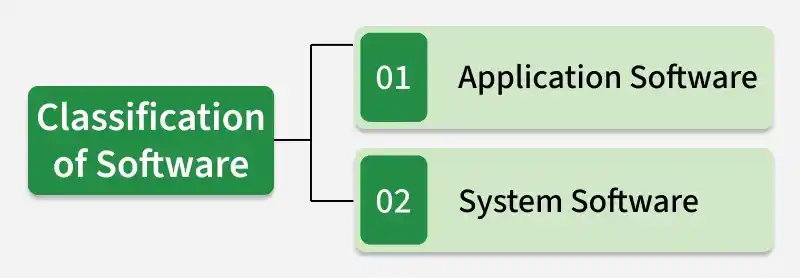
Classification of Software
1. System Software
System software is software that directly operates the computer hardware and provides the basic functionality to the users as well as to the other software to operate smoothly.
- System software basically controls a computer’s internal functioning and also controls hardware devices such as monitors, printers, and storage devices, etc.
- It is like an interface between hardware and user applications, it helps them to communicate with each other because hardware understands machine language(i.e. 1 or 0) whereas user applications are work in human-readable languages like English, Hindi, German, etc.
Features of System Software
- Closer to the computer system.
- Written in a low-level language in general.
- Difficult to design and understand.
- Fast in speed(working speed).
- Less interactive for the users in comparison to application software.
Types of System Software
- Operating System: It is the main program of a computer system. When the computer system is turned on, the operating system is the first software loaded into memory. Basically, it manages all the resources such as computer memory, CPU, printer, hard disk, etc., and provides an interface to the user, which helps the user to interact with the computer system.
- Programming Language Processor: As we know that system software converts the human-readable language into a machine language and vice versa. So, the conversion is done by the language processor. It converts programs written in high-level programming languages like Java, C, C++, Python, etc (known as source code), into sets of instructions that are easily readable by machines(known as object code or machine code).
- Device Driver: A device driver is a program or software that controls a device and helps that device to perform its functions. It enables the operating system to communicate with and control external hardware devices connected to the computer. Example: Printer, mouse, modem, etc.
- Utility Software: This type of application software is used to support the computer infrastructure. Utility software analyzes, configures, optimizes, and maintains the computer system to ensure efficient performance. Example: Antivirus, disk defragmenter, memory tester, disk repair, disk cleaners, registry cleaners, disk space analyzer, etc.
2. Application Software
Software that performs special functions or provides functions that are much more than the basic operation of the computer is known as application software.
- Application software is designed to perform a specific task for end-users. It is a product or a program that is designed only to fulfill end-users' requirements.
- Examples include word processors, spreadsheets, database management, inventory, payroll programs, etc.
Features of Application Software
- Perform more specialized tasks like word processing, spreadsheets, email, etc.
- Mostly, the size of the software is big, so it requires more storage space.
- More interactive for the users, so it is easy to use and design.
- Easy to design and understand.
- Written in a high-level language in general.
Types of Application Software
There are different types of application software and those are:
- General Purpose Software: This type of application software is used for a variety of tasks and it is not limited to performing a specific task only. For example, MS-Word, MS-Excel, PowerPoint, etc.
- Customized Software: This type of application software is used or designed to perform specific tasks or functions or designed for specific organizations. For example, railway reservation system, airline reservation system, invoice management system, etc.
