

Cyber security is the practice of protecting computers, networks and data from cyber threats and unauthorized access. As technology evolved, cyber attacks also became more advanced. Today, cyber security is essential for protecting businesses, governments and individuals in the digital world.
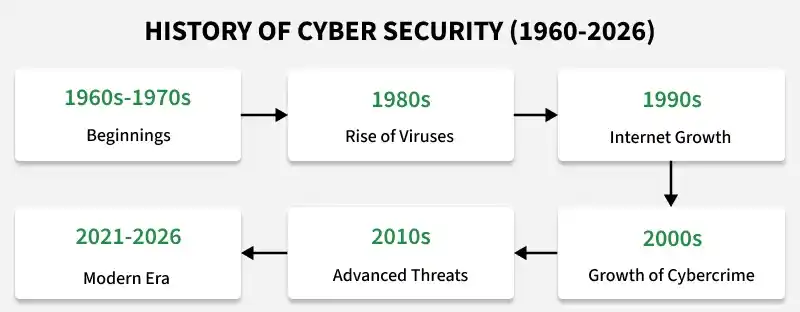
Beginning of Cyber Security (1960s-1970s)
The history of cyber security began in the 1960s when computers were mainly used by governments and research organizations. During this period, ARPANET, the early version of the internet, was developed.
- In 1971, a program called "Creeper" became one of the first self-replicating programs.
- "Reaper" was later created to remove it, becoming an early example of antivirus software.
- Basic security methods such as passwords and user authentication were introduced to protect computer systems.
Rise of Computer Viruses (1980s)
The 1980s saw the rise of personal computers and computer viruses. In 1986, the “Brain” virus spread through floppy disks and infected many systems worldwide. In 1988, the Morris Worm became one of the first major internet attacks, affecting thousands of computers. During this decade:
- Antivirus software became popular.
- Malware detection tools improved.
- Organizations started focusing on cyber protection.
Internet Growth and Security (1990s)
The internet expanded rapidly during the 1990s. As more people started using online services, cyber criminals developed attacks such as phishing, password theft and hacking. To improve protection, organizations introduced:
- Firewalls & Encryption technologies.
- SSL technology became important for securing online transactions and websites.
Growth of Cybercrime (2000-2010)
Between 2000 and 2010, cybercrime increased significantly. Attackers focused on financial fraud, identity theft, spyware and ransomware attacks. Mobile devices and wireless networks also created new security challenges during this period. Organizations improved their security through:
- Security awareness training.
- Regular software updates.
- Ethical hacking practices.
Advanced Cyber Security (2011-2020)
Cyber attacks became more advanced between 2011 and 2020. Hackers targeted businesses, healthcare systems and government organizations. Ransomware attacks became one of the biggest global cyber threats. The COVID-19 pandemic also increased cyber risks due to remote work and online services. Important developments included:
- Cloud security solutions.
- Multi-factor authentication (MFA).
- Threat intelligence systems.
- Artificial Intelligence in cyber security.
Cyber Security in 2021-2026
From 2021 to 2026, cyber security has become more important than ever. Organizations now face AI-powered attacks, advanced phishing campaigns and cloud security threats. Major trends in 2026 include:
- Artificial Intelligence in Security: AI helps detect threats, monitor networks and respond to attacks faster.
- Rise of Ransomware: Ransomware attacks continue targeting businesses, hospitals and educational institutions.
- Cloud Security: Companies use cloud security tools, Zero Trust models and encryption to protect online data.
- IoT Security: Smart devices and connected systems require stronger protection against cyber attacks.
- Cyber Security Awareness: Organizations train employees to recognize phishing emails, scams and social engineering attacks.
Future of Cyber Security
As technology continues to grow, cyber security will remain essential for protecting digital systems worldwide. The future of cyber security will focus on:
- AI-based security systems.
- Advanced encryption.
- Biometric authentication.
- Automated threat detection.
- Stronger cloud security.
