

Boolean Algebra is a branch of mathematics that deals with variables that have only two possible values — typically denoted as 0 and 1 (or false and true). It focuses on binary variables and logic operations such as AND, OR, and NOT.
- Boolean Algebra provides a formal way to represent and manipulate logical statements and binary operations.
- It is the mathematical foundation of digital electronics, computer logic, and programming conditions.
Logical Operations
• Negation or NOT Operation
• Conjunction or AND Operation
• Disjunction or OR Operation
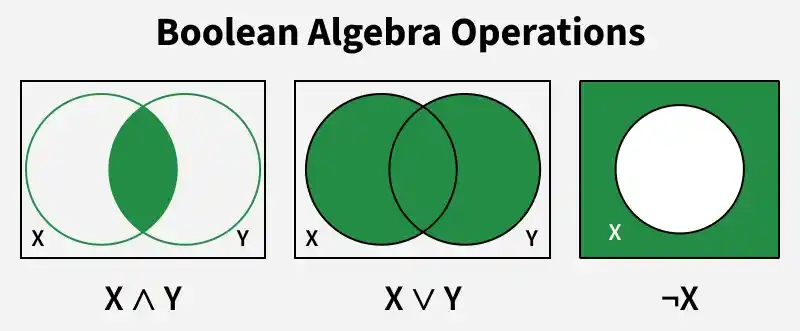
These operations have their own symbols and precedence, and the table below shows the symbols and precedence of these operators.
Operator | Symbol | Precedence |
|---|---|---|
NOT | ' (or) ⇁ | First |
AND | . (or) ∧ | Second |
OR | + (or) ∨ | Third |
We can easily define these operations using two Boolean variables.
Let's take two Boolean variables A and B that can have any of the two values 0 or 1, i.e., they can be either OFF or ON. Then these operations are explained as,
Negation or NOT Operation
Using the NOT operation reverse the value of the Boolean variable from 0 to 1 or vice-versa. This can be understood as:
- If A = 1, then using NOT operation we have (A)' = 0
- If A = 0, then using the NOT operation we have (A)' = 1
- We also represent the negation operation as ~A, i.e. if A = 1, ~A = 0
Conjunction or AND Operation
Using the AND operation satisfies the condition if both the values of the individual variables are true, and if any of the values is false, then this operation gives a negative result. This can be understood as,
- If A = True, B = True, then A . B = True
- If A = True, B = False, Or A = false, B = True, then A . B = False
- If A = False, B = False, then A . B = False
Disjunction (OR) Operation
Using the OR operation satisfies the condition if any value of the individual variables is true; it only gives a negative result if both the values are false. This can be understood as,
- If A = True, B = True, then A + B = True
- If A = True, B = False, Or A = false, B = True, then A + B = True
- If A = False, B = False, then A + B = False
Boolean Expression and Variables
Boolean expression is an expression that produces a Boolean value when evaluated, i.e., it produces either a true value or a false value. Whereas Boolean variables are variables that store Boolean numbers.
P + Q = R is a Boolean expression in which P, Q, and R are Boolean variables that can only store two values: 0 and 1.
Thus, we can say that statements using Boolean variables and operating on Boolean operations are Boolean Expressions. Some examples of Boolean expressions are,
- A + B = True
- A . B = True
- (A)' = False
Truth Tables
A truth table represents all the combinations of input values and outputs in a tabular manner. All the possibilities of the input and output are shown in it ,and hence the name truth table. In logic problems, truth tables are commonly used to represent various cases. T or 1 denotes 'True' & F or 0 denotes 'False' in the truth table.
Number of Rows in Truth Table = 2 n
- where n is the number of Boolean variables used.
Example: Draw the truth table of the conditions A + B and A . B ,where A and B are Boolean variables.
Solution:
The required Truth Table is
| A | B | X = A + B | Y = A . B |
|---|---|---|---|
| T | T | T | T |
| T | F | T | F |
| F | T | T | F |
| F | F | F | F |
Laws of Boolean Algebra
Boolean Algebra follows several important laws such as:
- Annulment Law
- Identity Law
- Idempotent Law
- Complement Law
- Double Negation Law
- Commutative Law
- Associative Law
- Distributive Law
- Absorption Law
- De Morgan's Law
These are used to simplify logical expressions and design efficient circuits.
Read more about - Properties of Boolean Algebra
Solved Examples on Boolean Algebra
Question 1: Draw a Truth Table for P + P . Q = P
Solution:
The truth table for P + P . Q = P
P Q P . Q P + P . Q T T T T T F F T F T F F F F F F In the truth table, we can see that the truth values for P + P.Q is exactly the same as P.
Question 2: Draw Truth Table for P . Q + P + Q
Solution:
The truth table for P . Q + P + Q
P Q P . Q P . Q + P + Q T T T T T F F T F T F T F F F F
Applications
- Logical Expression Simplification: Reduces complex logic expressions to minimize gates, power, and cost.
- Arithmetic Circuits: Helps design binary adders, subtractors, multipliers, and dividers.
- Memory Design: Used in flip-flops, latches, and registers for data storage and state control.
- Combinational & Sequential Circuit Design: Used to design and optimize circuits like multiplexers, decoders, and counters.
- Error Detection & Correction: Applied in parity checks and Hamming codes for data accuracy.
