

Backtracking is one of the most frequently tested problem-solving techniques in coding interviews because it systematically explores all possible solutions while eliminating invalid ones early. Interviewers often ask theoretical questions to evaluate whether candidates understand recursion, state-space search, pruning, and optimization.
- Covers the most commonly asked theoretical Backtracking interview questions.
- Explains core concepts with practical examples and interview-oriented answers.
Table of Content
Theoretical Interiew Question
1. What is Backtracking?
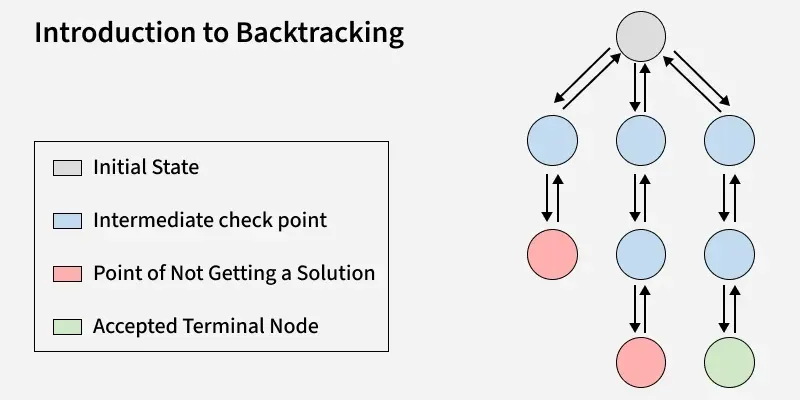
Backtracking is an algorithmic technique that builds a solution step by step and undoes previous choices whenever a choice cannot lead to a valid solution.
- Explores one possible solution at a time.
- Abandons invalid paths and tries alternatives.
- Uses recursion to explore all possibilities.
- Commonly used for constraint-based search problems.
2. When should Backtracking be used?
Backtracking should be used when a problem requires exploring multiple possible solutions and invalid choices can be discarded before completing the search.
- Problems involve searching all possible solutions.
- Choices can be validated at each step.
- Invalid paths can be pruned early.
- Commonly used for constraint satisfaction problems.
3. How does Backtracking differ from Brute Force?
Backtracking improves upon Brute Force by pruning invalid or unnecessary paths, whereas Brute Force explores every possible solution without considering whether a path can lead to the answer.
| Backtracking | Brute Force |
|---|---|
| Prunes invalid paths early. | Explores all possible solutions. |
| Avoids unnecessary computations. | Performs many redundant computations. |
| Usually faster for constrained problems. | Often has higher execution time. |
| Example: N-Queens, Sudoku Solver. | Example: Generating all possible combinations. |
4. How is Backtracking different from Dynamic Programming?
Backtracking explores different solution paths and abandons invalid ones, whereas Dynamic Programming solves overlapping subproblems and stores their results for reuse.
| Backtracking | Dynamic Programming |
|---|---|
| Explores possible choices recursively. | Solves overlapping subproblems. |
| Discards invalid paths during the search. | Stores and reuses computed results. |
| Used for search and constraint problems. | Used for optimization and counting problems. |
| Example: Sudoku, N-Queens. | Example: Knapsack, Longest Common Subsequence. |
5. What is the role of recursion in Backtracking?
Recursion is the foundation of Backtracking. It explores one choice at a time and returns to previous states whenever a choice cannot lead to a valid solution.
- Explores one possible solution recursively.
- Returns to previous states when needed.
- Tries alternative choices after backtracking.
- Continues until all valid solutions are explored.
6. What is a decision tree in Backtracking?
A decision tree is a conceptual representation of all possible choices made during a Backtracking algorithm. Each node represents a decision, and each path represents a possible solution.
- Each node represents a decision or state.
- Branches represent different possible choices.
- Leaf nodes represent complete or invalid solutions.
- Helps visualize the search process.
7. What is pruning in Backtracking?
Pruning is the process of discarding search paths that cannot lead to a valid or optimal solution, reducing unnecessary exploration.
- Eliminates invalid or unpromising paths early.
- Reduces the number of recursive calls.
- Improves the overall efficiency of the algorithm.
- Avoids exploring unnecessary solutions.
8. Why is Backtracking generally considered an exponential algorithm?
Backtracking is generally considered an exponential algorithm because it may need to explore many possible combinations or permutations before finding all valid solutions or determining that none exist.
- Explores multiple choices at each decision level.
- The number of possible paths grows rapidly.
- Pruning reduces the search but not the worst-case complexity.
- Worst-case time complexity is often O(2ⁿ) or O(n!).
9. What is the time complexity of Backtracking algorithms?
The time complexity of Backtracking algorithms is generally exponential because they may explore many possible solution paths. The exact complexity depends on the number of choices and the effectiveness of pruning.
- Typically exponential in the worst case.
- Common complexities are O(2ⁿ) or O(n!).
- Pruning can significantly reduce the search space.
10. What is the space complexity of Backtracking?
The space complexity of Backtracking is mainly determined by the maximum depth of the recursion stack. It depends on how many recursive calls are active at the same time.
- Depends on the recursion depth.
- Typically O(n) for most problems.
- Additional space may be needed to store the current solution.
11. What is the "Choose-Explore-Unchoose" pattern?
The Choose-Explore-Unchoose pattern is a common Backtracking approach where an algorithm makes a choice, explores its consequences, and then reverses the choice before trying the next option.
- Choose a possible option.
- Explore the remaining problem recursively.
- Unchoose (undo) the last decision.
- Repeat until all possibilities are explored.
12. What are some common problems solved using Backtracking?
Backtracking is commonly used for problems that require exploring multiple possible solutions while satisfying given constraints.
- N-Queens and Sudoku Solver.
- Rat in a Maze and Maze Path problems.
- Permutations and Combinations.
- Subset Sum and Graph Coloring.
13. How is Backtracking used in the N-Queens problem?
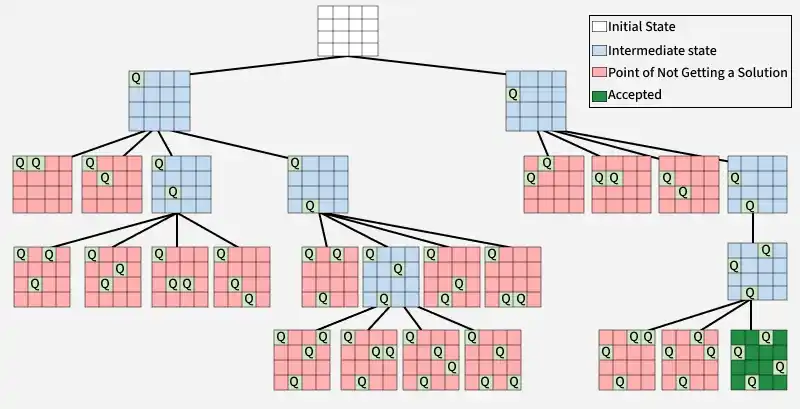
In the N-Queens problem, Backtracking places one queen at a time and checks whether the placement is safe. If a conflict occurs, it removes the queen and tries the next position.
- Places queens row by row.
- Checks rows, columns, and diagonals for conflicts.
- Backtracks when a safe position is not available.
- Continues until all valid arrangements are found.
14. How is Backtracking used to solve Sudoku?
Backtracking solves Sudoku by filling one empty cell at a time with a valid number. If no valid number can be placed, it backtracks and tries a different choice.
- Selects an empty cell.
- Tries all valid numbers for that cell.
- Backtracks when no valid choice exists.
- Repeats until the puzzle is completely solved.
15. What is the Hamiltonian Path problem, and how does Backtracking solve it?
A Hamiltonian Path is a path in a graph that visits every vertex exactly once. Backtracking explores different paths and abandons those that cannot lead to a valid Hamiltonian Path.
- Starts from a vertex and explores adjacent vertices.
- Marks each visited vertex to avoid revisiting.
- Backtracks when no valid next vertex exists.
- Continues until a valid path is found or all possibilities are exhausted.
16. Can Backtracking solve the Traveling Salesman Problem (TSP)?
Yes. Backtracking can solve the Traveling Salesman Problem (TSP) by exploring all possible tours and selecting the one with the minimum cost. However, it is practical only for small inputs due to its exponential time complexity.
- Explores all possible tours recursively.
- Discards invalid or non-promising paths when possible.
- Finds the minimum-cost tour.
- Inefficient for large graphs because of exponential complexity.
17. What is the difference between Backtracking and Branch and Bound?
The key difference is that Backtracking focuses on finding feasible solutions by discarding invalid paths, whereas Branch and Bound finds the optimal solution by pruning paths that cannot produce a better result.
| Backtracking | Branch and Bound |
|---|---|
| Searches for feasible solutions. | Searches for the optimal solution. |
| Prunes invalid paths. | Prunes paths using cost or bound values. |
| Commonly used for constraint satisfaction problems. | Commonly used for optimization problems. |
| Example: N-Queens, Sudoku. | Example: Traveling Salesman Problem, 0/1 Knapsack. |
18. How can Backtracking be optimized?
Backtracking can be optimized by reducing the number of paths explored and eliminating unnecessary computations.
- Use pruning to discard invalid paths early.
- Avoid repeated computations with memoization when applicable.
- Choose promising candidates first to reduce the search space.
- Apply problem-specific constraints to eliminate impossible choices early.
19. Can every recursive problem be solved using Backtracking?
No. Backtracking is suitable only for problems that involve making choices and exploring multiple possibilities. Not every recursive problem has these characteristics.
- Requires multiple possible choices at each step.
- Works well for search and constraint satisfaction problems.
- Simple recursive problems may not need backtracking.
- Some recursive problems are better solved using Dynamic Programming or Divide and Conquer.
20. How do you identify that a problem can be solved using Backtracking?
A problem is a good candidate for Backtracking if it involves exploring multiple possible solutions and invalid choices can be eliminated before reaching the final solution.
- The problem involves making a sequence of choices.
- Partial solutions can be validated at each step.
- Invalid paths can be pruned early.
- The goal is to find one or all valid solutions.
Coding Interview Questions on Backtracking
The following list of Backtracking coding problems covers a range of difficulty levels, from easy to hard, to help candidates prepare for interviews.
Easy Problems
Medium Problems
- N Queens Problem
- Word Break Problem
- Hamiltonian cycle
- Sudoku
- M Coloring Problem
- Cryptarithmetic puzzle
- Path of more than k length
- Partition into k subsets with equal sum
