

Given an adjacency matrix graph[][] of a weighted graph consisting of N nodes and positive weights, the task for each connected component of the graph is to find the maximum among all possible shortest distances between every pair of nodes.
Examples:
Input:
Output:
8 0 11
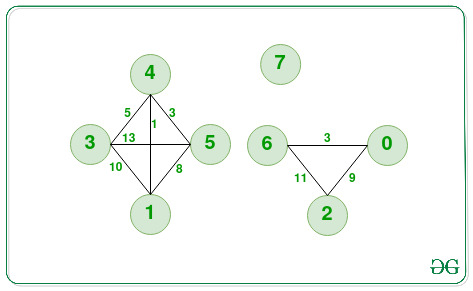
Explanation: There are three components in the graph namely a, b, c. In component (a) the shortest paths are following:
- The shortest distance between 3 and 4 is 5 units.
- The shortest distance between 3 and 1 is 1+5=6 units.
- The shortest distance between 3 and 5 is 5+3=8 units.
- The shortest distance between 1 and 4 is 1 unit.
- The shortest distance between 1 and 5 is 1+3=4 units.
- The shortest distance between 4 and 5 is 3 units.
Out of these shortest distances:
The maximum shortest distance in component (a) is 8 units between node 3 and node 5.
Similarly,
The maximum shortest distance in component (b) is 0 units.
The maximum shortest distance in component (c) is 11 units between nodes 2 and 6.Input:
Output:
7
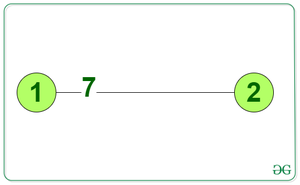
Explanation: Since, there is only one component with 2 nodes having an edge between them of distance 7. Therefore, the answer will be 7.
Approach: This given problem can be solved by finding the connected components in the graph using DFS and store the components in a list of lists. Floyd Warshall's Algorithm can be used to find all-pairs shortest paths in each connected component which is based on Dynamic Programming. After getting the shortest distances of all possible pairs in the graph, find the maximum shortest distances for each and every component in the graph. Follow the steps below to solve the problem:
- Define a function maxInThisComponent(vector<int> component, vector<vector<int>> graph) and perform the following steps:
- Initialize the variable maxDistance as INT_MIN and n as the size of the component.
- Iterate over the range [0, n) using the variable i and perform the following tasks:
- Iterate over the range [i+1, n) using the variable j and update the value of maxDistance as the maximum of maxDistance or graph[component[i]][component[j]].
- Return the value of maxDistance as the answer.
- Initialize a vector visited of size N and initialize the values as false.
- Initialize vectors, say components[][] and temp[] to store each component of the graph.
- Using Depth First Search(DFS) find all the components and store them in the vector components[][].
- Now, call the function floydWarshall(graph, V) to implement Floyd Warshall algorithm to find the shortest distance between all pairs of a component of a graph.
- Initialize a vector result[] to store the result.
- Initialize the variable numOfComp as the size of the vector components[][].
- Iterate over the range [0, numOfComp) using the variable i and call the function maxInThisComponent(components[i], graph) and store the value returned by it in the vector result[].
- After performing the above steps, print the values of the vector result[] as the answer.
Below is the implementation of the above approach:
// C++ program for the above approach
#include <bits/stdc++.h>
using namespace std;

// Below dfs function will be used to
// get the connected components of a
// graph and stores all the connected
// nodes in the vector component
void dfs(int src, vector<bool>& visited,
         vector<vector<int> >& graph,
         vector<int>& component, int N)
{

    // Mark this vertex as visited
    visited[src] = true;

    // Put this node in component vector
    component.push_back(src);

    // For all other vertices in graph
    for (int dest = 0; dest < N; dest++) {

        // If there is an edge between
        // src and dest i.e., the value
        // of graph[u][v]!=INT_MAX
        if (graph[src][dest] != INT_MAX) {

            // If we haven't visited dest
            // then recursively apply
            // dfs on dest
            if (!visited[dest])
                dfs(dest, visited, graph,
                    component, N);
        }
    }
}

// Below is the Floyd Warshall Algorithm
// which is based on Dynamic Programming
void floydWarshall(
    vector<vector<int> >& graph, int N)
{

    // For every vertex of graph find
    // the shortest distance with
    // other vertices
    for (int k = 0; k < N; k++) {
        for (int i = 0; i < N; i++) {
            for (int j = 0; j < N; j++) {

                // Taking care of integer
                // overflow
                if (graph[i][k] != INT_MAX
                    && graph[k][j] != INT_MAX) {

                    // Update distance between
                    // vertex i and j if choosing
                    // k as an intermediate vertex
                    // make a shorter distance
                    if (graph[i][k] + graph[k][j]
                        < graph[i][j])
                        graph[i][j]
                            = graph[i][k] + graph[k][j];
                }
            }
        }
    }
}

// Function to find the maximum shortest
// path distance in a component by checking
// the shortest distances between all
// possible pairs of nodes
int maxInThisComponent(vector<int>& component,
                       vector<vector<int> >& graph)
{
    int maxDistance = INT_MIN;
    int n = component.size();
    for (int i = 0; i < n; i++) {
        for (int j = i + 1; j < n; j++) {
            maxDistance
                = max(maxDistance,
                      graph[component[i]][component[j]]);
        }
    }

    // If the maxDistance is still INT_MIN
    // then return 0 because this component
    // has a single element
    return (maxDistance == INT_MIN
                ? 0
                : maxDistance);
}

// Below function uses above two method
// to get the  maximum shortest distances
// in each component of the graph the
// function returns a vector, where each
// element denotes maximum shortest path
// distance for a component
vector<int> maximumShortesDistances(
    vector<vector<int> >& graph, int N)
{

    // Find the connected components
    vector<bool> visited(N, false);
    vector<vector<int> > components;

    // For storing the nodes in a
    // particular component
    vector<int> temp;

    // Now for each unvisited node run
    // the dfs to get the connected
    // component having this unvisited node
    for (int i = 0; i < N; i++) {
        if (!visited[i]) {

            // First of all clear the temp
            temp.clear();
            dfs(i, visited, graph, temp, N);
            components.push_back(temp);
        }
    }

    // Now for all-pair find the shortest
    // path distances using Floyd Warshall
    floydWarshall(graph, N);

    // Now for each component find the
    // maximum shortest distance and
    // store it in result
    vector<int> result;
    int numOfComp = components.size();
    int maxDistance;
    for (int i = 0; i < numOfComp; i++) {
        maxDistance
            = maxInThisComponent(components[i], graph);
        result.push_back(maxDistance);
    }
    return result;
}

// Driver Code
int main()
{
    int N = 8;
    const int inf = INT_MAX;

    // Adjacency Matrix for the first
    // graph in the examples
    vector<vector<int> > graph1 = {
        { 0, inf, 9, inf, inf, inf, 3, inf },
        { inf, 0, inf, 10, 1, 8, inf, inf },
        { 9, inf, 0, inf, inf, inf, 11, inf },
        { inf, 10, inf, 0, 5, 13, inf, inf },
        { inf, 1, inf, 5, 0, 3, inf, inf },
        { 8, inf, inf, 13, 3, 0, inf, inf },
        { 3, inf, 11, inf, inf, inf, 0, inf },
        { inf, inf, inf, inf, inf, inf, inf, 0 },
    };

    // Find the maximum shortest distances
    vector<int> result1
        = maximumShortesDistances(graph1, N);

    // Printing the maximum shortest path
    // distances for each components
    for (int mx1 : result1)
        cout << mx1 << ' ';

    return 0;
}
// Java code for the above approach:

import java.util.*;

public class Main {
    static boolean[] visited;
    // For storing the connected components
    static ArrayList <ArrayList <Integer> > components;

    // Below dfs function will be used to
    // get the connected components of a
    // graph and stores all the connected
    // nodes in the vector component
    static void dfs(int[][] graph, ArrayList<Integer> temp,int src, int N)
    {
        // Mark this vertex as visited
        visited[src] = true;

        // Put this node in component vector
        temp.add(src);

        // For all other vertices in graph
        for (int dest = 0; dest < N; dest++) {

            // If there is an edge between
            // src and dest i.e., the value
            // of graph[u][v]!=Integer.MAX_VALUE
            if (graph[src][dest] != Integer.MAX_VALUE) {

                // If we haven't visited dest
                // then recursively apply
                // dfs on dest
                if (!visited[dest])
                    dfs(graph, temp, dest, N);
            }
        }
    }
    // Below is the Floyd Warshall Algorithm
    // which is based on Dynamic Programming
    static void floydWarshall(int[][] graph, int N)
    {
        // For every vertex of graph find
        // the shortest distance with
        // other vertices
        for (int k = 0; k < N; k++) {
            for (int i = 0; i < N; i++) {
                for (int j = 0; j < N; j++) {

                    // Taking care of integer
                    // overflow
                    if (graph[i][k] != Integer.MAX_VALUE
                        && graph[k][j] != Integer.MAX_VALUE) {

                        // Update distance between
                        // vertex i and j if choosing
                        // k as an intermediate vertex
                        // make a shorter distance
                        if (graph[i][k] + graph[k][j]
                            < graph[i][j])
                            graph[i][j] = graph[i][k] + graph[k][j];
                    }
                }
            }
        }
    }
    // Function to find the maximum shortest
    // path distance in a component by checking
    // the shortest distances between all
    // possible pairs of nodes
    static int maxInThisComponent(int[][] graph, ArrayList <Integer> component)
    {
        int maxDistance = Integer.MIN_VALUE;
        int n = component.size();
        for (int i = 0; i < n; i++) {
            for (int j = i + 1; j < n; j++) {
                maxDistance
                    = Math.max(maxDistance,
                        graph[component.get(i)][component.get(j)]);
            }
        }

        // If the maxDistance is still Integer.MIN_VALUE
        // then return 0 because this component
        // has a single element
        return (maxDistance == Integer.MIN_VALUE
                    ? 0
                    : maxDistance);
    }

    // Below function uses above two method
    // to get the  maximum shortest distances
    // in each component of the graph the
    // function returns a vector, where each
    // element denotes maximum shortest path
    // distance for a component
    static ArrayList <Integer> maximumShortesDistances(int[][] graph, int N)
    {
        visited = new boolean[N];
        Arrays.fill(visited, false);
        // Find the connected components
        components =  new ArrayList <ArrayList<Integer> > ();

        // Now for each unvisited node run
        // the dfs to get the connected
        // component having this unvisited node
        for (int i = 0; i < N; i++) {
            if (!visited[i] ) {

                // For storing the nodes in a
                // particular component
                ArrayList<Integer> temp = new ArrayList<Integer> ();
                dfs(graph, temp, i, N);
                components.add(temp);
            }
        }

        // Now for all-pair find the shortest
        // path distances using Floyd Warshall
        floydWarshall(graph, N);

        // Now for each component find the
        // maximum shortest distance and
        // store it in result
        ArrayList <Integer> result = new ArrayList <Integer> ();
        int numOfComp = components.size();

        int maxDistance;
        for (int i = 0; i < numOfComp; i++) {
            maxDistance
                = maxInThisComponent(graph, components.get(i));
            result.add(maxDistance);
        }
        return result;
    }

    // Driver Code
    public static void main(String args[]) {
        int N = 8;
        final int inf = Integer.MAX_VALUE;

        // Adjacency Matrix for the first
        // graph in the examples
        int[][] graph = {
            { 0, inf, 9, inf, inf, inf, 3, inf },
            { inf, 0, inf, 10, 1, 8, inf, inf },
            { 9, inf, 0, inf, inf, inf, 11, inf },
            { inf, 10, inf, 0, 5, 13, inf, inf },
            { inf, 1, inf, 5, 0, 3, inf, inf },
            { 8, inf, inf, 13, 3, 0, inf, inf },
            { 3, inf, 11, inf, inf, inf, 0, inf },
            { inf, inf, inf, inf, inf, inf, inf, 0 },
        };

        // Find the maximum shortest distances
        ArrayList <Integer> result1
            = maximumShortesDistances(graph, N);

        // Printing the maximum shortest path
        // distances for each components
        for (int mx1 : result1)
            System.out.print(mx1 + " ");

    }
}

// This code has been contributed by Sachin Sahara (sachin801)
## Python program for the above approach:

INT_MAX = 9223372036854775807
INT_MIN = -9223372036854775808

## Below dfs function will be used to
## get the connected components of a
## graph and stores all the connected
## nodes in the vector component
def dfs(src, visited, graph, component, N):

    ## Mark this vertex as visited
    visited[src] = True

    ## Put this node in component vector
    component.append(src);

    ## For all other vertices in graph
    for dest in range(0, N):

        ## If there is an edge between
        ## src and dest i.e., the value
        ## of graph[u][v]!=INT_MAX
        if (graph[src][dest] != INT_MAX):

            ## If we haven't visited dest
            ## then recursively apply
            ## dfs on dest
            if not visited[dest]:
                dfs(dest, visited, graph, component, N);

## Below is the Floyd Warshall Algorithm
## which is based on Dynamic Programming
def floydWarshall(graph, N):

    ## For every vertex of graph find
    ## the shortest distance with
    ## other vertices
    for k in range(0, N):
        for i in range(0, N):
            for j in range(0, N):

                ## Taking care of integer
                ## overflow
                if (graph[i][k] != INT_MAX and graph[k][j] != INT_MAX):

                    ## Update distance between
                    ## vertex i and j if choosing
                    ## k as an intermediate vertex
                    ## make a shorter distance
                    if (graph[i][k] + graph[k][j] < graph[i][j]):
                        graph[i][j] = graph[i][k] + graph[k][j];

## Function to find the maximum shortest
## path distance in a component by checking
## the shortest distances between all
## possible pairs of nodes
def maxInThisComponent(component, graph):
    maxDistance = INT_MIN;
    n = len(component);
    for i in range(0, n):
        for j in range(i+1, n):
            maxDistance = max(maxDistance, graph[component[i]][component[j]])

    ## If the maxDistance is still INT_MIN
    ## then return 0 because this component
    ## has a single element
    if maxDistance == INT_MIN:
        return 0
    return maxDistance

## Below function uses above two method
## to get the maximum shortest distances
## in each component of the graph the
## function returns a vector, where each
## element denotes maximum shortest path
## distance for a component
def maximumShortesDistances(graph, N):

    ## Find the connected components
    visited = []
    for i in range(0, N):
        visited.append(False)

    components = []


    ## Now for each unvisited node run
    ## the dfs to get the connected
    ## component having this unvisited node
    for i in range(0, N):
        if not visited[i]:

            ## For storing the nodes in a
            ## particular component
            temp = []
            dfs(i, visited, graph, temp, N)
            components.append(temp)

    ## Now for all-pair find the shortest
    ## path distances using Floyd Warshall
    floydWarshall(graph, N)

    ## Now for each component find the
    ## maximum shortest distance and
    ## store it in result
    result = []
    numOfComp = len(components)
    maxDistance = 0
    for i in range(0, numOfComp):
        maxDistance = maxInThisComponent(components[i], graph)
        result.append(maxDistance)
    return result

## Driver code
if __name__=='__main__':

    N = 8
    inf = INT_MAX;

    ## Adjacency Matrix for the first
    ## graph in the examples
    graph1 = [
        [ 0, inf, 9, inf, inf, inf, 3, inf ],
        [ inf, 0, inf, 10, 1, 8, inf, inf ],
        [ 9, inf, 0, inf, inf, inf, 11, inf ],
        [ inf, 10, inf, 0, 5, 13, inf, inf ],
        [ inf, 1, inf, 5, 0, 3, inf, inf ],
        [ 8, inf, inf, 13, 3, 0, inf, inf ],
        [ 3, inf, 11, inf, inf, inf, 0, inf ],
        [ inf, inf, inf, inf, inf, inf, inf, 0 ],
    ];

    ## Find the maximum shortest distances
    result1 = maximumShortesDistances(graph1, N);

    ## Printing the maximum shortest path
    ## distances for each components
    for mx1 in result1:
        print(mx1, end = " ")
    print("")

    # This code is contributed by subhamgoyal2014.
<script>
// Javascript program for the above approach

// Below dfs function will be used to
// get the connected components of a
// graph and stores all the connected
// nodes in the vector component
function dfs(src, visited, graph, component, N)
{

  // Mark this vertex as visited
  visited[src] = true;

  // Put this node in component vector
  component.push(src);

  // For all other vertices in graph
  for (let dest = 0; dest < N; dest++)
  {

    // If there is an edge between
    // src and dest i.e., the value
    // of graph[u][v]!=INT_MAX
    if (graph[src][dest] != Number.MAX_SAFE_INTEGER)
    {

      // If we haven't visited dest
      // then recursively apply
      // dfs on dest
      if (!visited[dest]) dfs(dest, visited, graph, component, N);
    }
  }
}

// Below is the Floyd Warshall Algorithm
// which is based on Dynamic Programming
function floydWarshall(graph, N)
{

  // For every vertex of graph find
  // the shortest distance with
  // other vertices
  for (let k = 0; k < N; k++)
  {
    for (let i = 0; i < N; i++)
    {
      for (let j = 0; j < N; j++)
      {
        // Taking care of integer
        // overflow
        if (graph[i][k] != Number.MAX_SAFE_INTEGER && graph[k][j] != Number.MAX_SAFE_INTEGER)
        {

          // Update distance between
          // vertex i and j if choosing
          // k as an intermediate vertex
          // make a shorter distance
          if (graph[i][k] + graph[k][j] < graph[i][j])
            graph[i][j] = graph[i][k] + graph[k][j];
        }
      }
    }
  }
}

// Function to find the maximum shortest
// path distance in a component by checking
// the shortest distances between all
// possible pairs of nodes
function maxInThisComponent(component, graph) {
  let maxDistance = Number.MIN_SAFE_INTEGER;
  let n = component.length;
  for (let i = 0; i < n; i++) {
    for (let j = i + 1; j < n; j++) {
      maxDistance = Math.max(maxDistance, graph[component[i]][component[j]]);
    }
  }

  // If the maxDistance is still INT_MIN
  // then return 0 because this component
  // has a single element
  return maxDistance == Number.MIN_SAFE_INTEGER ? 0 : maxDistance;
}

// Below function uses above two method
// to get the  maximum shortest distances
// in each component of the graph the
// function returns a vector, where each
// element denotes maximum shortest path
// distance for a component
function maximumShortesDistances(graph, N) {
  // Find the connected components
  let visited = new Array(N).fill(false);
  let components = new Array();

  // For storing the nodes in a
  // particular component
  let temp = [];

  // Now for each unvisited node run
  // the dfs to get the connected
  // component having this unvisited node
  for (let i = 0; i < N; i++) {
    if (!visited[i]) {
      // First of all clear the temp
      temp = [];
      dfs(i, visited, graph, temp, N);
      components.push(temp);
    }
  }

  // Now for all-pair find the shortest
  // path distances using Floyd Warshall
  floydWarshall(graph, N);

  // Now for each component find the
  // maximum shortest distance and
  // store it in result
  let result = [];
  let numOfComp = components.length;
  let maxDistance;
  for (let i = 0; i < numOfComp; i++) {
    maxDistance = maxInThisComponent(components[i], graph);
    result.push(maxDistance);
  }
  return result;
}

// Driver Code

let N = 8;
const inf = Number.MAX_SAFE_INTEGER;

// Adjacency Matrix for the first
// graph in the examples
let graph1 = [
  [0, inf, 9, inf, inf, inf, 3, inf],
  [inf, 0, inf, 10, 1, 8, inf, inf],
  [9, inf, 0, inf, inf, inf, 11, inf],
  [inf, 10, inf, 0, 5, 13, inf, inf],
  [inf, 1, inf, 5, 0, 3, inf, inf],
  [8, inf, inf, 13, 3, 0, inf, inf],
  [3, inf, 11, inf, inf, inf, 0, inf],
  [inf, inf, inf, inf, inf, inf, inf, 0],
];

// Find the maximum shortest distances
let result1 = maximumShortesDistances(graph1, N);

// Printing the maximum shortest path
// distances for each components
for (mx1 of result1) document.write(mx1 + " ");

// This code is contributed by gfgking.
</script>
using System;
using System.Collections.Generic;

public class Graph {
    public int N;
    public int[, ] graph;
    public bool[] visited;
    public List<int> component;

    public Graph(int N)
    {
        this.N = N;
        graph = new int[N, N];
        visited = new bool[N];
        component = new List<int>();
    }

    public void dfs(int src)
    {
        visited[src] = true;
        component.Add(src);

        for (int dest = 0; dest < N; dest++) {
            if (graph[src, dest] != Int32.MaxValue
                && !visited[dest])
                dfs(dest);
        }
    }

    public void floydWarshall()
    {
        for (int k = 0; k < N; k++)
            for (int i = 0; i < N; i++)
                for (int j = 0; j < N; j++)
                    if (graph[i, k] != Int32.MaxValue
                        && graph[k, j] != Int32.MaxValue)
                        if (graph[i, k] + graph[k, j]
                            < graph[i, j])
                            graph[i, j]
                                = graph[i, k] + graph[k, j];
    }

    public int maxInThisComponent(List<int> component)
    {
        int maxDistance = Int32.MinValue;
        int n = component.Count;

        for (int i = 0; i < n; i++)
            for (int j = i + 1; j < n; j++)
                maxDistance = Math.Max(
                    maxDistance,
                    graph[component[i], component[j]]);

        return maxDistance == Int32.MinValue ? 0
                                             : maxDistance;
    }
    public List<int> maximumShortesDistances()
    {
        List<List<int> > components
            = new List<List<int> >();
        List<int> temp = new List<int>();

        for (int i = 0; i < N; i++) {
            if (!visited[i]) {
                temp.Clear();
                dfs(i);
                components.Add(new List<int>(component));
                component.Clear();
            }
        }

        floydWarshall();

        List<int> result = new List<int>();
        int numOfComp = components.Count;
        int maxDistance;

        for (int i = 0; i < numOfComp; i++) {
            maxDistance = maxInThisComponent(components[i]);
            result.Add(maxDistance);
        }

        return result;
    }
}

class Program {
    static void Main(string[] args)
    {
        int N = 8;
        int inf = int.MaxValue;

        // Adjacency Matrix for the first graph in the
        // examples
        int[, ] graph1 = new int[, ] {
            { 0, inf, 9, inf, inf, inf, 3, inf },
            { inf, 0, inf, 10, 1, 8, inf, inf },
            { 9, inf, 0, inf, inf, inf, 11, inf },
            { inf, 10, inf, 0, 5, 13, inf, inf },
            { inf, 1, inf, 5, 0, 3, inf, inf },
            { 8, inf, inf, 13, 3, 0, inf, inf },
            { 3, inf, 11, inf, inf, inf, 0, inf },
            { inf, inf, inf, inf, inf, inf, inf, 0 },
        };

        Graph g = new Graph(N);
        g.graph = graph1;

        // Find the maximum shortest distances
        List<int> result1 = g.maximumShortesDistances();

        // Printing the maximum shortest path distances for
        // each component
        foreach(int mx1 in result1)
        {
            Console.Write(mx1 + " ");
        }
    }
}
Output
11 8 0
Time Complexity: O(N3), where N is the number of vertices in the graph.
Auxiliary Space: O(N)
