

We have seen different ways of performing postorder traversal on Binary Trees.
- Post Order Traversal.
- Iterative Postorder Traversal using Two Stacks.
- Iterative Postorder Traversal using One Stack.
Here is another way of performing the postorder traversal on a Binary Tree iteratively using a single stack.
Using Single Stack with Two Fields - O(n) Time and O(n) Space
Consider the Below Terminologies for an extra field in the stack.
0 - Left element
1 - Right element
2 - Node element
Following is the detailed algorithm:
Take a Stack and perform the below operations:
1) Insert a pair of the root node as (node, 0).
2) Pop the top element to get the pair
(Let a = node and b be the variable)
If b is equal to 0:
Push another pair as (node, 1) and
Push the left child as (node->left, 0)
Repeat Step 2
Else If b is equal to 1:
Push another pair as (node, 2) and
Push right child of node as (node->right, 0)
Repeat Step 2
Else If b is equal to 2:
Print(node->data)
3) Repeat the above steps while stack is not empty
Consider the Below Binary Tree with just 3 nodes:
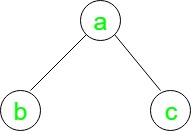
Illustration:
1) Push(a, 0)
Stack - (a, 0)
2) top = (a, 0)
Push(a, 1)
Push(b, 0)
Stack - (b, 0)
(a, 1)
3) top = (b, 0)
Push(b, 1)
Stack - (b, 1)
(a, 1)
4) top = (b, 1)
Push(b, 2)
Stack - (b, 2)
(a, 1)
5) top = (b, 2)
print(b)
Stack -(a, 1)
6) top = (a, 1)
push(a, 2)
push(c, 0)
Stack - (c, 0)
(a, 2)
7) top = (c, 0)
push(c, 1)
Stack - (c, 1)
(a, 2)
8) top = (c, 1)
push(c, 2)
Stack - (c, 2)
(a, 2)
9) top = (c, 2)
print(c)
Stack - (a, 2)
10) top = (a, 2)
print(a)
Stack - empty()
Below is the implementation of the above approach:
// C++ program for iterative postorder traversal
// using one stack with states
#include <bits/stdc++.h>

using namespace std;

class Node {
public:
    int data;
    Node* left;
    Node* right;

    Node(int x) {
        data = x;
        left = right = nullptr;
    }
};

// Function for iterative post-order traversal
// using a single stack
vector<int> postOrder(Node* root) {
    vector<int> result;
    if (root == nullptr) {
        return result;
    }

    // Stack to store pairs of (Node, state)
    stack<pair<Node*, int>> stk;
    stk.push({root, 0});

    while (!stk.empty()) {

        // Get the top element of the stack
        pair<Node*, int>& topElement = stk.top();
        Node* node = topElement.first;
        int& state = topElement.second;

        if (state == 0) {

            // State 0: Push left child and move to it
            stk.top().second = 1;
            if (node->left) {
                stk.push({node->left, 0});
            }
        } else if (state == 1) {

            // State 1: Push right child and move to it
            stk.top().second = 2;
            if (node->right) {
                stk.push({node->right, 0});
            }
        } else {

            // State 2: Process the node
            result.push_back(node->data);
            stk.pop();
        }
    }

    return result;
}

void printArray(vector<int>& arr) {
    for (int data : arr) {
        cout << data << " ";
    }
    cout << endl;
}

int main() {

    // Representation of input binary tree:
    //           1
    //          / \
    //         2   3
    //            / \
    //           4   5
    Node* root = new Node(1);
    root->left = new Node(2);
    root->right = new Node(3);
    root->right->left = new Node(4);
    root->right->right = new Node(5);

    vector<int> result = postOrder(root);

    printArray(result);

    return 0;
}
// Java program for iterative postorder traversal
// using one stack with states
import java.util.*;

class Node {
    int data;
    Node left, right;

    Node(int x) {
        data = x;
        left = right = null;
    }
}

public class GfG {

    // Function for iterative post-order traversal
   // using a single stack
    public static ArrayList<Integer> postOrder(Node root) {
        ArrayList<Integer> result = new ArrayList<>();
        if (root == null) {
            return result;
        }

        // Stack to store pairs of (Node, state)
        Stack<Pair> stk = new Stack<>();
        stk.push(new Pair(root, 0));

        while (!stk.isEmpty()) {

            // Get the top element of the stack
            Pair topElement = stk.peek();
            Node node = topElement.node;
            int state = topElement.state;

            if (state == 0) {

                // State 0: Push left child and move to it
                stk.peek().state = 1;
                if (node.left != null) {
                    stk.push(new Pair(node.left, 0));
                }
            }
            else if (state == 1) {

                // State 1: Push right child and move to it
                stk.peek().state = 2;
                if (node.right != null) {
                    stk.push(new Pair(node.right, 0));
                }
            }
            else {

                // State 2: Process the node
                result.add(node.data);
                stk.pop();
            }
        }

        return result;
    }

    static class Pair {
        Node node;
        int state;

        Pair(Node node, int state) {
            this.node = node;
            this.state = state;
        }
    }

    public static void printList(List<Integer> arr) {
        for (int data : arr) {
            System.out.print(data + " ");
        }
        System.out.println();
    }

    public static void main(String[] args) {

        // Representation of input binary tree:
        //           1
        //          / \
        //         2   3
        //            / \
        //           4   5
        Node root = new Node(1);
        root.left = new Node(2);
        root.right = new Node(3);
        root.right.left = new Node(4);
        root.right.right = new Node(5);

        List<Integer> result = postOrder(root);
        printList(result);
    }
}
# Python program for iterative postorder traversal
# using one stack with states
class Node:
    def __init__(self, x):
        self.data = x
        self.left = None
        self.right = None

# Function for iterative post-order traversal
# using a single stack
def postOrder(root):
    result = []
    if root is None:
        return result

    # Stack to store tuples of (Node, state)
    stk = []
    stk.append((root, 0))

    while stk:

        # Get the top element of the stack
        node, state = stk[-1]

        if state == 0:

            # State 0: Push left child and move to it
            stk[-1] = (node, 1)
            if node.left:
                stk.append((node.left, 0))
        elif state == 1:

            # State 1: Push right child and move to it
            stk[-1] = (node, 2)
            if node.right:
                stk.append((node.right, 0))
        else:

            # State 2: Process the node
            result.append(node.data)
            stk.pop()

    return result

def printList(arr):
    print(" ".join(map(str, arr)))

if __name__ == "__main__":

    # Representation of input binary tree:
    #           1
    #          / \
    #         2   3
    #            / \
    #           4   5
    root = Node(1)
    root.left = Node(2)
    root.right = Node(3)
    root.right.left = Node(4)
    root.right.right = Node(5)

    result = postOrder(root)
    printList(result)
// C# program for iterative postorder traversal
// using one stack with states
using System;
using System.Collections.Generic;

class Node {
    public int data;
    public Node left, right;

    public Node(int x) {
        data = x;
        left = right = null;
    }
}

class GfG {

    // Function for iterative post-order
    // traversal using a single stack
    public static List<int> PostOrder(Node root) {
        List<int> result = new List<int>();
        if (root == null) {
            return result;
        }

        // Stack to store tuples of (Node, state)
        Stack<(Node, int)> stk = new Stack<(Node, int)>();
        stk.Push((root, 0));

        while (stk.Count > 0) {

            // Get the top element of the stack
            var (node, state) = stk.Peek();

            if (state == 0) {

                // State 0: Push left child and move to it
                stk.Pop();
                stk.Push((node, 1));
                if (node.left != null) {
                    stk.Push((node.left, 0));
                }
            }
            else if (state == 1) {

                // State 1: Push right child and move to it
                stk.Pop();
                stk.Push((node, 2));
                if (node.right != null) {
                    stk.Push((node.right, 0));
                }
            }
            else {

                // State 2: Process the node
                result.Add(node.data);
                stk.Pop();
            }
        }

        return result;
    }

    public static void PrintList(List<int> arr) {
        foreach (int data in arr) {
            Console.Write(data + " ");
        }
        Console.WriteLine();
    }

    static void Main() {

        // Representation of input binary tree:
        //           1
        //          / \
        //         2   3
        //            / \
        //           4   5
        Node root = new Node(1);
        root.left = new Node(2);
        root.right = new Node(3);
        root.right.left = new Node(4);
        root.right.right = new Node(5);

        List<int> result = PostOrder(root);
        PrintList(result);
    }
}
// JavaScript program for iterative postorder traversal
// using one stack with states (using tuple-like array)
class Node {
    constructor(data) {
        this.data = data;
        this.left = null;
        this.right = null;
    }
}

// Function for iterative post-order traversal
// using a single stack
function postOrder(root) {
    let result = [];
    if (root === null) {
        return result;
    }

    // Stack to store tuples of [Node, state]
    let stk = [];
    stk.push([root, 0]);

    while (stk.length > 0) {

        // Get the top element of the stack
        let [node, state] = stk[stk.length - 1];

        if (state === 0) {

            // State 0: Push left child and move to it
            stk[stk.length - 1][1] = 1;
            if (node.left !== null) {
                stk.push([node.left, 0]);
            }
        }
        else if (state === 1) {

            // State 1: Push right child and move to it
            stk[stk.length - 1][1] = 2;
            if (node.right !== null) {
                stk.push([node.right, 0]);
            }
        }
        else {

            // State 2: Process the node
            result.push(node.data);
            stk.pop();
        }
    }

    return result;
}

// Helper function to print the result list
function printList(arr) {
    console.log(arr.join(' '));
}

// Representation of input binary tree:
//           1
//          / \
//         2   3
//            / \
//           4   5
let root = new Node(1);
root.left = new Node(2);
root.right = new Node(3);
root.right.left = new Node(4);
root.right.right = new Node(5);

let result = postOrder(root);
printList(result);
Output
4 5 2 3 1
Time Complexity: O(n), since each node is visited exactly once, where n is the number of nodes in the tree.
Auxiliary Space: O(n), due to the stack storing tuple for each node, where n is the number of nodes in the tree.
