

Given two integers L and B representing the length and breadth of a rectangle, the task is to find the maximum number of largest possible circles that can be inscribed in the given rectangle without overlapping.
Examples:
Input: L = 3, B = 8
Output: 2
Explanation: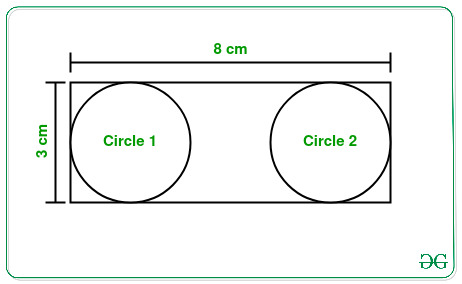
From the above figure it can be clearly seen that the largest circle with a diameter of 3 cm can be inscribed in the given rectangle.
Therefore, the count of such circles is 2.Input: L = 2, B = 9
Output: 4

Approach: The given problem can be solved based on the following observations:
- The largest circle that can be inscribed in a rectangle will have diameter equal to the smaller side of the rectangle.
- Therefore, the maximum number of such largest circles possible is equal to ( Length of the largest side ) / ( Length of the smallest side ).
Therefore, from the above observation, simply print the value of ( Length of the largest side ) / ( Length of the smallest side ) as the required result.
Below is the implementation of the above approach:
// C++ program for the above approach

#include <bits/stdc++.h>
using namespace std;

// Function to count the number of
// largest circles in a rectangle
int totalCircles(int L, int B)
{
    // If length exceeds breadth
    if (L > B) {

        // Swap to reduce length
        // to smaller than breadth
        int temp = L;
        L = B;
        B = temp;
    }

    // Return total count
    // of circles inscribed
    return B / L;
}

// Driver Code
int main()
{
    int L = 3;
    int B = 8;
    cout << totalCircles(L, B);

    return 0;
}
// Java program for the above approach
import java.io.*;
import java.util.*;
class GFG
{

  // Function to count the number of
  // largest circles in a rectangle
  static int totalCircles(int L, int B)
  {
    // If length exceeds breadth
    if (L > B) {

      // Swap to reduce length
      // to smaller than breadth
      int temp = L;
      L = B;
      B = temp;
    }

    // Return total count
    // of circles inscribed
    return B / L;
  }

  // Driver Code
  public static void main(String[] args)
  {
    int L = 3;
    int B = 8;
    System.out.print(totalCircles(L, B));
  }
}

// This code is contributed by susmitakundugoaldanga.
# Python3 program for the above approach

# Function to count the number of
# largest circles in a rectangle
def totalCircles(L, B) :

    # If length exceeds breadth
    if (L > B) :

        # Swap to reduce length
        # to smaller than breadth
        temp = L
        L = B
        B = temp

    # Return total count
    # of circles inscribed
    return B // L

# Driver Code
L = 3
B = 8
print(totalCircles(L, B))

# This code is contributed by splevel62.
// C# program to implement
// the above approach
using System;
public class GFG
{

  // Function to count the number of
  // largest circles in a rectangle
  static int totalCircles(int L, int B)
  {
    // If length exceeds breadth
    if (L > B) {

      // Swap to reduce length
      // to smaller than breadth
      int temp = L;
      L = B;
      B = temp;
    }

    // Return total count
    // of circles inscribed
    return B / L;
  }


  // Driver Code
  public static void Main(String[] args)
  {
    int L = 3;
    int B = 8;
    Console.Write(totalCircles(L, B));
  }
}

// This code is contributed by souravghosh0416.
<script>

// javascript program to implement
// the above approach


  // Function to count the number of
  // largest circles in a rectangle

  function  totalCircles( L,  B)
  {
    // If length exceeds breadth
    if (L > B) {

      // Swap to reduce length
      // to smaller than breadth

      var temp = L;
      L = B;
      B = temp;
    }

    // Return total count
    // of circles inscribed
    return B / L;
  }


  // Driver Code

    var L = 3;
    var B = 8;
    document.write(totalCircles(L, B).toString().split('.')[0]);


</script>
Output:
2
Time Complexity: O(1)
Auxiliary Space: O(1)
