

A deque (double-ended queue) is a linear data structure that supports insertion and deletion from both ends. These interview questions cover the key deque concepts commonly asked in technical interviews.
- Covers the most frequently asked deque interview questions with concise explanations.
- Suitable for both freshers and experienced professionals preparing for technical interviews.
Theoretical Questions for Interviews
1. What is a deque?
A deque (double-ended queue) is a linear data structure that allows insertion and deletion of elements from both the front and the rear. It combines the flexibility of both stacks and queues.
- Supports insertion and deletion at both ends in O(1) time.
- Can be used as both a queue (FIFO) and a stack (LIFO).

2. Why is a deque used?
A deque is used when an application requires efficient insertion and deletion of elements from both ends of a sequence.
- Allows constant-time insertion and deletion at both the front and rear.
- Eliminates the need to shift elements when modifying either end.
3. What are the applications of a deque?
A deque is used in applications that require efficient insertion and deletion of elements from both ends.
- Sliding Window Problems: Maintains the maximum or minimum element within a moving window.
- Task Scheduling: Supports processing tasks from either end based on priority.
- Undo/Redo Operations: Stores previous and future states efficiently.
- Palindrome Checking: Compares characters from both ends of a sequence.
- Breadth-First Search (BFS): Used in algorithms such as 0-1 BFS.
4. What are the main operations of a deque?
A deque supports insertion, deletion, and element access from both the front and the rear.
- Insert Front: Adds an element at the front of the deque.
- Insert Rear: Adds an element at the rear of the deque.
- Delete Front: Removes the front element.
- Delete Rear: Removes the rear element.
- Front/Rear: Returns the front or rear element without removing it.
- isEmpty: Checks whether the deque contains any elements.
- Size: Returns the number of elements currently stored in the deque.
5. How is a deque implemented?
A deque can be implemented using different underlying data structures depending on the required performance and use case.
- Array-based deque: Can use a fixed-size or dynamic array. Circular indexing is often used to optimize operations at both ends.
- Linked List-based deque: Uses a doubly linked list, allowing O(1) insertion and deletion at both ends.
- Library based deque: Built-in implementations handle resizing and memory management internally.
6. What is the time complexity of deque operations?
The time complexity of deque operations depends on the underlying implementation, but most standard implementations support constant-time operations at both ends.
| Operation | Time Complexity |
|---|---|
| Insert Front | O(1) |
| Insert Rear | O(1) |
| Delete Front | O(1) |
| Delete Rear | O(1) |
| Front/Rear Access | O(1) |
| Search | O(n) |
7. How does a deque differ from a queue?
Both queues and deques follow sequential data access, but a deque provides greater flexibility by allowing operations at both ends.
| Feature | Queue | Deque |
|---|---|---|
| Insertion | Rear only | Front and rear |
| Deletion | Front only | Front and rear |
| Principle | FIFO | FIFO or LIFO |
| Flexibility | Limited | More flexible |
| Applications | Scheduling, BFS | Sliding window, undo operations, 0-1 BFS |
- A queue restricts insertion and deletion to specific ends.
- A deque allows insertion and deletion from both the front and the rear.
8. How does a deque differ from a stack?
A stack allows operations at only one end, whereas a deque supports insertion and deletion at both the front and the rear.
| Feature | Stack | Deque |
|---|---|---|
| Insertion | Top only | Front and rear |
| Deletion | Top only | Front and rear |
| Principle | LIFO | FIFO or LIFO |
| Flexibility | Limited | More flexible |
| Applications | Function calls, undo operations | Sliding window, task scheduling, caching |
- A stack is designed for Last In, First Out (LIFO) operations.
- A deque can function as both a stack and a queue depending on how it is used.
9. What is the difference between a deque and a doubly linked list?
A deque is an abstract data structure that defines operations, while a doubly linked list is a data structure that can be used to implement a deque.
| Feature | Deque | Doubly Linked List |
|---|---|---|
| Type | Abstract Data Structure (ADT) | Linear Data Structure |
| Purpose | Supports insertion and deletion at both ends | Stores nodes connected by previous and next pointers |
| Implementation | Can use arrays or linked lists | Uses linked nodes only |
| Random Access | Supported in array-based implementations | Not supported |
| Memory Usage | Depends on implementation | Requires extra memory for pointers |
- A deque defines how elements can be accessed and modified.
- A doubly linked list is one possible implementation of a deque.
10. What is a circular deque?
A circular deque is a deque in which the front and rear positions wrap around the ends of a fixed-size array, allowing efficient use of available space.
- Uses a circular array to avoid unused slots after deletions.
- Supports O(1) insertion and deletion at both the front and rear.
- Commonly used in fixed-size buffers and memory-efficient queue implementations.
11. What is a monotonic queue, and how is it implemented using a deque?
A monotonic queue is a specialized data structure that maintains its elements in either increasing or decreasing order. It is typically implemented using a deque to support efficient insertion and deletion from both ends.
- Maintains elements in monotonic (increasing or decreasing) order.
- Removes elements that violate the required order during insertion.
- Commonly used to solve sliding window minimum and maximum problems.
- Processes each element at most twice, resulting in O(n) time complexity for sliding window algorithms.
12. How is a monotonic deque used in sliding window problems?
A monotonic deque efficiently maintains the maximum or minimum element of the current sliding window by keeping elements in a specific order.
- Removes elements that are no longer part of the current window.
- Discards smaller (or larger) elements that cannot become the window's max/ min.
- Solves sliding window maximum and minimum problems in O(n) time.
13. How would you check whether a string is a palindrome using a deque?
A deque can be used to check whether a string is a palindrome by comparing characters from both ends until the deque becomes empty or only one character remains.
- Insert all characters of the string into the deque.
- Repeatedly compare and remove the front and rear characters.
- If all corresponding characters match, the string is a palindrome; otherwise, it is not.
#include <deque>
#include <iostream>
using namespace std;

bool isPalindrome(string str) {
    deque<char> dq(str.begin(), str.end());

    while (dq.size() > 1) {
        if (dq.front() != dq.back())
            return false;

        dq.pop_front();
        dq.pop_back();
    }

    return true;
}

int main() {
    string str = "level";

    if (isPalindrome(str))
        cout << "Palindrome";
    else
        cout << "Not Palindrome";

    return 0;
}
#include <stdio.h>
#include <string.h>

int isPalindrome(char str[]) {
    int front = 0;
    int rear = strlen(str) - 1;

    while (front < rear) {
        if (str[front] != str[rear])
            return 0;

        front++;
        rear--;
    }

    return 1;
}

int main() {
    char str[] = "level";

    if (isPalindrome(str))
        printf("Palindrome");
    else
        printf("Not Palindrome");

    return 0;
}
import java.util.ArrayDeque;

public class Main {

    static boolean isPalindrome(String str) {
        ArrayDeque<Character> deque = new ArrayDeque<>();

        for (char ch : str.toCharArray())
            deque.addLast(ch);

        while (deque.size() > 1) {
            if (!deque.removeFirst().equals(deque.removeLast()))
                return false;
        }

        return true;
    }

    public static void main(String[] args) {
        String str = "level";

        if (isPalindrome(str))
            System.out.println("Palindrome");
        else
            System.out.println("Not Palindrome");
    }
}
Output
Palindrome
14. What are the different types of deques?
Deques can be classified based on the operations they support and their implementation or usage.
Based on Supported Operations
- General Deque: Allows insertion and deletion at both the front and the rear.
- Input-Restricted Deque: Allows insertion at only one end but deletion from both ends.
- Output-Restricted Deque: Allows deletion from only one end but insertion from both ends.
Based on Implementation or Usage
- Circular Deque: Uses a circular buffer to efficiently utilize fixed-size memory.
- Monotonic Deque: Maintains elements in increasing or decreasing order for efficient sliding window operations.
15. What are the advantages and disadvantages of a deque?
A deque offers greater flexibility than stacks and queues, but this flexibility comes with certain trade-offs.
Advantages
- Provides efficient access and updates from both ends of the sequence.
- Adapts to a wide variety of algorithms without changing the underlying data structure.
- Eliminates the need to maintain separate stack and queue implementations.
Disadvantages
- Has a more complex implementation than a simple stack or queue.
- May incur additional memory overhead depending on the implementation.
- Is less suitable when operations are required only at a single end.
16. How can a deque be reversed?
A deque can be reversed by repeatedly swapping elements from the front and the rear until the two pointers meet.
- Swap the front and rear elements while moving towards the center.
- Continue the process until all corresponding elements are exchanged.
- Alternatively, copy the elements into another deque in reverse order.
#include <deque>
#include <iostream>
#include <algorithm>
using namespace std;

int main() {
    deque<int> dq = {1, 2, 3, 4, 5};

    reverse(dq.begin(), dq.end());

    for (int x : dq)
        cout << x << " ";

    return 0;
}
#include <stdio.h>

void reverse(int arr[], int n) {
    int left = 0, right = n - 1;

    while (left < right) {
        int temp = arr[left];
        arr[left] = arr[right];
        arr[right] = temp;
        left++;
        right--;
    }
}

int main() {
    int deque[] = {1, 2, 3, 4, 5};
    int n = sizeof(deque) / sizeof(deque[0]);

    reverse(deque, n);

    for (int i = 0; i < n; i++)
        printf("%d ", deque[i]);

    return 0;
}
import java.util.ArrayDeque;
import java.util.Collections;
import java.util.ArrayList;

public class Main {
    public static void main(String[] args) {
        ArrayDeque<Integer> deque = new ArrayDeque<>();

        deque.add(1);
        deque.add(2);
        deque.add(3);
        deque.add(4);
        deque.add(5);

        ArrayList<Integer> list = new ArrayList<>(deque);
        Collections.reverse(list);

        for (int x : list)
            System.out.print(x + " ");
    }
}
Output
5 4 3 2 1
Note: Unlike C++'s std::deque, Java's ArrayDeque does not provide a built-in reverse() method, so the elements are copied to a list and then reversed using Collections.reverse().
17. How do you implement a deque using an array?
A deque can be implemented using a circular array, where two pointers (front and rear) keep track of the first and last elements.
- Store elements in a circular array.
- Update the front and rear indices using modular arithmetic.
- Detect overflow when the deque is full and underflow when it is empty.
#include <deque>
#include <iostream>
using namespace std;

int main() {
    deque<int> dq;

    dq.push_back(10);
    dq.push_back(20);
    dq.push_front(5);

    for (int x : dq)
        cout << x << " ";

    return 0;
}
#include <stdio.h>

#define SIZE 5

int deque[SIZE];
int front = -1, rear = -1;

int main() {
    // Insert at rear
    front = rear = 0;
    deque[rear] = 10;

    rear = (rear + 1) % SIZE;
    deque[rear] = 20;

    // Insert at front
    front = (front - 1 + SIZE) % SIZE;
    deque[front] = 5;

    printf("%d %d %d", deque[front], deque[(front + 1) % SIZE], deque[rear]);

    return 0;
}
import java.util.ArrayDeque;

public class Main {
    public static void main(String[] args) {
        ArrayDeque<Integer> dq = new ArrayDeque<>();

        dq.offerLast(10);
        dq.offerLast(20);
        dq.offerFirst(5);

        System.out.println(dq);
    }
}
Output
5 10 20
18. How do you implement a deque using a doubly linked list?
A deque can be implemented using a doubly linked list, where each node stores pointers to both the previous and next nodes. The front points to the first node, and the rear points to the last node.
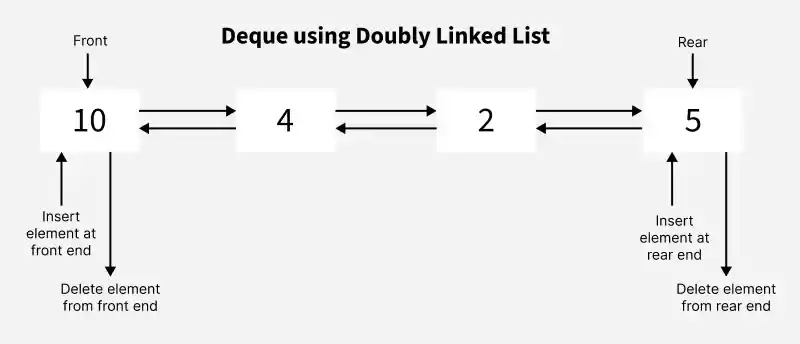
- Insert and delete nodes at both the front and rear.
- Update the front and rear pointers after each operation.
- No shifting of elements is required.
#include <deque>
#include <iostream>
using namespace std;

int main() {
    deque<int> dq;

    dq.push_front(10);
    dq.push_back(20);
    dq.push_front(5);

    dq.pop_back();

    for (int x : dq)
        cout << x << " ";

    return 0;
}
#include <stdio.h>
#include <stdlib.h>

struct Node {
    int data;
    struct Node *prev, *next;
};

int main() {
    struct Node *front = NULL, *rear = NULL;

    // Insert first node
    front = rear = (struct Node*)malloc(sizeof(struct Node));
    front->data = 10;
    front->prev = front->next = NULL;

    // Insert at rear
    struct Node *temp = (struct Node*)malloc(sizeof(struct Node));
    temp->data = 20;
    temp->next = NULL;
    temp->prev = rear;
    rear->next = temp;
    rear = temp;

    printf("%d %d", front->data, rear->data);

    return 0;
}
import java.util.LinkedList;

public class Main {
    public static void main(String[] args) {
        LinkedList<Integer> deque = new LinkedList<>();

        deque.addFirst(10);
        deque.addLast(20);

        System.out.println(deque.getFirst() + " " + deque.getLast());
    }
}
Output
5 10
19. What is an input-restricted deque?
An input-restricted deque is a type of deque in which insertion is allowed at only one end, while deletion can be performed from both ends.
- Insertion is restricted to a single end.
- Deletion is allowed from both the front and the rear.
- Useful when controlled insertion with flexible removal is required.
20. What is an output-restricted deque?
An output-restricted deque is a type of deque in which deletion is allowed at only one end, while insertion can be performed from both ends.
- Insertion is allowed at both the front and the rear.
- Deletion is restricted to a single end.
- Useful when flexible insertion with controlled removal is required.
Coading Problems for Interviews
Below is a list of top deque related coding problems ranging from easy to hard, commonly asked in software development engineer (SDE) interviews.
- Circular Array Implementation of Deque
- Implementation of Deque using doubly linked list
- Stack and Queue Implementation using Deque
- Reverse First K Elements of a Queue
- First Negative in Every Window of Size K
- Maximum of all subarrays of size K
- Sum of Min & Max in All Subarrays of Size K
- Maximum score possible
- Longest subarray with at most k difference
- 0-1 BFS
- Longest Subarray with Max Pair Difference ≤ X
- Minimize the Max difference between adjacent
- Bitonic Sequence from a given range
- Queue with Minimum
