

A set A together with a partial order relation R is called a Partially Ordered Set (POSET), denoted by (A, R) or (A, ≤).
POSET works on the principle of a partial ordering relation. A relation R is said to be a partial order relation when it can satisfy the following properties:
- R is reflexive, i.e., if set A = {1, 2, 3}, then R = {(1, 1), (2, 2), (3, 3)} is a reflexive relation.
- R is anti-symmetric, i.e., if R contains (1, 2), then (2, 1) is not allowed.
- R is transitive, i.e., if R contains (1, 2) and (2, 3), then it should contain (1, 3) to make it transitive.
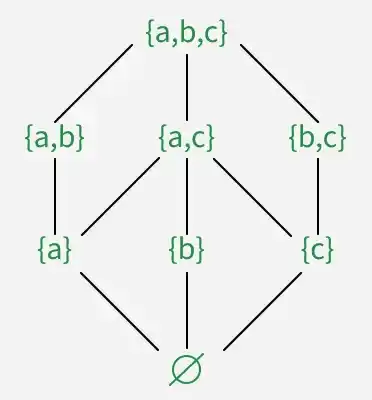
In a POSET, not every pair of elements needs to be comparable, making it a versatile tool for representing hierarchical relationships and dependencies.
In a POSET, different types of elements help describe the structure and ordering of the set. These elements identify the smallest, largest, and boundary elements within the partial order and are useful for analyzing Hasse diagrams, lattices, and ordered relationships. The most commonly used elements in a POSET are:
1. Maximal Element
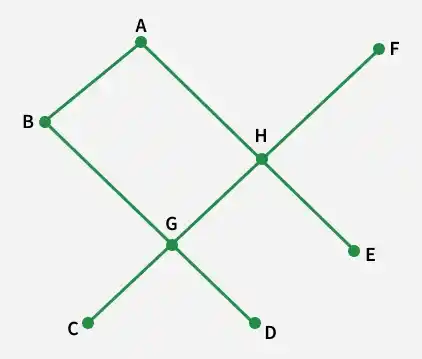
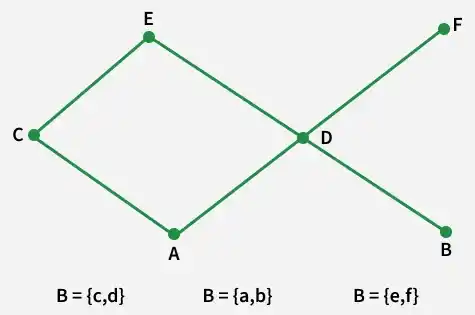
If in a POSET/Lattice, an element is not related to any other element. Or, it is an element with no outgoing (upward) edge. In the above diagram, A, B, and F are Maximal elements.
2. Minimal Element
If in a POSET/Lattice, no element is related to an element. Or, in simple words, it is an element with no incoming (downward) edge. In the above diagram, C, D, and E are Minimal elements.
3. Maximum Element (Greatest)
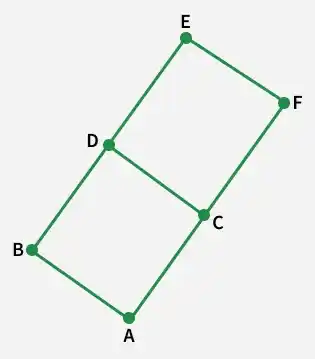
If in a POSET/Lattice, it is a Maximal element, and every element is related to it, i.e., every element of the lattice should be connected to this element. In the above diagram, E and F are Maximal elements, but E is the only Maximum element.
4. Minimum Element (Least)
If in a POSET/Lattice, it is a Minimal element and is related to every other element, i.e., it should be connected to every element of the lattice. In the above diagram, A and B are Minimal elements, but A is the only Minimum element.
Note:
- Every Maximum element is a Maximal element but every Maximal element is not a Maximum element.
- Every Minimum element is a Minimal element but every Minimal element is not a Minimum element.
5. Upper Bound
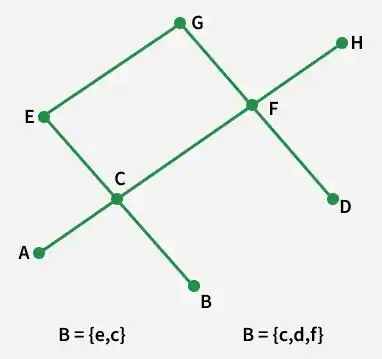
Let's assume B is a subset of set A. An element x ∈ A is in the upper bound of B if (y, x) ∈ POSET, where ∀ y ∈ B. Or we can say that it is an element to which every element of a subset is related.
- B = {E, C}: Upper Bound- {G, E} (E can itself be an upper bound because Partial order follows Reflexive property)
- B = {C, F, D}: Upper Bound- {G, H, F}
6. Lower Bound
If B is a subset of set A, an element x ∈ A is in the lower bound of B if (x, y) ∈ POSET, where ∀ y ∈ B. Or we can say that it is an element that is related /connected to every element of subset B.
- B = {E, C}: Lower Bound- {A, B, C} ( C can itself be a lower bound because Partial order follows Reflexive property)
- B = {C, F, D}: Lower Bound- { ∅ }
7. Least Upper Bound
Least Upper Bound of a subset S within a POSET is the smallest element in the set that is greater than or equal to every element of S. It is also known as the Join. The Minimum (Least) element in Upper Bound.
- B = {C, D} : Least Upper Bound- { E }
- B = {A, B} : Least Upper Bound- { D }
- B = {E, F} : Least Upper Bound- { ∅ }
8. Greatest Lower Bound
Greatest Lower Bound of a subset SSS in a POSET is the largest element in the set that is less than or equal to every element of S. It is also known as Meet. The Maximum (Greatest) element in the Lower Bound.
- B = {C, D} : Least Upper Bound- { A }
- B = {A, B} : Least Upper Bound- { ∅ }
- B = {E, F} : Least Upper Bound- { D }
➢Practice: Solved Examples
