

In the study of algebraic structures, group isomorphisms and automorphisms play a fundamental role. By defining internal symmetries inside a group (automorphisms) and when two groups have the same structure (isomorphisms), these ideas aid in our understanding of the structure and symmetry of groups.
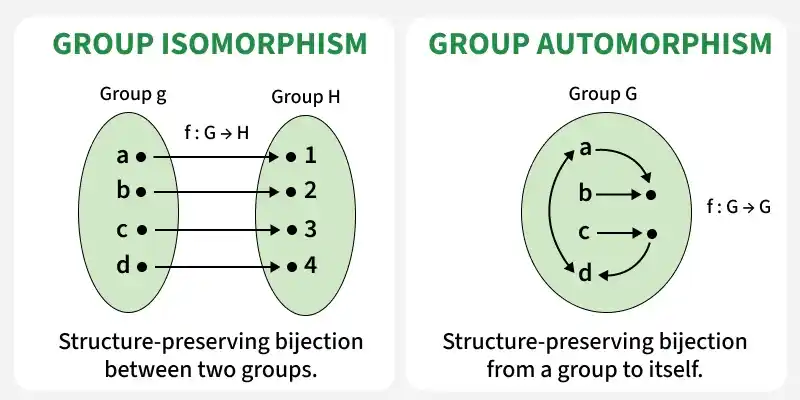
Group Isomorphism
For two groups (G,+) and (G',*), a mapping f: G → G' is called an isomorphism if
- f is one-one
- f is onto
- f is homomorphism i.e. f(a + b) = f(a) * f(b) ∀ a, b ∈ G.
Thus, an isomorphism is a bijective homomorphism.
If there exists an isomorphism from group (G,+) to (G',*). Then a group (G,+) is called isomorphic to a group (G',*). It is written as G ≅ G'.
Isomorphic groups may have different elements or operations, but they have the same algebraic structure.
Properties
- Bijectiveness: An isomorphism is both injective (one-to-one) and surjective (onto), which makes it a bijection.
- Preservation of Structure: Group operations are preserved by isomorphisms, which means that the target group's operation is the image of the original group's operation under the isomorphism i.e., f(a+b)=f(a) * f(b)
Example: f(x) = log(x) for groups (R+, *) and (R, +) is a group isomorphism.
- f(x) = f(y) → log(x) = log(y) => x = y , so f is one-one.
- x = ey ∈ R+ such that f(x) = log(ey) = y, hence, f is surjective.
- f(x*y) = log(x*y) = log(x)+log(y) = f(x)+f(y) , so f is a homomorphism.
NOTE:
- If there is a Homomorphism f form groups (G,*) to (H,+) . Then f is also a Isomorphism if and only if Ker(f) = {e}. Here e is the identity of (G,*). Also, Ker(f) = Kernel of a homeomorphism f :(G,*) → (H,+) is a set of all the elements in G such that an image of all these elements in H is the identity element e' of (H,+) .
- If two groups are isomorphic, then both will be abelians or both will not be.
- A set of isomorphic group form an equivalence class and they have identical structure and said to be abstractly identical.
Group Automorphism
For a group (G,+), a mapping f : G → G is called automorphism if
- f is one-one.
- f homomorphic i.e. f(a +b) = f(a) + f(b) ∀ a, b ∈ G.
Properties
- Identity Automorphism: The identity mapping Ig: G → G, defined by Ig(g)=g ,g∀g ∈ G is an automorphism.
- Inverse Automorphisms: Every automorphism has an inverse which is also an automorphism.
- Composition: The composition of two automorphisms is also an automorphism.
Example: For any group (G,+) an identity mapping Ig: G → G, such that Ig(g)=g , ∀g ∈ G is an automorphism.
- I(a) = I(b) => a= b so I is one-one.
- I(a+b) = a+b = I(a) + I(b), so I is also a homomorphism.
Hence, it is automorphism
NOTE:
- A set of all the automorphisms( functions ) of a group, with a composite of functions as binary operations forms a group.
- Simply, an isomorphism is also called automorphism if both domain and range are equal.
- If f is an automorphism of group (G,+), then (G,+) is an Abelian group.
- Automorphism can be divided into inner and outer automorphism.
Relationship Between Isomorphisms and Automorphisms
| Isomorphism | Automorphism |
|---|---|
| Maps one group to another group | Maps a group to itself |
| Preserves group structure | Preserves group structure |
| Bijective homomorphism | Special case of isomorphism |
| Written as (G ≅ H) | Written as (f:G → G) |
➢Practice: Solved Examples
