

Rules of inference are logical patterns used to derive valid conclusions from given premises.
- They form the foundation of formal reasoning in mathematics, logic, and artificial intelligence by ensuring each step in a proof is logically correct.
- They are mainly divided into two categories: propositional logic and predicate logic
For Propositional Logic
These rules operate on propositions (statements that are either true or false).
They work on whole propositions using logical connectives like AND (∧), OR (∨), NOT (¬), and implication, ensuring each reasoning step is logically valid.
1. Modus Ponens (Law of Detachment)
If a conditional statement is true and its condition is satisfied, the conclusion must be true.
Form: If p → q and p, then q.
Example:
- Premise: If it rains, the ground will be wet.
- Premise: It is raining.
- Conclusion: The ground is wet.
2. Modus Tollens (Law of Contrapositive)
If a conditional statement is true, and its consequent is false, then its antecedent must also be false.
Form: If p → q and ¬q, then ¬p.
Example:
- Premise: If it rains, the ground will be wet.
- Premise: The ground is not wet.
- Conclusion: It is not raining.
3. Hypothetical Syllogism
If two conditional statements are true, where the consequent of the first is the antecedent of the second, then a third conditional statement combining the antecedent of the first and the consequent of the second is also true.
Form: If p → q and q → r, then p → r.
Example:
- Premise: If it rains, the ground will be wet.
- Premise: If the ground is wet, the plants will grow.
- Conclusion: If it rains, the plants will grow.
4. Disjunctive Syllogism
If a disjunction (an "or" statement) is true, and one of the disjuncts (the parts of the "or" statement) is false, then the other disjunct must be true.
Form: If p ∨ q and ¬p, then q.
Example:
- Premise: It is either raining or sunny.
- Premise: It is not raining.
- Conclusion: It is sunny.
5. Conjunction
If two statements are true, then their conjunction (an "and" statement) is also true.
Form: If p and q, then p ∧ q.
Example:
- Premise: It is raining.
- Premise: It is windy.
- Conclusion: It is raining and windy.
6. Simplification
If a conjunction (an "and" statement) is true, then each of its conjuncts is also true.
Form: If p ∧ q, then p
Example:
- Premise: It is raining and windy.
- Conclusion: It is raining.
7. Addition
If a statement is true, then the disjunction (an "or" statement) of that statement with any other statement is also true.
Form: If p, then p ∨ q
Example:
- Premise: It is raining.
- Conclusion: It is raining or sunny.
8. Absorption(Abs)
If a conditional statement (an "if-then" statement) is true, then the antecedent implies a conjunction of itself and the consequent.
Form: If P→Q, then P→(P∧Q)
Example:
- Premise: If it is raining, then the ground is wet.
- Conclusion: If it is raining, then it is raining and the ground is wet.
9. Resolution
If two disjunctions ("or" statements) are true, and one contains a proposition (P) while the other contains its negation (¬P), then the disjunction of the remaining parts is true.
Form:If P∨Q and ¬P∨R, then Q∨R.
Example: It is raining or snowing and not raining or cold, so it is snowing or cold.
| Rule of Inference | Tautology | Meaning |
|---|---|---|
| Modus Ponens | (p ∧ (p → q)) → q | If p is true and p implies q, then q is true |
| Modus Tollens | (¬q ∧ (p → q)) → ¬p | If q is false and p implies q, then p is false |
| Hypothetical Syllogism | ((p → q) ∧ (q → r)) → (p → r) | If p leads to q and q leads to r, then p leads to r |
| Disjunctive Syllogism | ((p ∨ q) ∧ ¬p) → q | If one option is false, the other is true |
| Conjunction | (p ∧ q) → (p ∧ q) | If p and q are true, they can be combined |
| Simplification | (p ∧ q) → p | From a pair, one part is true |
| Addition | p → (p ∨ q) | A true statement can be extended with OR |
| Absorption | (p → q) → (p → (p ∧ q)) | A rule can be strengthened by including itself |
| Resolution | ((p ∨ q) ∧ (¬p ∨ r)) → (q ∨ r) | Eliminates contradiction to combine results |
For Predicate Logic
Predicate logic uses all the propositional rules above, plus additional rules for handling quantifiers.
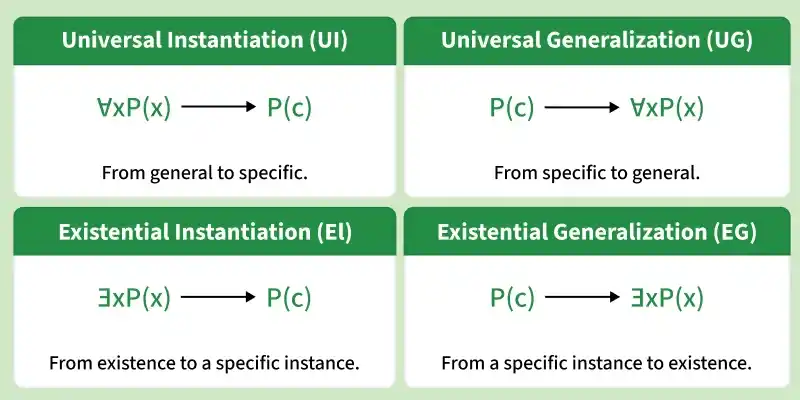
These rules help derive valid conclusions from statements containing variables, predicates, and quantifiers.
1. Universal Instantiation
If a statement is true for all objects in a domain, it is true for any specific object.
Form: ∀x P(x) ⟹ P(c)
Example: If all humans are mortal, then Socrates is mortal.
2. Universal Generalization
If a property holds for an arbitrary object, it holds for all objects.
Form: P(c) ⟹ ∀x P(x)
Example: If a randomly chosen number is even, then all numbers are even (under a given proof condition).
3. Existential Instantiation
If something exists in a domain, we can assign a name to it.
Form: ∃x P(x) ⟹ P(c)
Example: If there exists a student who passed, then we can call that student “A”.
4. Existential Generalization
If a property holds for a specific object, then something exists with that property.
Form: P(c) ⟹ ∃x P(x)
Example: If Ram is intelligent, then there exists someone who is intelligent.
Rule of Inference | Form | Meaning |
|---|---|---|
Universal instantiation | ∀xP(x) ⇒ P(c) | If something is true for all x, it is true for a particular case c |
Universal generalization | P(c) ⇒ ∀x P(x) | If something is true for any arbitrary element, it’s true for all. |
Existential instantiation | ∃xP(x) ⇒ P(c) | If something exists, we can give it a name (c). |
Existential generalization | P(c)⇒ ∃x P(x) | If something is true for a particular c, it’s true for “some x”. |
