

The binary number system is a number system that uses only two digits: 0 and 1. It is also called the base-2 number system.
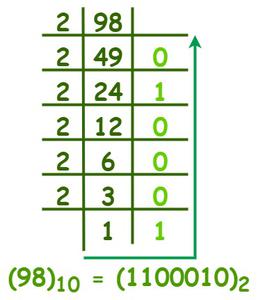
Example 1: Convert the Decimal Number (98)10 into Binary.
Solution:
Thus, Binary Number for (98)10 is equal to (1100010)2
Example 2: Convert the Binary Number (1010101)2 to a decimal Number.
Solution:
Given Binary Number, (1010101)2
= (1 × 20) + (0 × 21) + (1 × 22) + (0 × 23) + (1 × 24) + (0 × 25) + (1 ×26)
= 1 + 0 + 4 + 0 + 16 + 0 + 64
= (85)10Thus, Binary Number (1010101)2 is equal to (85)10 in decimal system.
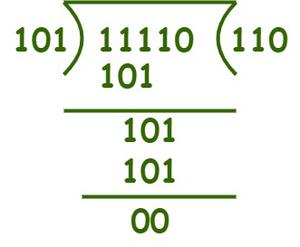
Example 3: Divide (11110)2 by (101)2.
Solution:
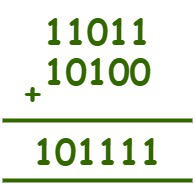
Example 4: Add (11011)2 and (10100)2.
Solution:
Hence, (11011)2 + (10100)2 = (101111)2
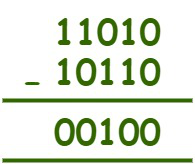
Example 5: Subtract (11010)2 and (10110)2.
Solution:
Hence, (11010)2 - (10110)2 = (00100)2
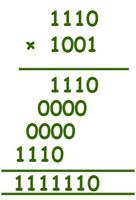
Example 6: Multiply (1110)2 and (1001)2.
Solution:
Thus, (1110)2 × (1001)2 = (1111110)2
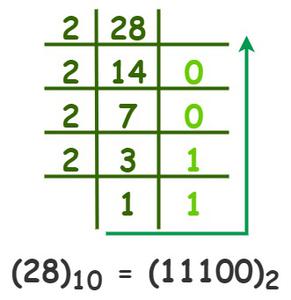
Example 7: Convert (28)10 into a binary number.
Solution:
Hence, (28)10 is expressed as (11100)2.
Example 8: Convert (10011)2 to a decimal number.
Solution:
The given binary number is (10011)2.
(10011)2 = (1 × 24) + (0 × 23) + (0 × 22) + (1 × 21) + (1 × 20)
= 16 + 0 + 0 + 2 + 1 = (19)10
Hence, the binary number (10011)2 is expressed as (19)10.
Practice Problems
Question 1. Convert the decimal number (98)₁₀ into binary.
Question 2. Divide the binary number (11110)₂ by (101)₂
Question 3. Find the 2's complement of the binary number (1011)₂.
Question 4. Multiply the binary numbers (1110)₂ and (1001)₂.
Question 5. Subtract the binary numbers (11010)₂ and (10110)₂.
Question 6. Add the binary numbers (11011)₂ and (10100)₂.
Answer:-
1. (1100010)2, 2. (110)2, 3. (0101)2, 4. (1111110)2, 5. (00100)2, 6. (101111)2
