

Question 1. Let ∆ ABC ~ ∆ DEF and their areas be, respectively, 64 cm2 and 121 cm2. If EF = 15.4 cm, find BC.
Solution:
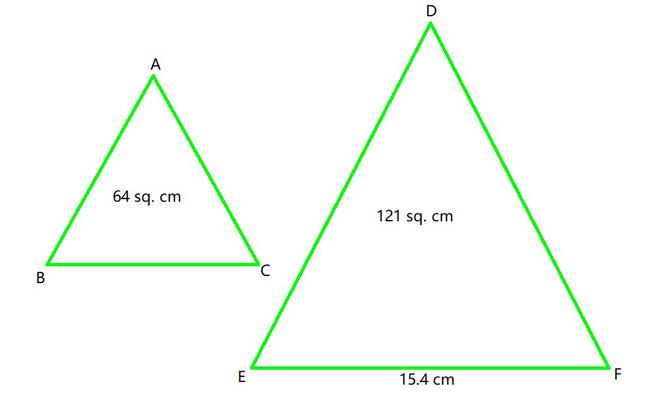
According to the theorem 1, we get
\frac{ar(ΔABC)}{ar(ΔDEF)} = \frac{AB^2}{DE^2} = \frac{AC^2}{DF^2} = \frac{BC^2}{EF^2}
\frac{ar(ΔABC)}{ar(ΔDEF)} = \frac{BC^2}{EF^2}
\frac{64}{121} = \frac{BC^2}{15.4^2}
\frac{8^2}{11^2} = \frac{BC^2}{15.4^2}
\frac{8}{11} = \frac{BC}{15.4} BC =
\frac{8}{11} × 15.4BC = 11.2 cm
Question 2. Diagonals of a trapezium ABCD with AB || DC intersect each other at the point O. If AB = 2 CD, find the ratio of the areas of triangles AOB and COD.
Solution:
Given, ABCD is a trapezium with AB || DC. Diagonals AC and BD intersect each other at point O.
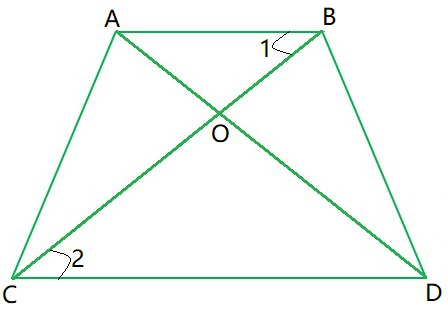
In △AOB and △COD,
∠ AOB = ∠ COD (Opposite angles)
∠ 1 = ∠ 2 (Alternate angles of parallel lines)
△AOB ~ △COD by AA property.
According to the theorem 1, we get
\frac{ar(ΔAOB)}{ar(ΔCOD)} = \frac{AB^2}{CD^2} As, AB = 2CD
=
\frac{(2CD)^2}{CD^2} =
\frac{4CD^2}{CD^2} =
\frac{4}{1} ar(AOB) : ar(COD) = 4 : 1
Question 3. In Figure, ABC and DBC are two triangles on the same base BC. If AD intersects BC at O, show that \frac{ar(ΔABC)}{ar(ΔDBC)} = \frac{AO}{DO} .
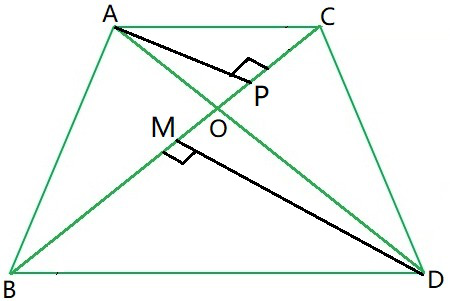
Solution:
Let's draw two perpendiculars AP and DM on line BC.
Area of triangle = ½ × Base × Height
\frac{ar(ΔABC)}{ar(ΔDBC)} = \frac{½ × BC × AP}{½ × BC × DM}
\frac{ar(ΔABC)}{ar(ΔDBC)} = \frac{AP}{DM} .................................(1)In ΔAPO and ΔDMO,
∠APO = ∠DMO (Each 90°)
∠AOP = ∠DOM (Vertically opposite angles)
ΔAPO ~ ΔDMO by AA similarity
\frac{AP}{DM} = \frac{AO}{DO} .................................(2)From (1) and (2), we can conclude that
\mathbf{\frac{ar(ΔABC)}{ar(ΔDBC)} = \frac{AO}{DO}}
Question 4. If the areas of two similar triangles are equal, prove that they are congruent.
Solution:
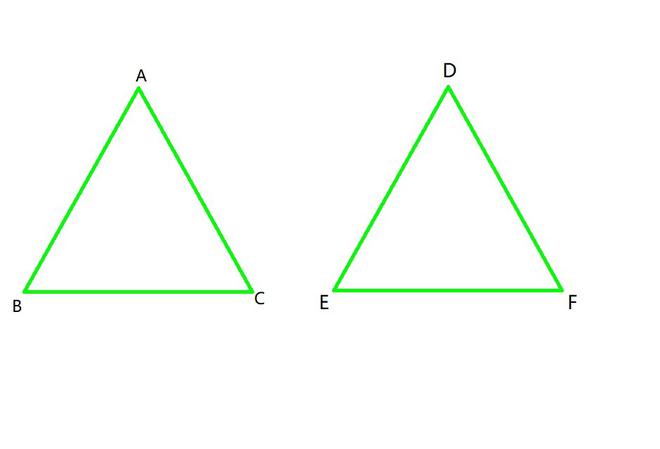
As it is given, ΔABC ~ ΔDEF
According to the theorem 1, we have
\frac{Area of (ΔABC)}{Area of (ΔDEF)} = \frac{BC^2}{EF^2}
\frac{BC^2}{EF^2} =1 [Since, Area(ΔABC) = Area(ΔDEF)BC2 = EF2
BC = EF
Similarly, we can prove that
AB = DE and AC = DF
Thus, ΔABC ≅ ΔPQR [SSS criterion of congruence]
Question 5. D, E and F are respectively the mid-points of sides AB, BC, and CA of ∆ ABC. Find the ratio of the areas of ∆ DEF and ∆ ABC.
Solution:
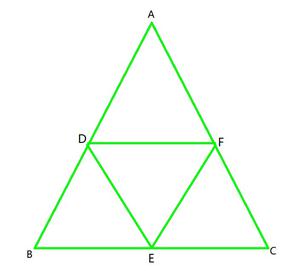
As, it is given here
DF = ½ BC
DE = ½ AC
EF = ½ AB
So,
\frac{DF}{BC} = \frac{DE}{AC} = \frac{EF}{AB} = \frac{1}{2} Hence, ΔABC ~ ΔDEF
According to theorem 1,
\frac{ar(ΔDEF)}{ar(ΔABC)} = \frac{DE^2}{AC^2} = \frac{EF^2}{AB^2} = \frac{DF^2}{AC^2} = \frac{1^2}{2^2}
\frac{ar(ΔDEF)}{ar(ΔABC)} = \frac{1}{4} ar(ΔDEF) : ar(ΔABC) = 1 : 4
Question 6. Prove that the ratio of the areas of two similar triangles is equal to the square of the ratio of their corresponding medians.
Solution:
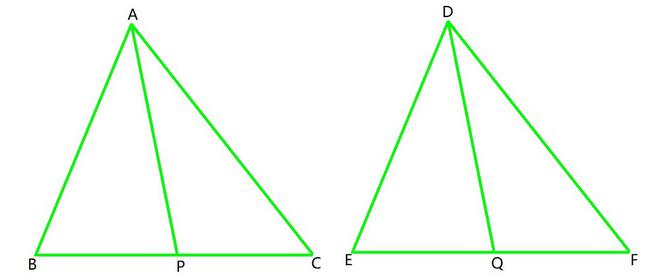
Given: AM and DN are the medians of triangles ABC and DEF respectively.
ΔABC ~ ΔDEF
According to theorem 1,
\frac{ar(ΔABC)}{ar(ΔDEF)} = \frac{AB^2}{DE^2} = \frac{BC^2}{EF^2} = \frac{AC^2}{DF^2} So,
\frac{AB}{DE} = \frac{BC}{EF} = \frac{2BP}{2EQ} = \frac{BP}{EQ}
\frac{AB}{DE} = \frac{BP}{EQ} ............................(1)∠B = ∠E (because ΔABC ~ ΔDEF)
Hence, ΔABP ~ ΔDEQ [SAS similarity criterion]
\frac{BP}{EQ} = \frac{AP}{DQ} ............................(2)From (1) and (2), we conclude that
\frac{ar(ΔABC)}{ar(ΔDEF)} = \frac{AP^2}{DQ^2} Hence, proved!
Question 7. Prove that the area of an equilateral triangle described on one side of a square is equal to half the area of the equilateral triangle described on one of its diagonals.
Solution:
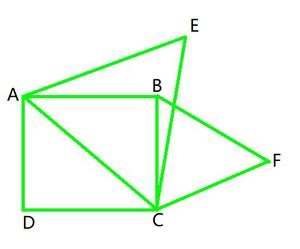
Let's take side of square = a
Diagonal of square AC = a√2
As, ΔBCF and ΔACE are equilateral, so they are similar
ΔBCF ~ ΔACE
According to theorem 1,
\frac{ar(ΔACE)}{ar(ΔBCF)} = \frac{AC^2}{BC^2} =
\frac{(a√2)^2}{a^2}
\frac{ar(ΔACE)}{ar(ΔBCF)} = 2Hence, Area of (ΔBCF) = ½ Area of (ΔACE)
Tick the correct answer and justify:
Question 8. ABC and BDE are two equilateral triangles such that D is the mid-point of BC. Ratio of the areas of triangles ABC and BDE is
(A) 2 : 1 (B) 1 : 2 (C) 4 : 1 (D) 1 : 4
Solution:
Here,
AB = BC = AC = a
and, BE = BD = ED = ½a
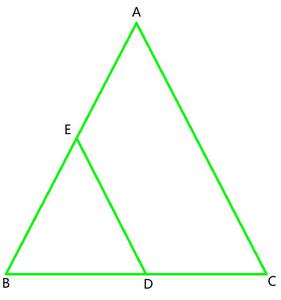
ΔABC ~ ΔEBD (Equilateral triangle)
According to theorem 1,
\frac{ar(ΔABC)}{ar(ΔEBD)} = \frac{AB^2}{EB^2} = \frac{a^2}{(½a)^2}
\frac{ar(ΔABC)}{ar(ΔEBD)} = \frac{4}{1} Area of (ΔABC) : Area of (ΔEBD) = 4 : 1
Hence, OPTION (C) is correct.
Question 9. Sides of two similar triangles are in the ratio 4 : 9. Areas of these triangles are in the ratio
(A) 2 : 3 (B) 4 : 9 (C) 81 : 16 (D) 16 : 81
Solution:
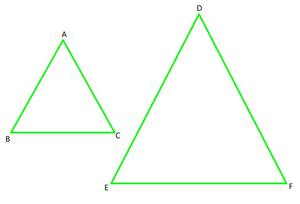
ΔABC ~ ΔDEF
\frac{AB}{DE} = \frac{BC}{EF} = \frac{AC}{DF} = \frac{4}{9} According to theorem 1,
\frac{ar(ΔABC)}{ar(ΔDEF)} = \frac{AB^2}{DE^2}
\frac{ar(ΔABC)}{ar(ΔDEF)} = \frac{4^2}{9^2} = \frac{16}{81} Area of (ΔABC) : Area of (ΔDEF) = 16 : 81
Hence, OPTION (D) is correct.
