

Chapter 15 of RD Sharma Class 10 Mathematics focuses on Areas Related to Circles, a fundamental concept in geometry that explores the relationships between circles and the areas associated with them. This chapter builds upon students' existing knowledge of circles and introduces new formulas and techniques for calculating areas of circular regions, sectors, and segments. Understanding these concepts is crucial for students as they form the foundation for more advanced mathematical topics and have practical applications in real-world scenarios, from engineering to architecture.
Class 10 RD Sharma Solutions - Exercise 15.1 | Set 2
Question 11. The radii of two circles are 19 cm and 9 cm respectively. Find the radius and area of the circle which has circumferences is equal to sum of the circumference of two circles.
Solution:
Radius of circle 1 = r1 = 19 cm
Radius of circle 2 = r2 = 9 cm
So, C1 = 2πr1, C2 = 2πr2
C = C1 + C2
2πr = 2πr1 + 2πr2
r = r1 + r2
r = 19 + 9
r = 28 cm
Therefore, the radius of the circle = 28 cm
Therefore, area of required circle = πr2
= (22/7) × 28 × 28
= 2464 cm2
Question 12. The area of a circular playground is 22176 m2. Find the cost of fencing this ground at the rate of ₹50 per meter.
Solution:
Area of the circular playground = 22176 m2
Area = πr2
πr2 = 22176
r2 = 22176(7/22)
= 7056
r = 84 m
Circumference of the ground = 2πr
= 2(22/7)84
= 528 m
Cost of fencing 528 m = ₹50 x 528
= ₹26400
Therefore, the cost of fencing the ground = ₹26400.
Question 13. The side of a square is 10 cm. Find the area of the circumscribed and inscribed circles.
Solution:
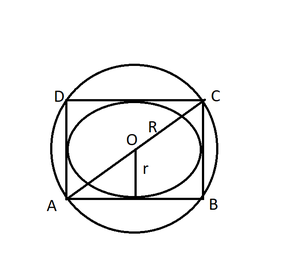
Diagonal of the square = AC = √2 x side
= 10√2 cm
Radius of circumscribed circle = Diagonal/2
R = 5√2cm
R = 7.07cm
Area= πR2
= (22/7) × 7.07 × 7.07
= 157.09 cm2
Therefore, the Area of the Circumscribed circle = 157.09 cm2
For inscribed circle diameter of circle = side of square = AB
Radius = side of square/2
= 10/2
r = 5 m
Area = πr2
= (22/7) × 5 × 5
= 78.5 cm2
Therefore, the area of the circumscribed circle = 157.09 cm2 and the area of the inscribed circle = 78.5 cm2.
Question 14. If a square is inscribed in a circle, find the ratio of areas of the circle and the square.
Solution:
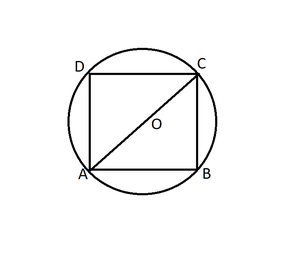
Let side of square AB be x cm which is inscribed in a circle.
Radius of circle (r) = 1/2 (diagonal of square)
= 1/2(a√2)
r = a/√2
Area of the square = a2
Area of the circle = πr2
= π(a2/2)
Ratio of areas = Area of circle:Area of square
= π(a2/2) : a2
= π : 2
Therefore, the ratio of areas of the circle and the square = π : 2
Question 15. The area of circle inscribed in an equilateral triangle is 154 cm2. Find the perimeter of the triangle.
Solution:
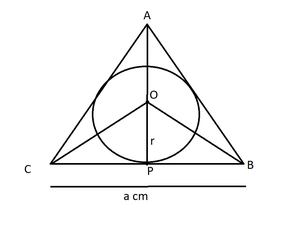
Area of a Circle = πr2
(22/7) × r2 = 154
r2 = (154 x 7)/22
= 7 × 7
= 49
r = 7 cm
OP is perpendicular bisector of BC (as BP is tangent and it is a equilateral triangle)
BP = ½ x BC
Consider the side of the equilateral triangle be a cm.
In right-angled triangle OPB
OB2 = OP2 + BP2 (By Pythagoras theorem)
OB2 = r2 + (a/2)2 (BP is half of a)
OB2 = 49 + a2/4
OB = √(49 + a2/2) ..... (1)
AP = (√3/2)a (height of an equilateral triangle)
OA = (√3/2)a - r
Similarly
OB = (√3/2)a - r .... (2)
From (1) and (2)
Squaring both sides
49 + a2/4 = (3/4)a2 + r2 - √3ar
r = 7
49 + a2/4 = (3/4)a2 + 49 - 7√3a
a2/4- (3/4)a2 = -7√3a
Taking 4 as LCM
(a2 - 3a2) / 4 = -7√3a
-2a2/4 = -7√3a
a = 14√3 cm
Perimeter of equilateral triangle = 3a
= 42√3
Therefore, the perimeter of the triangle = 42(1.73)
= 72.7 cm
Conclusion
Chapter 15 of RD Sharma Class 10 equips students with essential knowledge and skills for solving problems related to circular areas and their applications. Through a comprehensive exploration of concepts such as areas of sectors, segments, and circular rings, students learn to apply geometric principles to real-world situations. The chapter emphasizes both theoretical understanding and practical problem-solving, providing a strong foundation for advanced mathematics. By mastering these concepts, students develop critical thinking abilities and gain confidence in tackling complex geometric problems, preparing them for higher studies in mathematics and related fields.
