

Chapter 5 of the Class 10 RD Sharma Mathematics textbook, "Trigonometric Ratios," introduces students to the basic trigonometric functions and their applications. Exercise 5.1 focuses on solving problems involving the fundamental trigonometric ratios of angles in a right-angled triangle.
RD Sharma Solutions for Class 10 - Mathematics - Chapter 5 Trigonometric Ratios - Exercise 5.1 | Set 1
This section provides detailed solutions for Exercise 5.1 from Chapter 5 of the Class 10 RD Sharma Mathematics textbook. The exercise includes problems that require students to apply the basic trigonometric ratios—sine, cosine, and tangent—to find missing angles and side lengths in right-angled triangles. Solutions are presented step-by-step to help students understand and master trigonometric calculations.
Question 1. In each of the following, one of the six trigonometric ratios is given. Find the values of the other trigonometric ratios.
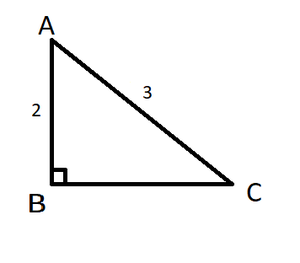
(i) sinA = 2/3
Solution:
sinA = 2/3 = Perpendicular/Hypotenuse
Draw a right-angled △ABC in which ∠B is = 90°
Using Pythagoras Theorem, in △ABC,
(Hypotenuse)2 = (Perpendicular)2 + (Base)2
AC2 = AB2 + BC2
(3)2 = (2)2 + (BC)2
9 = 4 + BC2
BC2 = 9 - 4 = 5
BC = √5 units
Now,
cosA = Base/Hypotenuse = BC/AC = √5/3
tanA = Perpendicular/Base = AB/BC = 2/√5
cotA = 1/tanA = √5/2
secA = 1/cosA = 3/√5
cosecA = 1/sinA = 3/2
(ii) cosA = 4/5
Solution:
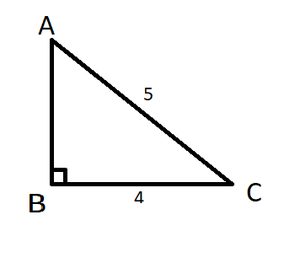
cosA = 4/5 = Base/Hypotenuse
Draw a right-angled △ABC in which ∠B is = 90°
Using Pythagoras Theorem, in △ABC,
(Hypotenuse)2 = (Perpendicular)2 + (Base)2
AC2 = AB2 + BC2
(5)2 = (AB)2 + (4)2
25 = AB2 + 16
AB2 = 25 - 16 = 9
AB = √9
= 3 units
Now,
sinA = Perpendicular/Hypotenuse = AB/AC =3/5
tanA = Perpendicular/Base = AB/BC = 3/4
cotA = 1/tanA = 4/3
secA = 1/cosA = 5/4
cosecA = 1/sinA =5/3
(iii) tanθ = 11/1
Solution:
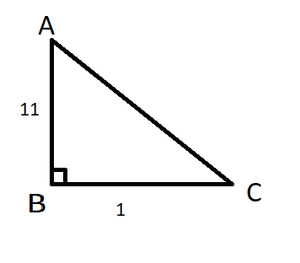
tanθ = 11/1 = Perpendicular/Base
Draw a right-angled △ABC in which ∠B is = 90°
Using Pythagoras Theorem, in △ABC,
(Hypotenuse)2 = (Perpendicular)2 + (Base)2
AC2 = AB2 + BC2
AC2 = (11)2 + (1)2
AC2 = 121 + 1
= 122
AC = √122units
Now,
sinθ = Perpendicular/Hypotenuse = AB/AC = 11/ √122
cosθ = Base/Hypotenuse = BC/AC = 1/√122
cotθ = 1/tanθ = 1/11
secθ = 1/cosθ = √122/1
cosecθ = 1/sinθ = √122/11
(iv) sinθ = 11/15
Solution:
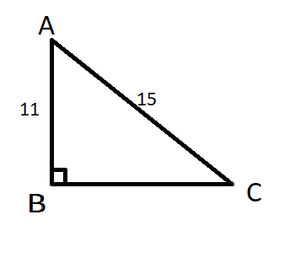
sinθ = 11/15 = Perpendicular/Hypotenuse
Draw a right-angled △ABC in which ∠B is = 90°
Using Pythagoras Theorem, in △ABC,
(Hypotenuse)2 = (Perpendicular)2 + (Base)2
AC2 = AB2 + BC2
(15)2 = (11)2 + (BC)2
225 = 121 + (BC)2
(BC)2 = 104
BC = 2√26
Now,
cosθ = Base/Hypotenuse = BC/AC = 2√26/15
tanθ = AB/BC = 11/ 2√26
cotθ = 1/tanθ = 2√26/11
secθ = 1/cosθ = 15/ 2√26
cosecθ = 1/sinθ = 15/11
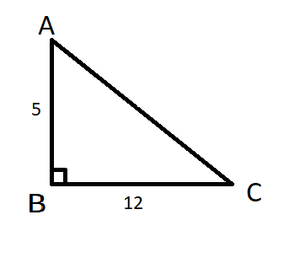
(v) tan α = 5/12
Solution:
tan α = 5/12 = Perpendicular/Base
Draw a right-angled △ABC in which ∠B is = 90°
Using Pythagoras Theorem, in △ABC,
(Hypotenuse)2 = (Perpendicular)2 + (Base)2
AC2 = AB2 + BC2
(AC)2 = (12)2 + (25)2
(AC)2 = 144 + 25
(AC)2 = 169
AC = √169 = 13 units
Now,
sin α = Perpendicular/Hypotenuse = AB/AC = 5/13
cos α = Base/Hypotenuse = BC/AC = 12/13
cot α = 1/tan α = 12/5
sec α = 1/cos α = 13/12
cosec α = 1/sin α = 13/5
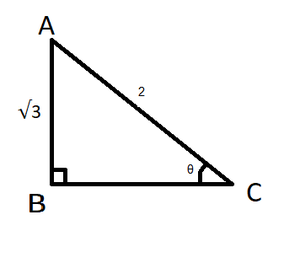
(vi) sinθ = √3/2
Solution:
sinθ = √3/2 = Perpendicular/Hypotenuse
Draw a right-angled △ABC in which ∠B is = 90°
Using Pythagoras Theorem, in △ ABC,
(Hypotenuse)2 = (Perpendicular)2 + (Base)2
AC2 = AB2 + BC2
(2)2 = (√3)2 + (BC)2
4 = 3 + (BC)2
(BC)2 = 4 - 3 = 1
BC = 1 units
Now,
cosθ = Base/Hypotenuse = BC/AC = 1/2
tanθ = AB/BC = √3/1
cotθ = 1/tanθ = 1/√3
secθ = 1/cosθ = 2/1
cosecθ = 1/sinθ = 2/√3
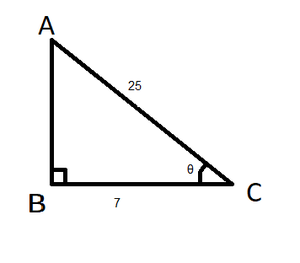
(vii) cosθ = 7/25
Solution:
cosθ = 7/25 = Base/Hypotenuse
Draw a right-angled △ABC in which ∠B is = 90°
Using Pythagoras Theorem, in △ ABC,
(Hypotenuse)2 = (Perpendicular)2 + (Base)2
AC2 = AB2 + BC2
(25)2 = (AB)2 + (7)2
625 = (AB)2 + 49
(AB)2 = 625 - 49 = 576
AB = √576 = 24 units
Now,
sinθ = Perpendicular/Hypotenuse = AB/AC = 24/25
tanθ = Perpendicular/Base = AB/BC = 24/7
cotθ = 1/tanθ = 7/24
secθ = 1/cosθ = 25/7
cosecθ = 1/sinθ = 25/24
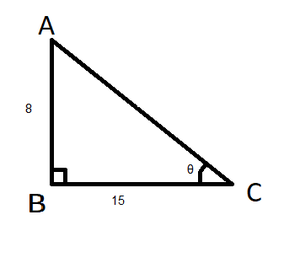
(viii) tanθ = 8/15
Solution:
tanθ = 8/15 = Perpendicular/Base
Draw a right-angled △ABC in which ∠B is = 90°
Using Pythagoras Theorem, in △ ABC,
(Hypotenuse)2 = (Perpendicular)2 + (Base)2
AC2 = AB2 + BC2
(AC)2 = (8)2 + (15)2
(AC)2 = 64 + 225
AC = √289 = 17
Now,
sinθ = Perpendicular/Hypotenuse = AB/AC = 8/17
cosθ = Base/Hypotenuse = BC/AC = 15/17
cotθ = 1/tanθ = 15/8
secθ = 1/cosθ = 17/15
cosecθ = 1/sinθ = 17/8
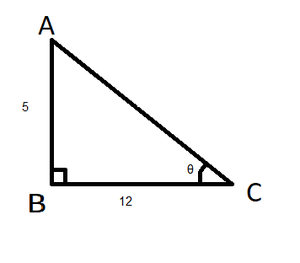
(ix) cotθ = 12/5
Solution:
cotθ = 12/5 = Base/Perpendicular
Draw a right-angled △ABC in which ∠B is = 90°
Using Pythagoras Theorem, in △ABC,
(Hypotenuse)2 = (Perpendicular)2 + (Base)2
AC2 = AB2 + BC2
(AC)2 = (5)2 + (12)2
(AC)2 = 25 + 144
(AC)2 = 169
AC = √169 = 13 units
Now,
sinθ = Perpendicular/Hypotenuse = AB/AC = 5/13
cosθ = Base/Hypotenuse = BC/AC = 12/13
tanθ = 1/tanθ = 5/12
secθ = 1/cosθ = 13/12
cosecθ = 1/sinθ = 13/5
(x) secθ = 13/5
Solution:
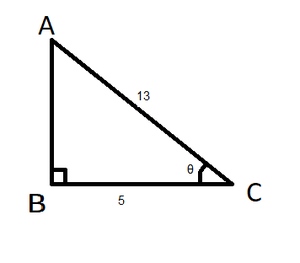
secθ = 13/5 = Hypotenuse/Base
Draw a right-angled △ABC in which ∠B is = 90°
Using Pythagoras Theorem, in △ABC,
(Hypotenuse)2 = (Perpendicular)2 + (Base)2
AC2 = AB2 + BC2
(13)2 = (AB)2 + (5)2
169 = (AB)2 + 25
(AB)2 = 169 - 25 = 144
AB = √144 = 12 units
Now,
sinθ = Perpendicular/Hypotenuse = AB/AC = 12/13
tanθ = Perpendicular/Base = AB/BC = 12/5
cotθ = 1/tanθ = 5/12
cosθ = 1/secθ = 5/13
cosecθ = 1/sinθ = 13/12
(xi) cosecθ = √10
Solution:
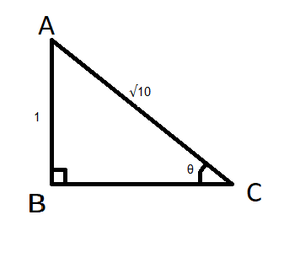
cosecθ = √10/1 = Hypotenuse/Perpendicular
Draw a right-angled △ABC in which ∠B is = 90°
Using Pythagoras Theorem, in △ ABC,
(Hypotenuse)2 = (Perpendicular)2 + (Base)2
AC2 = AB2 + BC2
(√10)2 = (1)2 + (BC)2
10 = 1 + (BC)2
(BC)2 = 10 - 1 = 9
BC = √9 = 3
Now,
sinθ = Perpendicular/Hypotenuse = AB/AC = 1/√10
cosθ = Base/Hypotenuse = BC/AC = 3/√10
tanθ = Perpendicular/Hypotenuse = AB/BC = 1/3
cotθ = 1/tanθ = 3/1 = 3
secθ = 1/cosθ = √10/3
(xii) cosθ = 12/15
Solution:
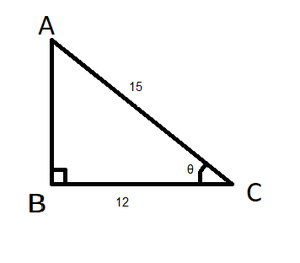
cosθ = 12/15 = Base/Hypotenuse
Draw a right-angled △ABC in which ∠B is = 90°
Using Pythagoras Theorem, in △ABC,
(Hypotenuse)2 = (Perpendicular)2 + (Base)2
AC2 = AB2 + BC2
(15)2 = (AB)2 + (12)2
225 = (AB)2 + 144
(AB)2 = 225 - 144 = 81
AB = √81 = 9 units
Now,
sinθ = Perpendicular/Hypotenuse = AB/AC = 9/15
tanθ = Perpendicular/Base = AB/BC = 9/12
cotθ = 1/tanθ = 12/9
secθ = 1/cosθ = 15/12
cosecθ = 1/sinθ = 15/9
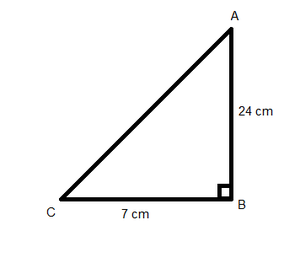
Question 2. In ΔABC, right angled at B, AB = 24 cm, BC = 7 cm. Determine
(i) sin A, cos A
(ii) sin C, cos C
Solution:
Given:
In right-angled ΔABC,
AB = 24 cm, BC = 7 cm. ∠B = 90°
Using Pythagoras Theorem
AC2 = AB2 + BC2
AC2 = 242 + 72 = 576 + 49
AC2 = 625
AC = √625 = 25cm
Now,
(i) sinA = BC/AC = 7/25
cosA = AB/AC = 24/25
(ii) sinC = AB/AC = 24/25
cosC = BC/AC = 7/25
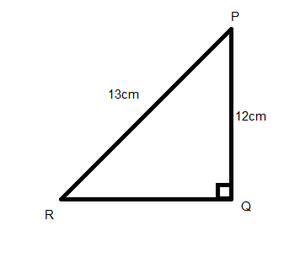
Question 3. In the figure, find tan P and cot R. Is tan P = cot R?
Solution:
Using Pythagoras Theorem
PR2 = PQ2 + QR2
132 = 122 + QR2
QR2 = 169 - 144 = 25
QR = √25 = 5 cm
Now,
tan P = Perpendicular/Base = QR/PQ = 5/2
cot R = Base/Perpendicular = QR/PQ = 5/2
Yes, tanP = cot R
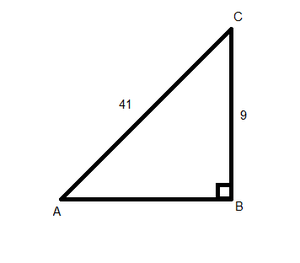
Question 4. If sin A = 9/41, compute cos A and tan A.
Solution:
Given, sinA = 9/41 = Perpendicular/Hypotenuse
Draw a △ ABC where ∠B = 90°, BC = 9, AC = 41
Using Pythagoras Theorem
AC2 = AB2 + BC2
BC2 = 412 - 92 = 1681 - 81
BC2 = 1600
BC = √1600 = 40
Now, cos A = Base/Hypotenuse = AB/AC = 40/41
tan A = Perpendicular/Base = BC/AB = 9/40
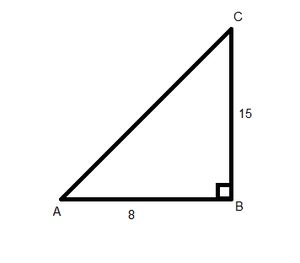
Question 5. Given 15 cot A = 8, find sin A and sec A.
Solution:
Given, 15 cot A = 8
cot A = 8/15 = Base/Perpendicular
Draw a △ ABC where ∠B = 90°, AB = 8, BC = 15
Using Pythagoras Theorem
AC2 = AB2 + BC2
AC2 = 82 + 152 = 64 + 225
AC2 = 289
AC = √289 = 17
Now,
sin A = Perpendicular/Hypotenuse = BC/AC = 15/17
sec A = Hypotenuse/Base = AC/AB = 17/8
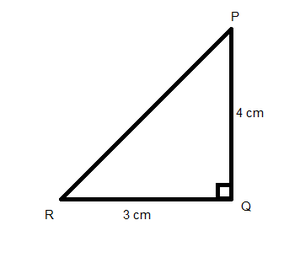
Question 6. In ΔPQR, right-angled at Q, PQ = 4 cm and RQ = 3 cm. Find the values of sin P, sin R, sec P, and sec R.
Solution:
In right-angled ΔPQR,
∠Q = 90°, PQ = 4cm, RQ = 3cm
Using Pythagoras Theorem
PR2 = PQ2 + QR2
PR2 = 42 + 32 = 16 + 9
PR2 = 25
PR = √25 =5
Now,
sin P = Perpendicular/Hypotenuse = RQ/PR = 3/5
sin R = Perpendicular/Hypotenuse = PQ/PR = 4/5
sec P = Hypotenuse/Base = PR/PQ = 5/4
sec R = Hypotenuse/Base = PR/RQ = 5/3
Related Articles:
- Class 10 RD Sharma Solutions - Chapter 5 Trigonometric Ratios - Exercise 5.2 | Set 1
- Class 10 RD Sharma Solutions - Chapter 5 Trigonometric Ratios - Exercise 5.2| Set 2
