

Many people tend to pick the number 37 when asked to choose a random number between 1 and 100. This is part of the "Randomness Paradox," which shows that our idea of randomness isn't as random as we think. Psychologists found a similar pattern called the "Blue-Seven Phenomenon," where people often choose blue and 7 when asked to pick a random color and number. In surveys, 7 is the most common single-digit number, and for two-digit numbers, 37 is the most popular.
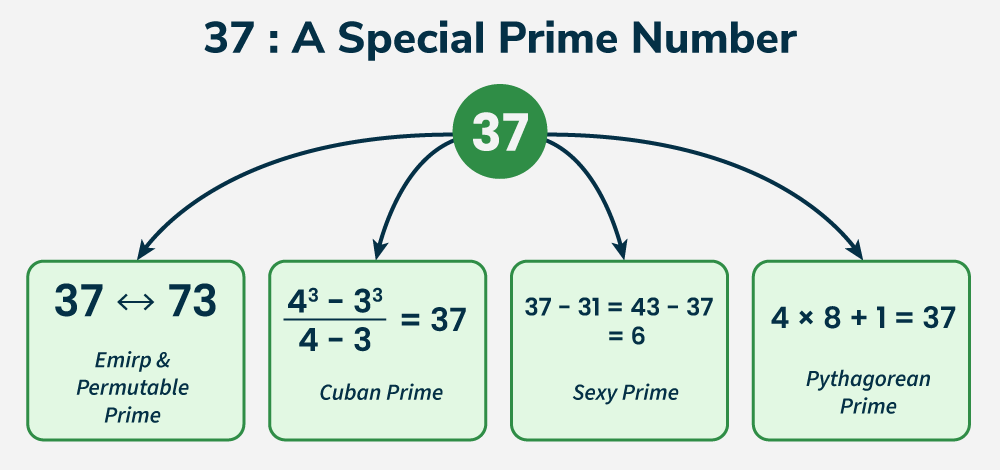
Some Interesting Facts about Number 37
- 37 is the fifth Lucky prime number (e.g., 3, 7, 13, 19, 37, 43, 67, 73, 79, 97...)
- 37 is fourth centered hexagonal number (e.g., 1, 7, 19, 37, 61...)
- 37 is the third star number (e.g. 1, 13, 37, 73, 121, 253, 337, 433, ...)
- 37 is 1 + 2 + 3 + 4 + 5 + 6 + 7 + 9 = 37; also 12345679 × 3 = 37037037
- Multiplying 37 by numbers like 3, 33, 333, or 3333 will produce palindromic results. For example: 37 × 3 = 111, 37 × 33 = 1221, 37 × 333 = 12321, 37 × 3333 = 123321...
- If a three-digit number is divisible by 37, its cyclic permutations are also divisible by 37. For example: if XYZ = 148 (a multiple of 37), then both YZX = 481 and ZXY = 814 are also multiples of 37.
- The smallest magic square that uses only prime numbers and 1 has 37 in the middle cell.
\begin{array}{|c|c|c|} \hline 31 & 73 & 7 \\ \hline 13 & \mathbf{37} & 61 \\ \hline 67 & 1 & 43 \\ \hline \end{array}
Mathematical Importance of Number 37
The number 37 is not just a simple prime; it holds a significant place in maths due to its unique properties and classifications. As a prime number, it can't be divided by any other numbers besides 1 and itself.
Number 37 is Classified as :
1. Emirp: The reverse of 37 is 73, which is also prime, so 37 is an emirp.
2. Lucky Prime : 37 is part of the sequence of lucky numbers, and it is 5th lucky prime.
3. Sexy Prime: 37 is a sexy prime because it is 6 more than 31 and 6 less than 43.
4. Permutable Prime: Its digits can be rearranged to form another prime i.e., 73.
5. Padovan Prime: It is 15th term of the Padovan sequence and fifth prime in this sequence.
6. Strong Prime: A prime that is greater than the arithmetic mean of the nearest primes on either side (31 and 41).
7. Pythagorean Prime: A prime of the form 4n + 1 (for 37, n = 9)
8. Star Number : 37 is the third star number.
9. Cuban Prime: It can be expressed in the form ( \frac{4^3 – 3^3}{4 – 3} = \frac{64 – 27}{1} = 37 ).
Magic of Number 37
The fascinating patterns hidden in the number 37 are:
Sum of Digits
Take a single digit number, for such as 9:
Write it 3 times, to form : 999
Add the digits: (9 + 9 + 9) = 27
Now divide the number with its digit sum, and you will get: 999 ÷ 27 = 37
This pattern will hold true for all single digit numbers from 1-9:
Digit | Number Formed | Sum of Digits | Division Result |
|---|---|---|---|
1 | 111 | 1 + 1 + 1 = 3 | 111 ÷ 3 = 37 |
2 | 222 | 2 + 2 + 2 =6 | 222 ÷ 6 = 37 |
3 | 333 | 3 + 3 + 3 = 9 | 333 ÷ 9 = 37 |
4 | 444 | 4 + 4 + 4 = 12 | 444 ÷ 12 = 37 |
5 | 555 | 5 + 5 + 5 = 15 | 555 ÷ 15 = 37 |
6 | 666 | 6 + 6 + 6 = 18 | 666 ÷ 18 = 37 |
7 | 777 | 7 + 7 + 7 = 21 | 777 ÷ 21 = 37 |
8 | 888 | 8 + 8 + 8 = 24 | 888 ÷ 24 = 37 |
9 | 999 | 9 + 9 + 9 = 27 | 999 ÷ 27 = 37 |
Reversal of Digits
If you take any multiple of 37 lets say 148 (37 × 4)
Reverse the digits : 841
Now put 0 in between the digits: 80401
This number will also be completely divisible by 37 (80401 ÷ 37 = 2173)
Multiple of 37 | Reversed Digits | Insert 0 Between Digits | Divisible by 37 |
|---|---|---|---|
37 × 1 = 37 | 73 | 703 | 703 ÷ 37 = 19 |
37 × 2 = 74 | 47 | 407 | 407 ÷ 37 = 11 |
37 × 3 = 111 | 111 | 10101 | 10101 ÷ 37 = 273 |
37 × 4 = 148 | 841 | 80401 | 80401 ÷ 37 = 2173 |
37 × 5 = 185 | 581 | 50801 | 50801 ÷ 37 = 1373 |
37 × 6 = 222 | 222 | 20202 | 20202 ÷ 37 = 546 |
37 × 7 = 259 | 952 | 90502 | 90502 ÷ 37 = 2446 |
37 × 8 = 296 | 692 | 60902 | 60902 ÷ 37 = 1646 |
37 × 9 = 333 | 333 | 30303 | 30303 ÷ 37 = 819 |
Pattern of Repeated Digits
When multiplied by the multiple of 3, 37 exhibits a repetition of digits, such as like 37 × 3 = 111 and 37 × 6 = 222.
This will continue till 27
Multiple of 3 | 37 × (Multiple of 3) | Result |
|---|---|---|
3 | 37 × 3 | 111 |
6 | 37 × 6 | 222 |
9 | 37 × 9 | 333 |
12 | 37 × 12 | 444 |
15 | 37 × 15 | 555 |
18 | 37 × 18 | 666 |
21 | 37 × 21 | 777 |
24 | 37 × 24 | 888 |
27 | 37 × 27 | 999 |
Palindromic Multiplication Pattern
Multiplying 37 by numbers consisting entirely of the digit 3 creates symmetrical results.
Examples:
37 × 3 = 111
37 × 33 = 1221
37 × 333 = 12321
37 × 3333 = 123321
These products form attractive numerical patterns that make 37 a favorite among recreational mathematicians.
