

Microservices architecture is a software design approach in which an application is divided into small services, each responsible for a specific business function. These services communicate over a network to support the application's overall functionality.
- Each service can be developed, deployed, and scaled independently.
- Different services can use different technologies based on their requirements.
Example: An e-commerce application may use separate services for product management, shopping carts, orders, and payments.
Real-World Applications
Microservices are commonly used in applications that require frequent updates, flexible scaling, and multiple business functions
- Banking Systems: Separate services manage accounts, transactions, payments, and fraud detection.
- E-commerce: Services handle product catalogs, shopping carts, orders, and payments.
- Ride-Hailing Apps: Services manage ride booking, driver matching, location tracking, and payments.
- OTT Platforms: Services handle user accounts, video streaming, subscriptions, and recommendations.
Working of Microservices Architecture
In microservices architecture, a client request passes through the appropriate services to complete an operation.
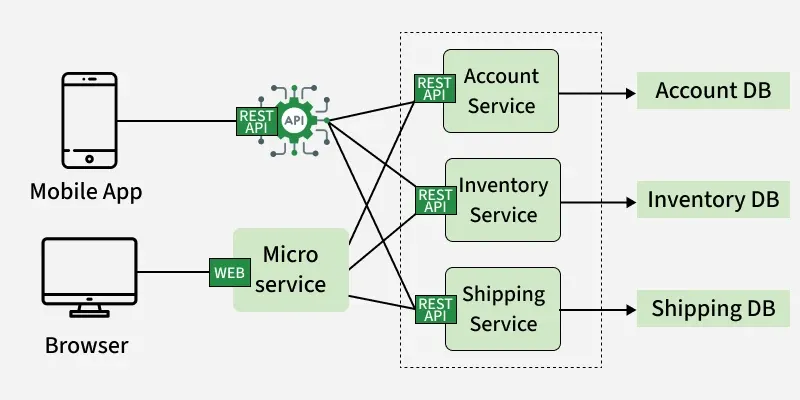
The request flow works as follows:
- Client Request: A user sends a request from a web or mobile application.
- Request Routing: An API Gateway or another entry point forwards the request to the appropriate service.
- Service Processing: The receiving service processes the request and accesses its data when required.
- Service Communication: The service communicates with other services if additional operations are needed.
- Response: The result is returned to the client through the entry point.
Components of Microservices Architecture
Microservices architecture uses several components and patterns to manage requests, communication, and data.
- Microservices: Individual services responsible for specific business functions, such as orders or payments.
- API Gateway: Routes client requests to the appropriate services and can handle common security concerns.
- Service Discovery: Helps services locate available instances of other services.
- Message Broker: Supports asynchronous communication between services using messages.
- Database per Service: Allows services to own their data and reduces direct data dependencies.
Other supporting concepts include load balancing, caching, and fault tolerance.
Real-World Example of Microservices
Consider an e-commerce application where different services manage shopping operations, from browsing products to completing an order.
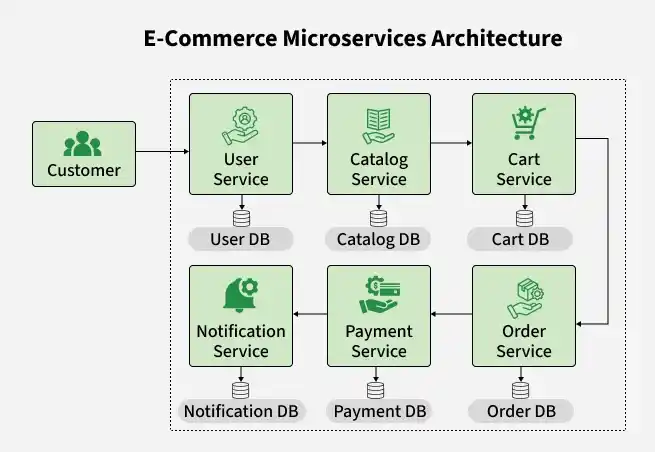
The main services involved in an e-commerce application include:
- User Service: Manages customer accounts and authentication.
- Catalog Service: Maintains product information, prices, and availability details.
- Cart Service: Manages products added to the shopping cart.
- Order Service: Creates orders and coordinates order processing.
- Payment Service: Processes payments and returns transaction results.
- Notification Service: Sends order confirmations and status updates.
Example: A customer selects a product from the Catalog Service and adds it to the Cart Service. During checkout, the Order Service creates an order and requests payment processing from the Payment Service. After successful payment confirmation, the Notification Service sends an order confirmation to the customer.
Migrating from Monolithic to Microservices Architecture
Migration involves gradually separating business functions from an existing monolithic application into independently deployable services.
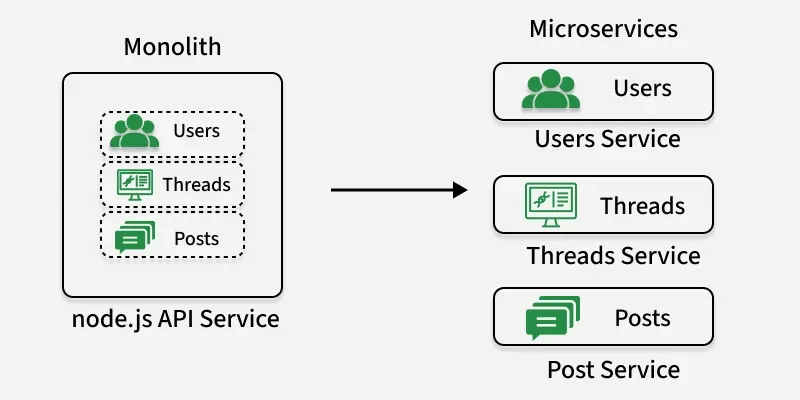
- A common migration strategy is the Strangler Fig Pattern, where selected features are gradually moved into services while the remaining monolith continues operating.
- The migration typically involves identifying service boundaries, extracting suitable modules, establishing communication interfaces, and validating each change before proceeding.
For more details, see Strategies for Migrating from Monolithic Architecture to Microservices
Challenges of Microservices Architecture
Microservices offer flexibility but introduce challenges when managing multiple services.
- Network Latency: Communication between services can increase response times.
- Data Consistency: Maintaining consistent data across services can be difficult.
- Operational Complexity: Deploying, monitoring, and maintaining multiple services requires additional infrastructure and tools.
- Testing and Debugging: Identifying failures across service boundaries can be challenging.
- Security: Multiple service endpoints require proper authentication, authorization, and secure communication.
