

Projectile motion is the motion of an object that is thrown, launched, or projected into the air and then moves under the influence of gravity alone (assuming air resistance is negligible).
The equation of trajectory gives the relationship between the horizontal and vertical coordinates (x, y) of a projectile at any instant. It is used to determine the path followed by the projectile.
Consider that an object is launched into space with an initial velocity of "u" and at an angle "θ" with respect to the horizontal.
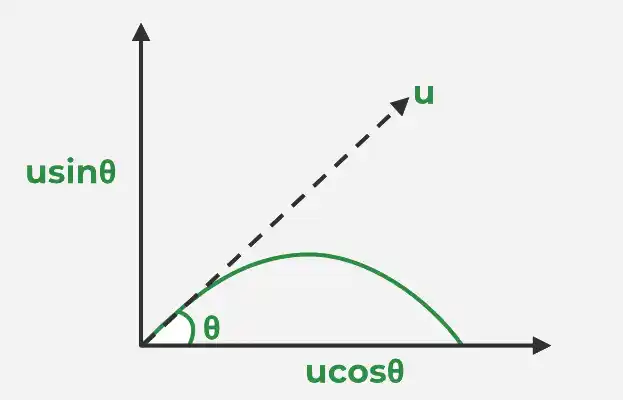
- The horizontal component of the initial velocity is ux = u cosθ
- The vertical component of the initial velocity is uy = u sinθ
At t = 0, the projectile is at the point of projection. Therefore, the horizontal and vertical displacements are both zero.
Horizontal Motion
At time t, Since gravity acts only in the vertical direction, there is no horizontal acceleration. Therefore, the horizontal velocity remains constant throughout the motion.
vx = ux = ucosθ
Hence, the horizontal displacement of the projectile is
x = uxt = (ucosθ)t ...(1)
Vertical Motion
Gravity acts vertically downward, the vertical velocity changes continuously during the motion.
vy = usinθ − gt
The vertical displacement of the projectile is
y = (usinθ)t −1/2gt2 ...(2)
From equation (1),
t = x/ucosθ ...(3)
Now, substitute the value of "t" in equation (2)
y = (u sinθ) × x/ (u cosθ) − [½ × g × (x/ (u cosθ))2]
y = x tanθ − [gx2/2(ucosθ)2]
y = x tanθ − [gx2/2u2cos2θ] ... (4)
In the above equation, the angle of projection (θ), acceleration due to gravity (g), and the initial velocity (u) are all constants.
So, by rewriting equation (4), we get
y = ax + bx2, where "a" and "b" are constants.
Since this equation is quadratic in x, it represents a parabola. Therefore, the trajectory of a projectile is parabolic when air resistance is neglected.
Formula
The trajectory formula describes the path followed by a projectile during its motion. It relates the horizontal displacement of the projectile to its vertical displacement.
y = x tanθ − \frac{gx^{2}}{2u^{2}cos^{2}\theta}
- "y" is the vertical distance of the object,
- "x" is the horizontal distance of the object,
- "u" is the initial velocity of the object,
- "θ" is the angle of projection with respect to the horizontal,
- "g" is the acceleration due to gravity.
Solved Examples
Example 1: A ball is thrown with an initial velocity of 40 m/s at an angle of 45° with the horizontal. Determine the vertical displacement of the ball after 4 seconds using the trajectory equation. Take the acceleration due to gravity as 10 m/s².
Solution:
Given data:
Angle (θ) = 45°
Time = 4 sec
Initial Velocity (u) = 40 m/s
Horizontal distance (x) = uxt
x = ucosθ t
x = 40 × cos 45° × 4 = 113.137 m
From the trajectory formula, we have,
y = x tanθ − [gx2/2u2cos2θ]
y = 113.137 × tan 45° − [10 × (113.137)2/2 × (40)2 × (cos 45°)2]
y = 113.137 × 1 − [10 × 12,799.981/2 × 1600 × (1/√2)2]
y = 113.137 − [1,27,999.81/1600]
y = 113.137 − 79.99
= 33.147 m
Hence, the vertical distance covered by the ball is 33.147 m.
Example 2: A bullet is fired from a gun with a velocity of 15 m/s at an angle of 60°. Find the equation for the path of a projectile using the trajectory formula. (g = 9.8 m/s2)
Solution:
Given data:
Initial Velocity (u) = 15 m/s
Angle (θ) = 60°
From the trajectory formula, we have,
y = x tanθ − [gx2/2(ucosθ)2]
y = x tan 60° − [9.8 × x2/2(15 × cos 60°)2]
y = x × (√3) − [9.8x2/2 × (225/4)]
y = √3x - 0.087x2
Thus, the equation of the trajectory of the projectile is y = √3x - 0.087x2.
Example 3: A boy threw a stone with a velocity of 9 m/s at an angle of 35°. Find the equation for the path of a projectile using the trajectory formula. (g = 10 m/s2)
Solution:
Given data:
Initial Velocity (u) = 9 m/s
Angle (θ) = 35°
From the trajectory formula, we have,
y = x tanθ − [gx2/2(ucosθ)2]
y = x tan 35° − [10 × x2/2(9 × cos 35°)2]
y = x × (0.7002) − [10x2/2 × (9 × 0.819)2]
y = (0.7002) x - (0.0920) x2
Thus, the equation of the trajectory of the projectile is y = (0.7002) x - (0.0920) x2.
