

Unit testing is a software testing method used to verify the functionality of individual components or modules of a program. It ensures that each unit performs correctly in isolation before integration into the complete system.
- Validates small sections of code independently.
- Helps identify defects during early development stages.
- Enhances software reliability and maintainability.
Approaches of Unit Testing
Unit testing can be performed using different approaches depending on the project size, complexity, and available tools. The two main approaches are:
1. Framework-Based Testing
Framework-based testing uses dedicated testing tools or libraries to write, organize, and execute test cases in a structured way.
Common frameworks include CppUTest, Unity, Google Test, and Pytest for C/C++, embedded C, and Python testing.
- Provides built-in test runners and reporting tools
- Supports assertions for validating results
- Allows grouping of test cases into test suites
- Easier to maintain and scale in large projects
- Supports automation and CI/CD integration
2. Framework-Less Unit Tests
Framework-less unit testing is a simple approach where tests are written without using any dedicated testing framework. Developers manually create test functions and validate outputs.
- No external libraries or tools required
- Tests are written using basic programming constructs
- Output is usually checked using manual conditions (if/else, print statements)
- Often used in small projects or embedded systems
Minimal Unit Test
A minimal unit test is a test that checks the smallest possible unit of code in an application, usually a single function or method. Its purpose is to verify that the code behaves as expected for a given input.
A minimal unit test should be:
- Self-contained and independent of external data or state.
- Focused on testing a single behavior.
- Easy to understand and maintain.
- Runnable automatically without manual intervention.
Example:
public class MyClassTest {
@Test
public void testMyClass() {MyClass myClass = new MyClass();
assertEquals(expected, myClass.myMethod());}
}
In this example, the myMethod() function of MyClass is tested. The assertEquals() method verifies whether the actual output matches the expected result.
Minimal unit tests help developers identify bugs quickly and ensure that code works correctly.
Embedded C/C++ Unit Testing
Embedded C/C++ unit testing is the process of testing individual modules or functions of embedded software to ensure they work correctly in isolation. It is especially important in embedded systems because software often interacts directly with hardware, where bugs can be difficult and expensive to debug.
It helps in:
- Detecting defects early in development
- Ensuring reliable interaction with hardware components
- Improving code quality and system stability
- Reducing risks in safety-critical applications
Process
Embedded unit testing generally follows these steps:
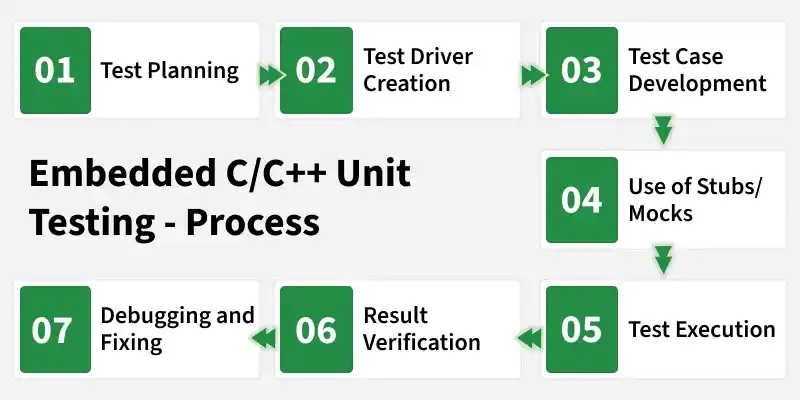
- Test Planning: Identify the functions/modules to be tested and define test cases.
- Test Driver Creation: Develop a driver program to call the function under test in a controlled environment.
- Test Case Development: Create test inputs for normal, boundary, and error conditions.
- Use of Stubs/Mocks: Replace hardware or external dependencies with stubs or mocks for isolated testing.
- Test Execution: Run the test suite and observe outputs.
- Result Verification: Compare actual results with expected results using assertions.
- Debugging and Fixing: Identify defects and fix issues in the code.
Techniques in Embedded Testing
Embedded testing uses different techniques to isolate and test software components effectively, especially when hardware or external modules are involved.
1. Stubs & Drivers
- Stubs: Dummy functions that replace real dependencies and provide predefined outputs for testing.
- Drivers: Test programs that call the function under test and provide input data.
2. Mocks & Fakes
- Mocks: Simulated objects used to verify interactions between components and function calls.
- Fakes: Simplified working versions of real components used instead of actual systems.
Frameworks (Embedded C/C++ Unit Testing)
Unit testing frameworks provide a structured way to write, organize, and execute test cases in C/C++ projects, especially in embedded systems.
- CppUTest: A lightweight C/C++ framework designed for embedded systems. It supports test automation, assertions, and mocking.
- Unity: A simple and easy-to-use unit testing framework for Embedded C, suitable for resource-constrained environments.
- Google Test (GTest): A powerful C++ testing framework with rich assertions, test fixtures, and strong test organization features.
- Google Mock: Works with Google Test to create mock objects and simulate dependencies for isolated testing.
- Ceedling: A test framework that integrates Unity and provides build automation and test execution support.
Real-World Unit Test Example
A real-world unit test checks whether a function or method produces the correct output for different inputs.
For example:
- Average calculation function
- Loan EMI calculator
- E-commerce order total calculation
- Login validation system
- User registration system
Common Issues in C/C++ Unit Testing (Embedded Systems)
Unit testing in C/C++ embedded systems faces several practical challenges due to hardware dependency and low-level programming constraints.
- Difficulty in Mocking Dependencies: External hardware or system components are hard to simulate, making proper isolation of tests difficult.
- Lack of Standard Framework: Unlike some languages, C/C++ does not have one universal testing framework, leading to tool fragmentation.
- Limited Support for TDD: Test-Driven Development is harder to implement due to tight hardware coupling and build complexity.
- Memory Leaks: Improper memory management can cause leaks that are difficult to detect during testing.
- Resource Leaks: Failure to release hardware or system resources can lead to unstable behavior.
- Concurrency Issues (Deadlocks): Improper handling of multi-threading or interrupts can cause deadlocks or race conditions.
- Hard to Achieve Full Isolation: Embedded code often depends on hardware, making true unit isolation difficult.
Benefits of Embedded C/C++ Unit Testing
Embedded C/C++ unit testing provides several advantages that improve software quality, reliability, and development efficiency.
- Early Bug Detection: Helps identify defects in the early stages of development, reducing cost and effort of fixing them later.
- Improved Code Quality: Encourages clean, modular, and well-structured code design.
- Ensures Correct Functionality: Verifies that each function or module behaves as expected under different conditions.
- Increased Confidence: Developers can modify or refactor code with confidence knowing tests will catch issues.
- Better Maintainability: Makes it easier to update and maintain code without breaking existing functionality.
- Reduced Development Risks: Especially important in embedded and safety-critical systems where failures can be costly.
- Supports Continuous Integration: Automated tests can be integrated into CI pipelines for continuous verification.
