

End-to-End (E2E) Testing is a software testing technique used to verify the complete workflow of an application from start to finish. It ensures that all integrated components, including the user interface, backend services, databases, APIs, and external systems, work together correctly.
- Validates complete user workflows from the user’s perspective.
- Ensures proper communication between different application components.
- Helps verify real business processes such as login, payment, and order placement
Example: Testing an e-commerce website by verifying the complete user journey from login, product search, adding items to the cart, payment, and order confirmation.
Types of End-to-End Testing
E2E testing is mainly classified into two types:
Horizontal End-to-End Testing
- Tests the complete workflow across multiple applications, systems, or services from the user's perspective.
- Example: Customer places an order, payment is processed, inventory is updated, and a confirmation email is sent.
Vertical End-to-End Testing
- Validates a complete workflow across different layers of a single application, including the user interface, APIs, backend services, and database.
- Example: User registration verifies the UI form, API request, backend processing, and database storage.
Process of End-to-End Testing
E2E testing follows a structured process to validate complete application workflows.
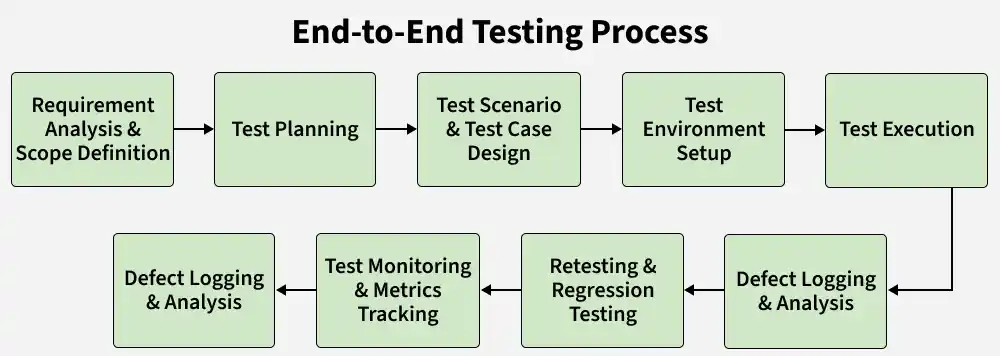
- Requirement Analysis and Scope Definition: Identify user workflows, business processes, and system interactions that need to be tested. Define the scope and objectives of E2E testing.
- Test Planning: Create a test plan that includes testing objectives, scope, resources, tools, timelines, and testing strategies.
- Test Scenario and Test Case Design: Create test scenarios based on real user journeys and prepare test cases with expected results to validate application behavior.
- Test Environment Setup: Configure a testing environment similar to production with required applications, databases, APIs, and test data.
- Test Execution: Execute test cases manually or using automation tools to verify that the complete application workflow works as expected.
- Defect Logging and Analysis: Record identified defects with relevant details and analyze their impact on the application workflow.
- Retesting and Regression Testing: Execute failed test cases after defect fixes and perform regression testing to ensure existing functionalities are not affected.
- Test Monitoring and Metrics Tracking: Track testing progress using metrics such as executed test cases, pass/fail results, defect status, and overall test coverage.
- Test Closure and Summary Report: Prepare a final report containing test results, defect details, and observations to evaluate release readiness.
Tools Used for End-to-End Testing
- Selenium: Used for automating web application testing across different browsers.
- Cypress: A modern testing framework used for fast and reliable end-to-end testing of web applications.
- Playwright: Supports cross-browser automation testing for web applications, including Chromium, Firefox, and WebKit.
- Appium: Used for end-to-end testing of mobile applications on Android and iOS platforms.
- TestComplete: Provides automated testing solutions for web, desktop, and mobile applications.
- Katalon Studio: A low-code automation tool for testing web, API, mobile, and desktop applications.
- Robot Framework: An open-source automation framework used for acceptance and end-to-end testing.
Best Practices for End-to-End Testing
- Prioritize critical business workflows for testing.
- Use stable and production-like test environments.
- Automate repetitive E2E test cases whenever possible.
- Keep test data realistic and well-managed.
- Execute E2E tests as part of the CI/CD pipeline.
Advantages of End to End Testing
Here are the Advantages of end-to-end testing as follows:
- Validates the complete application workflow from start to finish.
- Detects integration issues between different modules, APIs, databases, and external systems.
- Improves software reliability by testing the application in real-world conditions.
- Enhances user experience by verifying critical user journeys.
- Reduces production failures by identifying defects before deployment.
- Tests real user scenarios to ensure complete system functionality.
Limitations of End-to-End Testing
- Requires more time to design, execute, and maintain compared to unit and integration testing.
- Needs a complete testing environment with required systems, databases, and services.
- Debugging failures can be difficult because multiple components are involved.
- Requires higher maintenance efforts when application workflows change.
- Test execution is slower due to testing the complete application flow.
- Depends on external systems and services, which may affect test reliability.
