AgentKitOne endpoint between your agent and every app and MCP it needs.











A tool call is one action your agent runs through AgentKit in production, such as sending an email from Gmail, creating a lead in Salesforce, or reading a message from Slack. A tool call can run on-behalf-of a user's credentials or with team-wide admin credentials, and both count the same. Tool discovery and listing, authorization flows, token refreshes, retries and dashboard actions are never billed. Tool call request or response payload size and number of users don't affect the count.
A trigger event is one change in a connected app, like a new email, a new Slack message, or a new or updated CRM record, that Scalekit delivers to your webhook endpoint. We count it once, when your endpoint accepts it. Retries of the same event aren't counted again, and events that are never delivered are free. The webhooks we receive from the app, and the polls we make to detect changes, are never billed. Trigger events in development and staging environments are free.
Free has a hard stop: once you reach 10,000 tool calls or 10,000 trigger events in a month, upgrade to Growth to keep going. On Growth and Scale plans, your agents keep running, and any usage above the included limits is billed at $0.50 per 1,000 tool calls and $3 per 1,000 trigger events. Enterprise plans have custom tool call and trigger event volumes and prices, set in your contract.
Yes, on Enterprise plans. You can host in your own infrastructure, or inside your customer's infrastructure. We support Kubernetes (with Helm charts) or Docker. OAuth tokens, encryption keys, audit logs and configuration stay in your boundary, and we have no access to them. Once installed, the instance doesn't connect to Scalekit. We ship versioned releases, security patches and upgrade runbooks, and your team applies upgrades in its own maintenance windows.
No. Tool-call requests and responses are never stored in our databases, disk or logs. We store call metadata for your tool-call logs, and store and refresh the OAuth tokens and API keys required for connections, encrypted at rest with keys separate for each environment. If you turn on the optional setting "Store connector error details", which is off by default, we keep error responses from the connected app for debugging purposes. We do not train AI models on customer data.
We host on Google Cloud with separate standalone deployments in US and EU regions, and data stays in the region you choose. On self-hosted Enterprise, data stays in your own infrastructure.
Yes. You can bring your own OAuth app credentials, so end users see your app's name on the consent screens and the upstream rate limits belong to your app. On Growth, Scale and Enterprise plans, you can also brand the hosted connect page, remove the Scalekit watermark and serve authorization links from your own domain.
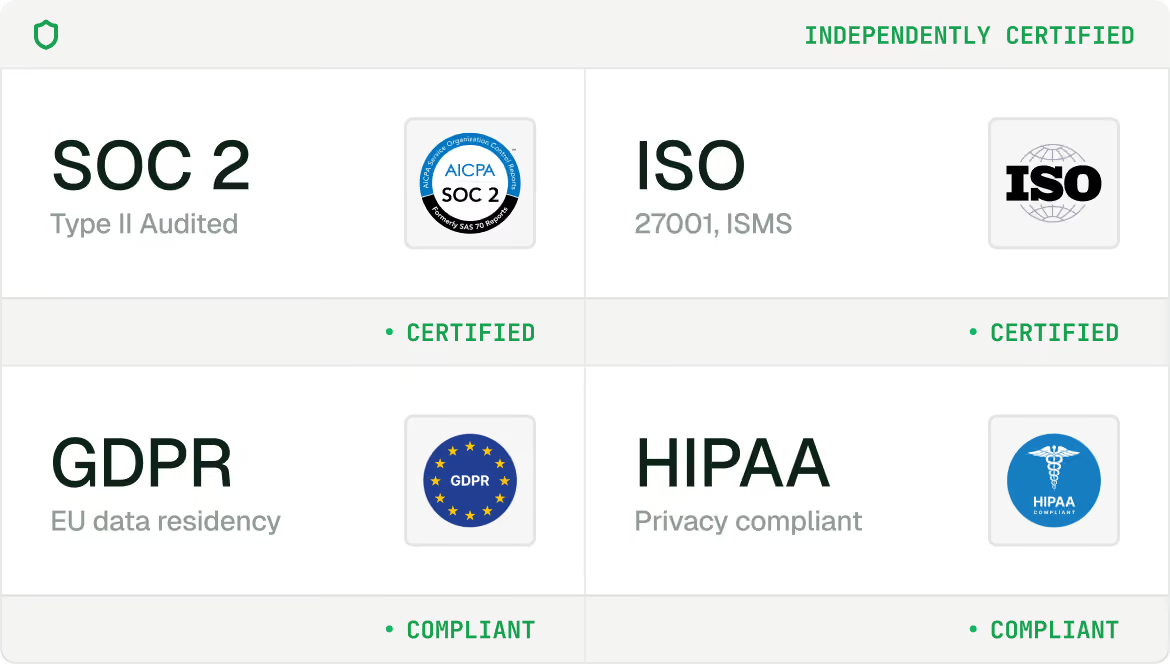
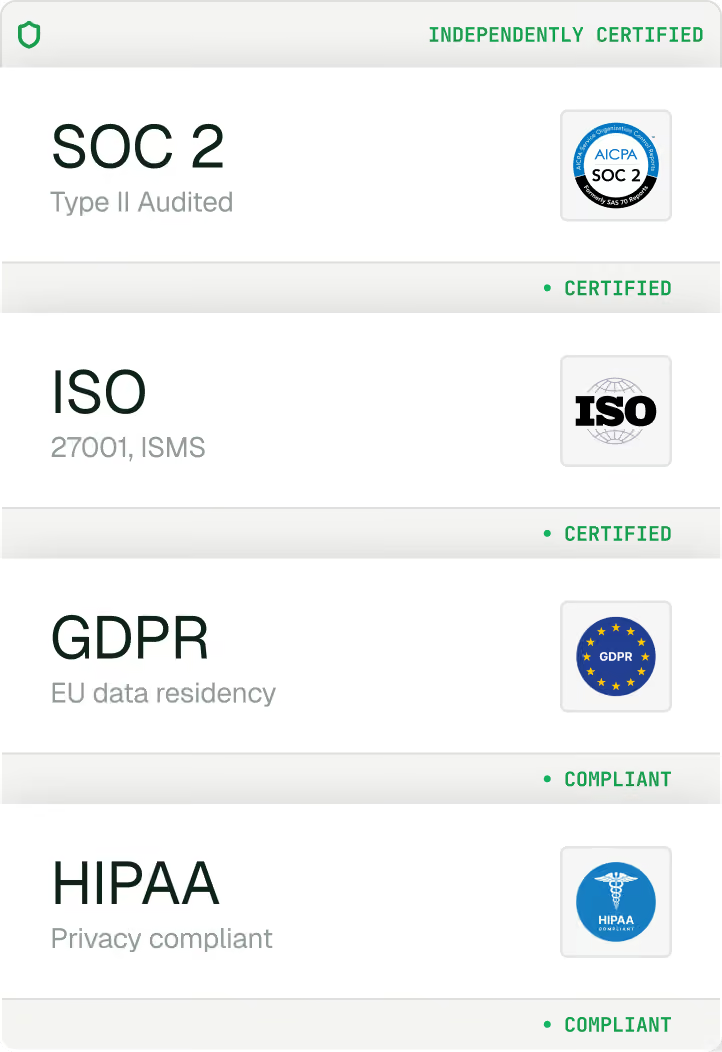
Scalekit is SOC 2 Type II and ISO 27001 certified. We are GDPR and CCPA compliant. Our standard DPA covers EU and UK GDPR and US state privacy laws, and includes Standard Contractual Clauses for data transfers. We sign a HIPAA BAA on Scale and Enterprise plans. Enterprise customers can also negotiate a custom MSA and DPA. Security documents are available in our Trust Center, and you can reach us at security@scalekit.com.
Tokens and API keys are encrypted at rest in a vault isolated per environment, and your agents never see them: your application asks AgentKit to run a tool, and AgentKit injects the right token, whether it belongs to one user or is shared across a team. On Enterprise, you can bring your own encryption keys in Google Cloud KMS, so you control the master key. With self-hosting, tokens are stored in your own database.
Enterprise plan on Scalekit Cloud comes with a 99.99% uptime SLA and contractual support response times. Support runs 24×5 over a private Slack channel and email, with direct access to our engineers. First-response targets are 30 minutes for P0, 4 hours for P1 and 1 business day for P2. A forward deployed engineer works with your team through go-live, and a customer success manager stays on the account after that.