Showing posts with label speed. Show all posts

Thursday, November 15, 2012

WiFox - A New Protocol to Boost WiFi Performance

By a whopping 700%! From Matt Brian … The end of slow public WiFi? Researchers develop new protocol that boosts WiFi performance by 700%:

Conferences, airports, cafes – they might offer free WiFi to visitors, but they are often sluggish in their operation because everyone else is hogging the connection.

This issue might become a thing of the past, after a team of engineers at NC State University (NCSU) announced the development of WiFox (via ExtremeTech), a new software protocol that could theoretically be added to existing Internet routers and is capable of boosting WiFi performance by 700 percent.

Traditionally, routers offer a single channel of data to users. When the access point receives an increased number of data requests, it becomes harder for it to send back the data it has requested. The access point could be programmed to give all pieces of data a high priority to clear its backlog, but then users have issues submitting new requests.

Data backs up, and the router has issues dishing out the necessary information to users. You may have experienced this when you turn up early to a conference, enjoy the public WiFi connection, and then get kicked off when the venue starts to fill up and you have to share it with everyone else.

NCSU engineers position WiFox as the software equivalent of a traffic policeman, ensuring that the data traffic moves smoothly in both directions. WiFox works by monitoring the traffic on a WiFi channel, intelligently detecting load issues and granting access to priority data when it detects a backlog of information passing backwards and forwards.

The team says that when they tested the software on a router in their labs capable of handling 45 users, it saw improvements of between 400 and 700 percent when it reached the maximum number of users.

Tuesday, June 26, 2012

Researchers Demonstrate 2.5 Terabits Per Second Wireless

NewImage

From Sebastian Anthony – Infinite-capacity wireless vortex beams carry 2.5 terabits per second:

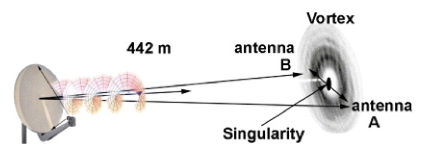
American and Israeli researchers have used twisted, vortex beams to transmit data at 2.5 terabits per second. As far as we can discern, this is the fastest wireless network ever created — by some margin. This technique is likely to be used in the next few years to vastly increase the throughput of both wireless and fiber-optic networks.

These twisted signals use orbital angular momentum (OAM) to cram much more data into a single stream. In current state-of-the-art transmission protocols (WiFi, LTE, COFDM), we only modulate the spin angular momentum (SAM) of radio waves, not the OAM. If you picture the Earth, SAM is our planet spinning on its axis, while OAM is our movement around the Sun. Basically, the breakthrough here is that researchers have created a wireless network protocol that uses both OAM and SAM.

In this case, Alan Willner and fellow researchers from the University of Southern California, NASA’s Jet Propulsion Laboratory, and Tel Aviv University, twisted together eight ~300Gbps visible light data streams using OAM. Each of the eight beams has a different level of OAM twist. The beams are bundled into two groups of four, which are passed through different polarization filters. One bundle of four is transmitted as a thin stream, like a screw thread, while the other four are transmitted around the outside, like a sheathe. The beam is then transmitted over open space (just one meter in this case), and untwisted and processed by the receiving end. 2.5 terabits per second is equivalent to 320 gigabytes per second, or around seven full Blu-ray movies per second.

...

According to Thide [researcher Bo Thide of the Swedish Institute of Space Physics], OAM should allow us to twist together an “infinite number” of conventional transmission protocols without using any more spectrum. In theory, we should be able to take 10 (or 100 or 1000 or…) WiFi or LTE signals and twist them into a single beam, increasing throughput by 10 (or 100 or 1000 or…) times. For fiber networks, where we still have a lot of spare capacity, this isn’t all that exciting — but for wireless networks, where we’ve virtually run out of useful spectrum, twisted radio waves could provide an instant, future-proof solution. For the networking nerds, Willner’s OAM link has a spectral efficiency of 95.7 bits per hertz; LTE maxes out at 16.32 bits/Hz; 802.11n is 2.4 bits/Hz. Digital TV (DVB-T) is just 0.55 bits/Hz.

Photo from New Journal of Physics


Monday, February 20, 2012

HSPA+ Multiflow May Double Download Speeds

Hspa multiflow

Kyle Wagner reporting … New HSPA+ Multiflow Tech Could Double Your Download Speeds:

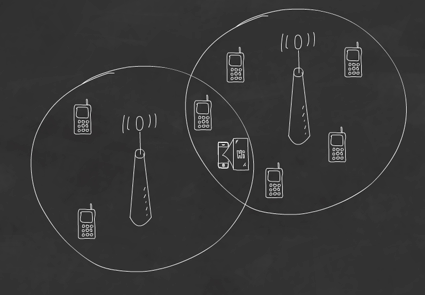
Nokia Siemens is going to demo HSPA+ Multiflow—a new cell tech that lets phones talk to two cell towers at once—at Mobile World Congress. It's the first time that the tech, which can apparently double data speeds, will be shown working on stuff you might actually be able to buy.

HSPA+ Multiflow works by sending and receiving data from the base station in two totally separate streams when your phone is in range of two cell towers at the same time. Devices with the tech won't be available until probably late 2013


Friday, December 09, 2011

802.11ac - 1.3 Gbps Throughput!

Stephen Lawson - Broadcom Pushes 802.11ac for Faster Wi-Fi:

Gigabit-speed wireless LAN products based on the emerging IEEE 802.11ac standard will start shipping next year and usher Wi-Fi into its next era of high speed and long range, communications chip maker Broadcom said Thursday.

The new technology will use beam-forming, wide bands and multiple antennas to deliver as much as 1.3G bps (bits per second) of real-world throughput, with a longer range and better wall-penetration capability that will help it serve entire homes, said Rahul Patel, vice president of Broadcom's mobile and wireless group. It represents a big step up from 802.11n, the current standard that typically tops out at about 300M bps, he said.

Consumers will need faster Wi-Fi soon to enjoy activities such as sending multiple streams of video to a TV, Patel said.

Wednesday, July 20, 2011

Trading Speed for Security

James E. Powell on a potentially troubling trend among network security professionals. I see the need/demand for more and more bandwidth, but at the expensive of security?

Security Pros Trading Network Speed for Secure Environment:
A new survey of 478 security professionals and C-level executives reveals that IT security pros are responding to increased network traffic by turning off functionality in their security solutions.

Despite the increasing number of risks posed by a variety of recent data breaches and attacks, 90 percent of respondents admit that they make the security/throughput trade-off. It’s not that these IT professionals don’t understand the problem; they understand the growing impact of mobile devices, for example. Despite a majority (67 percent) admitting that security trumps performance in security solution evaluations, 81 percent say they turn off functionality because network performance was negatively affected.

Even when they adopt “next generational firewall” (NGFW) products, Crossbeam says security pros have to select which features to allow so they can meet network performance goals.

LinkWithin

Related Posts Plugin for WordPress, Blogger...