Showing posts with label book study. Show all posts

August 4, 2016

Teach Like A Pirate Book Study {part 2}

Yo ho! Yo ho! It's a pirate's life for me. 


What qualifies as treasure to teachers?  Student engagement? Student learning? Student’s remembering what we’ve taught?


If student engagement and learning is the ultimate teacher treasure, then Part 2 of Teach Like a Pirate is the official treasure map.


Part 2 of Teach Like A Pirate is chalk full of engagement strategies. Burgess provides you with 63 pages of ideas to help teachers build presentation into their lessons and increase student engagement.

The long and short of it is… presentation matters. It matters how we present our material.  

As Burgess says, “There is no award given to the teacher who fills every class period with bell-to-bell instruction. It doesn’t matter how much material you teach, it only matters how much is received.”

How true is that?  I can’t tell you how many times I’ve thought but I’ve taught this.  Um… clearly, it was not received. You can teach and teach and teach, but if the material isn’t being received, then you will always find yourself back at square one. 

Hmmm??? Perhaps it wasn’t the content that I lacked in my lesson, perhaps it was my presentation. Perhaps I just didn’t teach it in a memorable way.   

Never fear though, Dave has got you covered.  From huge ideas like creating a room transformation to small ideas like leaving a message on the board, Burgess provides you with 32 (assuming I've counted correctly) possible hooks for your lessons.

Below are a few of my favorite hooks. 


For a complete list compiled by Stephanie at Third Grade Thoughts, click here. For a complete list and a thorough description of each with inspirations stories and more, buy the book here.  :)

1)     The Kinesthetic Hook


The kinesthetic hook is all about incorporating movement into your lessons. This could include gestures of some kind, acting something out, or throwing and catching something. Movement gets kids involved.

About five years ago I started teaching all my geometry vocabulary through movement and gestures. Each vocabulary word from “line” to “symmetry” had a gesture that reminded students of the meaning of each word. We reviewed and practiced our vocabulary everyday throughout the unit, and I couldn’t believe how successful my students were at retaining the vocabulary. Units later, they could still tell me the difference between a “line segment” and “ray.” They used their gestures constantly. I even saw a few doing the movements quietly during the test.

2)     The Safari Hook


The safari hook is simply going somewhere outside of your classroom for a particular lesson. Just by changing the scenery and mixing things up, students are more alert and attentive. This takes no planning at all, just a little thinking ahead about where would be the best place to deliver your lesson.
My hope this year is to make it outside more often.  My school has a wonderful outdoor classroom/gazebo that I would like to take advantage of. I was also thinking the playground would be a very fun place for a geometry scavenger hunt.

3)     The Mozart Hook


The Mozart hook is about bringing music into your lessons. I use music in my classroom, but not always in a thoughtfully crafted way. It’s more… let’s listen to the Beatles while we work sort of way. 

My goal this year is to start matching some music with some of our content, especially to help set the stage in reading. Wouldn’t that be a cool way to introduce a historical text?  With music from that time period?  Music is such a powerful representation of an era. 

For example, we always read a few articles about the Dust Bowl and the Great Depression during our reading unit. My students are always fascinated by these topics and this historical era. They became even more engaged and excited about their learning when we watched a video that included images and The Dustbowl Blues by Woody Guthrie.


Between the pictures and the music, students had a profoundly better understanding of the time period and read with enthusiasm, asked incredible questions, and demonstrated some powerful thinking. The lesson quickly went from good to great with just a little extra in the presentation.

4. The Interior Design Hook


The interior design hook is about transforming your space! This hook encourages teachers to change the look or layout of their room for a specific lesson.

We do this for Writing Camp every year. For the week before the Texas Writing STAAR test, all our 4th graders head off to Camp Write-A-Lotta. We transform our classroom into cabins by decorating our doors and bringing in tents and camping chairs.  The students love walking in Monday morning and seeing the transformation. It’s magical. 

Changing the classroom for the day makes the day and the learning for the day feel special. Gotta love that! 

This year I want to find ways to do this more. Maybe just a quick one day transformation here or there. Have you transformed your classroom?  I would love to hear any tips, advice, or stories you have about this idea. Please please share!!

5.  The Props Hook


The props hook is exactly what it sounds like – bringing in props and/or pictures for students to see, study, and hold. Easy enough and something that takes just a little bit of planning.


My favorite prop is my jar of molasses. You see, every year we read this incredible article about the Great Molasses Flood in Boston, Massachusetts in 1919. Many of my students have heard of molasses, but few have cooked with molasses or fully understand the viscosity of the substance. So, I bring in a jar. We open it up and smell it. We pour a little out and watch it ooze down the side of a cup. This drastically increases the engagement and the understanding of our reading and it’s really fun!!

*****
With so many strategies, it was hard to pick just five to share.  I could go on and on, but instead I’m just going to highly recommend Teach Like A Pirate. It is one that you will want to pull off your shelf again and again.  Sooo many good ideas and sooo many ways to energize the teacher, engage the students, and make teaching and learning more exciting, memorable, and fun!

If you missed my first post on Teach Like A Pirate, check it out here. Also, check out Dave Burgess' blog for further inspiration and general awesomeness.  :)

Part One and Part Two Complete.

July 21, 2016

The Reading Strategies Book: Goal 5 {Book Study}

One of the greatest gifts of summer is time. Time to dive into whatever inspires you, rejuvenates you, and relaxes you. One of my favorite ways to spend my time is reading. This summer I have been reading about pirates, catching up on some children's literature and diving into The Reading Strategies Book by Jennifer Serravallo.


This week I am teaming up with some amazing bloggers to host a quick reflection of Goal 5 -Supporting Comprehension in Fiction: Understanding Plot and Setting.

Truthfully, this book had been on Amazon wishlist for awhile, but I never pulled the trigger on the purchase. I don't know why! Now, I can't believe I didn't have this book in my hands the minute it was published. The Reading Strategies Book is truly an incredible resource for teachers. It is practical, easy to use, and filled with great ideas that are easily implemented and great for students. I can't wait to make this book part of my daily practice in the classroom.

To catch up on our book study and all things Reading Strategies Book related click below:


Now, let's take a closer look at Goal 5

Supporting Comprehension in Fiction:

Understanding Plot and Setting

http://wallpaper-s.org/11__Lost_in_a_Good_Book.htm

Why is Goal 5 important?  Well, it is basically the heart of what makes reading enjoyable. The best reading happens when one is completely immersed in the text, lost in another world, and apart of a story that feels all too real. Naturally, we want all our students to experience this true magic of reading. But in order for this to happen, readers must know what is happening.  They need to know the who, the where, and the what to fully understand what they read. Plot and setting are a pretty big deal.


Who needs Goal 5? Students who may need additional practice with this skill are your kiddos that retell with WAAAY too much detail, or not enough detail, or jumble up the order of events during a retell. They are the kids that miss the connections between events and don't see how one event leads to another event in the story. Sequential understanding is a key component of understanding plot. I can think of many students who fall into one or more of these categories and I'm sure you can too.

Serravallo breaks down plot and setting into 4 parts and offers twenty-eight (TWENTY-EIGHT!) different strategies to support readers working on this goal.
  • problem/conflict and solution/resolution
  • retelling/summarizing (must be sequential)
  • visualizing setting
  • cause and effect (connecting events in the story)


Today, I want to focus on three strategies that I can't wait to use with my students this year in both independent conferences, guided reading, and general reading instruction.


5.3 Summarizing What's Most Essential


What is it?
This strategy focuses on summarizing what is most important in the story in order in a way that makes sense.  It is ideal for levels E-K and fictional texts.

This is basically an introduction to a good fictional summary. I love the language Serravallo uses to explain a summary. She says, "Your summary should include enough information to make sense to someone who hasn't read the story before. That means you need to make it clear in your summary how one event led to another." This idea forces students to think about the most important events that are connected to each other, not simply part of the story.  


Best Part:
My favorite part of this strategy was the foldable idea presented in the book (shown above,  The Reading Strategies book, pg. 136).  It is a wonderful visual for students and serves as a practical guide for summarizing.  I could see making these foldables with my small group as we talk about  the important elements of a good summary. Then using this tool each time we finish a book or a chapter to help us practice.  I can't wait!

Now, I know you could easily recreate this with markers and colored paper, but I was so excited about this idea, that I created a template for my students to use to create their own.

https://www.teacherspayteachers.com/Product/The-Essential-Summary-Foldable-2659143

https://www.teacherspayteachers.com/Product/The-Essential-Summary-Foldable-2659143
If you think you may use this strategy and would like to use my template, go for it! Click the pictures above to download it for free!


5.14 Chapter-End Stop Signs


What is it?
This strategy gives students additional practice finding the most important events in each chapter. At the end of a chapter, students simply stop and jot the most important event. Students can then reread their notes to remind themselves of where they are in the story. This strategy is great for kids reading level L and up.

It is also incredibly versatile. You could easily use post-it notes, bookmark, or notes page to keep track of big ideas in each chapter.

I've used them all, but I like the notes page best for independent reading/conferences and guided reading. I like to have everything all in one place and easily accessible. Kids simply fold the page in half, stick it in their books, and use their notes as their bookmark.

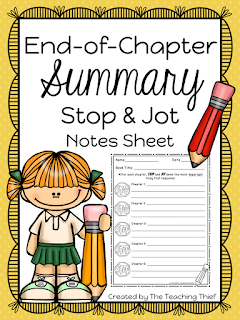
Click the image below to grab my End-of-Chapter Summary Stop & Jot Notes Sheet.  It includes a two-sided fill in the chapter form and pages for chapters 1-47.

https://www.teacherspayteachers.com/Product/End-of-Chapter-STOP-and-Jot-Summary-Notes-Sheet-2659117

Best Part:
I love to use this strategy during read alouds. After each chapter, we pause and think about the most important event in that chapter. We write 1-2 sentences on a strip of colored paper and add it to our "Story Chain."  I just tape the new sheet on to the old and we keep building on, always switching colors for each chapter.  By the end of the novel, our "Story Chain" is almost touching the floor!

This is a great way to help students keep track of the "important stuff" as we read and serves as a jumping off point the next day when we return to our book. Plus, it create a pretty fun display in the classroom. I really wish I had a picture to show y'all, but (of course) I can't find a a single one. Follow me on Instagram and I will be sure to post a picture this upcoming year when we start again.  :)


5.24 FQR (Facts/Questions/Response) 

Sheets for Filling in Gaps


What is it?
This strategy is helpful when you are reading a book that is a bit confusing.  A FQR Sheet is any simple three column chart with a column for facts, questions, and responses. I have known about FQR charts for what feels like forever, but I always associated them with non-fiction text. Turns out, they are great for fiction too! FQR charts are a great way to help readers on levels Q and up develop a better understanding of complicated plots.

Best Part:
I love that it is a new way to use this old idea. Recommended for when you are reading a more challenging text that is set in imaginary places or historical times, this strategy helps the reader take stock of what they DO know and what the NEED to know to better understand the text. I can think of so many books this would be great for: The Westing Game, City of Ember, The Fog Diver, Sky Jumpers, The Lost Planet, etc.

********

These are three of my favorite strategies from this chapter, but I flagged many more in my book. I hope you find these ideas as helpful and inspiring as I did. I'm just itching to get started. 

Thank you for joining my for a quick look at 

Goal 5: Understanding Plot and Setting. 


Have you read The Reading Strategies Book? 

Do you already use it in your classroom? Tell us more!

We would love for you to share your knowledge, ideas, and expertise with us. 

Comment below or link up your blog to join the conversation. 

Thanks for reading!


July 11, 2016

Teach Like A Pirate Book Study {part 1}

Ahoy Mateys! Let's talk pirates and professional development!


Sometimes in life you get really lucky and the book your principal gives you for a school-wide summer book study is a book that has been on your list for ages!  Suddenly, there it is! Sitting on the table of the last staff meeting of the year just begging to be read.

And I thought, FINALLY I will know what everyone has been talking about!

I remember when Teach like a Pirate by Dave Burgess swept the blogging community last summer. The book was everywhere, except in my hands getting read. Apparently, last summer the pirate's life was not for me, but this summer I'm all in!

So, in case you are a bit like me and a little late to the pirate party, let me catch you up a bit. Below are some thoughts, musings, and big ideas for Part 1: Teach Like A Pirate.

First of all, Dave Burgess is inspiring and maybe a little intimidating, but truly remarkable. In one word, his book is entertaining. Filled with witty quips, memorable stories, and an honesty you can't ignore, his book is a stunning example of his passion for teaching. I would LOVE to be a student in this man's class. 

His voice fills the pages as if he is beside you. He's talking to you, guiding you, and to some extent holding you accountable. I like that. You can't help but nod along in agreement.

Dave is all about engagement for kids and bringing out the fun and joy in teaching. He is unapologetic about it being our job to inspire students, create lifelong learners and engage kids each and every day in the learning process. You know?  Like a pirate!

So, how do you teach like a pirate? Well, you certainty don’t have your students walk the plank. 

PART 1 defines what it means to be a teaching pirate. The Teach Like A Pirate philosophy can be broken down into 6 categories.


Passion:

Teachers need passion every day in the classroom. Burgress breaks down passion into three distinct categories: Content, Professional, and Personal. 
  • Content Passion: The love and excitement you have for specific topics and standards you teach
  • Professional Passion: The reasons you became a teacher
  • Personal Passion: The things you love and enjoy outside of the classroom that have nothing to do with teaching
This section really resonated with me. I like the idea of looking at passions through different lens and finding ways to include each passion every day.

It's true. I am not always passionate about the subject I am teaching.  The 4 regions and sub regions of Texas is not what I would call the most exciting topic in 4th grade.  But, now I know to shift lens and use this opportunity to bring in my professional passions.

In the book, Burgess suggests writing down your professional passions to realign yourself as a teacher. I mean, seriously, when was the last time your wrote down what you were passionate about as an educator?

Take just a few minutes and write some thoughts down. Here are mine:

I am passionate about creating lifelong readers, writers, and communicators. I am passionate about getting kids to think deeply, ask questions, and think creatively. I am passionate about helping my students become problem solvers and community leaders. I want them to understand the power of kindness, empathy, and understanding. I want to create a room full of kind, compassionate, and thoughtful individuals who see strengths in themselves and strengths in others.

Once I got started, I almost couldn't stop. It turns out I have a lot of professional passion.  :)

Passion is not a singular entity. It comes in many forms. By including a mixture of all these passions in your teaching, your classroom becomes a place where engagement, joy, and excitement thrives for both the students and the teacher.

Immersion: 

Be a part of your class! Join in the lessons - the discovery - the learning! As Burgess says, "It is far more powerful to "swim" with your students."

I love being immersed in my classroom.  In fact, most adults come into the room and can't find me. Why? I'm on the floor. Under a desk. Hunched in a corner. You get the idea.  I tend to be knee deep in whatever we are doing and I love that!

Rapport:

Connect with your students.  Learn and know their interests. Make connections between the content and what already interests them.  This creates buy-in and engagement. Creating rapport with students not only creates a classroom climate that encourages risk, but it also alleviates a lot of misbehavior. Win-Win.

Hearing that rapport and positive relationships are important was nothing new.  But, it did make me think about how well I know my students throughout the year.

There are tons of fun ways to learn about your students during back to school. But, don't forget to keep learning about them throughout the year. As teachers, we all know how much they change and grow in one year with us. Interests change and grow throughout the year too. Consider giving those "get to know me" surveys throughout the year as well - maybe once every nine weeks. It will be fun for the kids to see what's changed too.  Or add a "Get to Know More" component to your morning routine.

This year I'm excited to try Anytime Morning Messages from Emily at I Love My Classroom. I was the lucky winner of her giveaway, but I already think I need the other sets.  These quick little prompts are the perfect way to squeeze in a little extra get to know you time all year long. Each set includes a daily question and a quarter page response sheet for students. To read more about Emily's awesome community building creations, click here. She has sets for back to school, autumn, winter, and a special holiday edition.

https://www.teacherspayteachers.com/Product/Anytime-Morning-Messages-Community-Building-Prompts-2585737


Ask & Analyze:

To help you become a effective teacher, you need to get creative! Burgess describes the creative process and the questions he uses to help spur creativity. He believes it's all about asking the right questions so that your brain begins to generate possibilities.

One of the things I especially liked about this chapter was that he didn't say it was easy. He describes the creative process as one of hard work, perseverance, and constant reflection.  His lessons are outstanding because he worked to make them outstanding.

Burgess writes, "Creativity is rarely about natural brilliance or innate genius. Much more often creativity results from properly directed attention, laser-like focus, relentless effort, and hard work."

In other words, it takes grit people. It takes the same thing we expect from our students. It takes stumbling over an idea, picking yourself up, trying again, and seeking improvement. I'm a fan.

"It's not supposed to be easy - it's supposed to be worth it."

 - Dave Burgess, Teach Like A Pirate


Transformation:

Transformation of a classroom begins with changing our expectations of what can be accomplished in the classroom. Instead of looking at limitations, imagine the possibilities. Go out of your way to make the content you teach interesting. Position lessons so that students can make connections to their daily lives.  Reframe the "boring"  content as something amazing.

Burgess asks, "Do you have any lessons you could sell tickets for??"

Hmmm.... do I?  I'm not sure, but by golly, I want to get some.  I'm sure there are lessons I could ramp up to be ticket worthy.  Imagine what my students would say when they got home from school if I did.

I loved this section because it got me fired up! I want to have lessons worthy of ticket sales, and suddenly the wheels in my brain started turning.  Creativity at work.

Enthusiasm:

Be enthusiastic! Be excited! Be willing to fake it if needed (until the enthusiasm becomes real) even if that means a couple of extra shots of espresso in the morning. :)

You know those days when you are excited to go to school, because you get to teach something really cool. I think the idea here is that we all (students and teachers) need more of those days.  And it doesn't happen by accident. It happens through putting all these elements together. It happens when you make a conscious choice to make each day exciting.  It happens when you teach like a pirate!

*******

Having read PART 1 and then revisiting the ideas to write this post,  I think I am even more inspired than ever! I loved PART 1 of Teach Like A Pirate and I love Dave Burgess!

These are not new ideas, but I believe they are the important foundational ideas of any good teaching philosophy. They are ideas that I strongly believe as an educator and it felt good to hear them again.  I think anytime we can have our beliefs affirmed and valued, especially in print, it makes us feel like we are not alone, we are on the right path, and we are making a difference. Pirates unite!

My thoughts and notes could never do Teach Like A Pirate justice. You simply have to read Dave's words yourself.  Click the image below to go directly to Amazon to get your own copy to join the pirate ranks.

https://www.amazon.com/Teach-Like-Pirate-Engagement-Creativity/dp/0988217600/ref=sr_1_1?ie=UTF8&qid=1467930674&sr=8-1&keywords=teach+like+a+pirate

THANK YOU Dave Burgess for an inspiring, entertaining, and reflective summer read! I'm feeling rejuvenated and excited to teach like a PIRATE!


Part One Complete.

July 10, 2014

Personal Book Study: Notice & Note Part 1

My colleagues call me a nerd. Yes, I took my professional books to the beach. Yes, I read my professional books while sitting on the beach. I found it relaxing and informative. I have been forever deemed the ultimate nerd, but I'm pretty much okay with that. Ya'll understand, right?

Anyway...Every summer I choose a couple of professional books to add to my summer reading list. Some years I am better about plowing through them than others, and some years I get more out of them than other. This year I decided to read Notice & Note: Strategies for Close Reading by Kylene Beers & Robert E. Probst and I LOVE it!


Why did I put this particular book on my nerdy reading list?  Because I went to a workshop with Kylene and Bob (oh yea, we are a first name basis, hehe) and they were amazing! First of all, they were real. They understood the challenges facing teachers in the classroom because they are in classrooms constantly. They didn't pretend like everything was easy or that everything went well every time. But they were WERE knowledgeable, practical, and inspiring!

I have seen other book studies on this book floating around the blogosphere, so I know I'm a little late to the party, but just in case you are also fashionably late like me, I thought I would share some  interesting tid-bits from the first part of book...the part I've read. It's a book study with myself, lol. :)

Notice & Note Part 1: The Questions We Pondered
The first part consists of 10 essential questions, Beers & Probst asked themselves as they began their research and educational journey that became Notice & Note. Here are some of the BIG ideas I took away from this chunk of reading...

  • Fiction is just as important as non-fiction. With the huge push to increase the amount of expository texts in the classroom, sometimes fiction gets put on the sidelines. However, we forget about the value of a fiction text. Beers & Probst write, "...it is the imaginative literature that offers readers a chance to think about the human issues that concern us all: love, hate, hope, fear, and all the other emotions, problems, situations, and experiences of living" (17). I had never thought about fiction that way. I knew it was important, but could I articulate why I felt it was important to teach?  I don't think I would have had a very strong argument before. Now, I understand. Fiction helps us define who we are as people. We experience what the characters experience. We live in other worlds and we learn to expect and anticipate different things from different people because of the books we read.

  • Fiction helps build social skills! This is clearly connected to the previous idea, but I think it is so important, it deserved it's own bullet point. Beers & Probst cite another study saying, " 'Recent research shows...that reading stories can actually improve your social skills by helping you better understand other human beings. This process of entering imagined worlds of fiction builds empathy and improves your ability to take another person's point of view' (Oatley, K. 2011)" This was huge for me because now I feel armed and ready to defend my position on the value of fiction. Not that too many were questioning me, but still...

  • Rigor is NOT about making the text more difficult. Beers & Probst argue that rigor is how you approach the text and the reading you do within the text, not about the number of multi-syllabic words found in the text. Simple and to the point, but how many times have we simply looked for a "harder" text. 
  • Rigor is achieved when students are actively engaged with a text. When a book or text is too difficult, it is not fun to read. It's not engaging and certainly not thought provoking because all the reader's energy is being  put into decoding and understanding the basics. This brings us back to the power of fiction. The kid who loves space is engaged in the space article, but the kid who loves sharks might be bored. Non-fiction is focused and specific to the topic. It can be difficult to engage a classroom full of unique learners with one topic. However, a book about survival, courage, and overcoming fear can be engaging to everyone. Oh, the power of fiction. :)
  • Dialogic talk stimulates critical thinking (hello rigor) in the classroom. Dialogic talk is a conversation between students and teacher. The teacher is an active listener in the conversation, not just a facilitator of a discussion. All participants take ownership of the conversation and questions are generated from the students, not the teacher. The opposite of this is monologic talk. We teachers love this type of talk. This is when we ask a question, already knowing the answer. We are checking for understanding and it's important that we continue to use this type of talk in our classrooms. However, dialogic talk engages students in rich conversation and encourages them to own their thinking. 
  • Let students create their own text-dependent questions. If students are in charge of writing their own text-dependent questions, they are in also in charge of finding the meaning of the text as opposed to seeking and finding what the teacher has already decided is important. Beers & Probst offer some great steps for getting this started in your classroom (43). 
  • Guide your students to books using more than just a reading level. Now, I've always been a bit skeptical of reading levels because it never made sense to me. How could a book with a 2.8 reading level, have a F&P guided reading level of S, and be sitting somewhere in the 800s in Lexile? Huh? How does that work?  Well, we know that each system uses quantitative and qualitative measures to determine the reading level including structure, vocabulary, complexity of ideas, etc. But the biggest factors for finding a "Just Right" book are still student interest,  background, and maturity. Over the years, I've gone back and forth with leveling my classroom books. I fought the trend for a long time because I felt it was important for students to be able to find a JR book without scanning for a letter or a number. I had visions of students running their finger along the library shelves until they hit their "AR level" and just grabbing it blindly. That was not the type of reader I wanted my students to become. Now my library is leveled, but I'm cautious. I always tell them it's a guide and NOT to choose a book based on the letter on the cover. Luckily, I am familiar enough with my own library to recommend books based on what I know about the book's readability, interest, and content. Things that simply can't always be determined by a reading level. 
Of course, there was SO MUCH more good information in the first part of this book, but I think my post is long enough as it is. Ha! I hope you learned something new or simply affirm something you already knew. Sometimes it feels good to know that we are doing the right things and that research has our back. Ya know? I'm absolutely in love with this book and looking forward to getting into Part 2. More to come. :)

Anyone else read Notice & Note?  From one nerd to another, I'd love to hear your thoughts.