I got to reading a bit of the forum thread for the SVT ballot dev blog. There are some wonderful quotes such as "TEST vote, please ignore." (I love that. Sorry TEST. It's just funny, in a dark sort of way.) There is the usual tinfoil hat-ery going on, even though null blocs didn't sweep the elections. There is the important idea that no voting system can represent people who cannot vote. Most interesting to me is the sentiment that null bloc candidates are bad. I'm not a null bloc guy, and don't currently want to be one. But I don't understand the sentiment.
Sharing time: I've had the fun experience of talking with a wide range of Eve players, with some serious conversations with people from all areas of the game aside from WH space. But I've dipped into that area enough to know a thing or two about it. There seem to be a few major types of players. High sec carebears, in the bad way. High sec carebears in the "I can't be bothered with that paranoia" camp. Low sec FW. Low sec Pirates. Null players. Give-no-shits pvpers.
Out of all of these groups, one particular mindset intrigues me. A particular quote comes to mind. The context first: On my industrial character I was explaining offhandedly that I was going to have a chat with a Goonswarm player, and I was rather excited to see what was going to happen. I knew very little about the upcoming conversation aside from broad strokes, and was just interested to hear a new perspective. The pilot I mentioned this to said "You shouldn't talk to goons."
The player who said this is not a bad player. In fact he is a great asset, and knows a lot about the game. But (and I am assuming this) he has bough into the "Null/Goons are Bad" mentality that probably most of the non-goon players have. Being in a new corp on my industrial character, I have been reintroduced to the high sec mindset that low sec and null are dangerous, and people who live there are bad. These assumptions blanket a large number of players. Some rightfully so, some for no good reason I can fathom. Yes, low sec is more dangerous to a usual resident of high sec than just ignoring the orange and red systems. But it's not instant death, and low sec can be a shockingly fun place to fly around in, chat in, and generally mess around with.
So where is this going? In the forum posts on the SVT ballots there was a lot of talk and inference that null bloc candidates would ruin the game for high sec players. While I think this is categorically false, I think it also shows an interesting lack of perspective. There is, simply put, a lot of game mechanics that do not work or exist in high sec, or only work in neutered ways. Without the perspective of low and null sec players, the CSM would be worse!
Here a few things most HS-only players will never or very rarely encounter: Cynos, Capitals, many POS functions, player-driven industry infrastructure, non-targeted warp disruption, smart bombs, most black ops functionality, the finer points of aggression and crime watch, anything related to sovereignty, bridging, most forms of pvp aside from ganking, POCOs, and many other topics I am forgetting.
Those are huge chunks of the game. Some of them have real impacts on players who only live in HS, even if they do not realize it. At this risk of sounding like an elitist or apologist, many of the mechanics I mentioned above also require more planning, investigation, and critically thinking through the mechanics before actually engaging in something, compared to running missions or mining in high sec. One cannot simply cyno anywhere and hope to survive. Managing crimewatch is easier than it was, but still requires a certain understanding beyond "Wait for the other guy to shoot first".
I am also confused as to what the alternative would be to a CSM with a healthy dose of null representatives. All High sec players? No offense to my empire allies, but that sounds like a bad recipe. If Eve is to have the conflict and tension that it needs to survive, we need people on the CSM who understand the finer points of what is used to create player conflict, and the mechanics by which that conflict is negotiated. If no one blew up ships, Eve would become a very lonely,dull, and economically sterile place. After all, asteroid minerals, salvage, and meta modules gathered in high sec have to be used for something, or those items will lose any real value. I doubt those NPCs are really helping ship turnover rates in New Eden all that much.
And hey, if all the null sec players bitch and moan about some idea while everyone else is silent tune your ear to understand why the moaning is happening. CSM 7 had, at my count, at least 50% null candidates. Not a peep was heard from them against the moon redistribution. That alone may cause more "strife" for null sec than anything since player sov space was created. You might even think they supported it... So for any carebears in high sec who think null candidates are killing the game, null sec CSMs may just have fought for a huge change that will help keep your goods in demand come this June.

Showing posts with label Economy. Show all posts
Showing posts with label Economy. Show all posts
Friday, May 17, 2013

Wednesday, May 8, 2013
My Little Corner of the Cluster
So ice changes, they are a coming. Not sure how this is going to shake out. Jester wrote an interesting take on why it might be a good idea to remove ice from high sec in the long run, and why it's ok for prices to go up. I disagree.
First there is the problem of POSes. For small group and industrial groups working in non-null space, the cost and effort of maintaining POSes is not insignifigant, and any real consideration of running one has to balance the cost of fuel against the potential profits from running said POS. For a medium or large, this is already a bit of a constraint for some players, at least from an initial setup and first few months of run time. Especially if you live in HS or LS. In high sec you can only do so much at a POS, and in low sec you have to manage the supply chain of getting the damn blocks to your towers. You don't have the same intel channels and blue donut protecting you. You also don't have the same level of juicy targets to distract would-be attackers.
Second, you have the issue of inflation or across the board price increases, and the resulting impact on players who want to do research and invention. Raise the cost of doing business, and everything else goes up in cost. This brilliantly follows Malcanis's Law that any changes hurt new players more than old players. Those who have a POS, an industry chain, and/or an income stream can probably just tweak prices. For newer players, you have just raised the bar to entry on the POS, via fuel, and many of the income sources for players, by making the ships and modules that facilitate isk making more expensive. Especially for new players who do not have access (via skills and standings) or money for the missions and ships that can easily print money. Increased POS costs will result in increased invention costs, which will result in increased T2 costs for hulls and modules. Overall, this will serve to depress new player ability to engage in PvE or PvP, or at least slow down the process of gearing up and moving on to the next step of the missioning/mining/exploring efficiency equation.
I understand that the price of ice affects many things going on in null and low sec, such as strategic POS placement, null industry (hee hee), cap production, and anything involving jumping ships through cynos. So by increasing the cost of POSes, you can increase the cost of caps and super caps moving around the cluster. This second thing may be good, I'm not sure. But if you want to make cynos more expensive, maybe the fuel for cynos and the fuel for POSes should be two different things?
If the goal is to slow down the cynos of veteran players, maybe there is a solution that doesn't make the game comparatively more difficult for those who don't use cynos, or don't care to get involved in the affairs of null or low sec. That group that doesn't care, they are the largest player base in Eve. They live in high sec, low sec, and wormholes. Let's not make the game harder on the majority just to address the minority.
First there is the problem of POSes. For small group and industrial groups working in non-null space, the cost and effort of maintaining POSes is not insignifigant, and any real consideration of running one has to balance the cost of fuel against the potential profits from running said POS. For a medium or large, this is already a bit of a constraint for some players, at least from an initial setup and first few months of run time. Especially if you live in HS or LS. In high sec you can only do so much at a POS, and in low sec you have to manage the supply chain of getting the damn blocks to your towers. You don't have the same intel channels and blue donut protecting you. You also don't have the same level of juicy targets to distract would-be attackers.
Second, you have the issue of inflation or across the board price increases, and the resulting impact on players who want to do research and invention. Raise the cost of doing business, and everything else goes up in cost. This brilliantly follows Malcanis's Law that any changes hurt new players more than old players. Those who have a POS, an industry chain, and/or an income stream can probably just tweak prices. For newer players, you have just raised the bar to entry on the POS, via fuel, and many of the income sources for players, by making the ships and modules that facilitate isk making more expensive. Especially for new players who do not have access (via skills and standings) or money for the missions and ships that can easily print money. Increased POS costs will result in increased invention costs, which will result in increased T2 costs for hulls and modules. Overall, this will serve to depress new player ability to engage in PvE or PvP, or at least slow down the process of gearing up and moving on to the next step of the missioning/mining/exploring efficiency equation.
I understand that the price of ice affects many things going on in null and low sec, such as strategic POS placement, null industry (hee hee), cap production, and anything involving jumping ships through cynos. So by increasing the cost of POSes, you can increase the cost of caps and super caps moving around the cluster. This second thing may be good, I'm not sure. But if you want to make cynos more expensive, maybe the fuel for cynos and the fuel for POSes should be two different things?
If the goal is to slow down the cynos of veteran players, maybe there is a solution that doesn't make the game comparatively more difficult for those who don't use cynos, or don't care to get involved in the affairs of null or low sec. That group that doesn't care, they are the largest player base in Eve. They live in high sec, low sec, and wormholes. Let's not make the game harder on the majority just to address the minority.
Tuesday, April 16, 2013
Making NPCs Matter - Blog Banter 46
"EVE Online is a unique piece of science fiction that is ‘participatory’." - CCP Seagull, December 2012
EVE Online is heading into its Second Decade with renewed vigour and a new development strategy. At the CSM Summit in December, Executive Producer CCP Unifex and Development Director CCP Seagull explained how future development and expansions will be broader in scope than recent "collections of features" stating that CCP "want to create something more inspirational, that players aspire to play."
With the return of Live Events such as the Battle for Caldari Prime, clearly the prime fiction of EVE is back in favour as part of this new thematic approach to expansions. However, EVE's story is very much a tale of two playstyles, with an entirely player-driven narrative unfolding daily in parallel to the reinvigorated backstory. Often, they do not mix well. How can these two disparate elements be united or at least comfortably co-exist in a single sandbox universe?
The biggest disconnect between the lore of Eve and the Reality of Eve, in my mind, is that nothing players do has much impact of the NPCs of New Eden, aside from making an endless supply of red crosses explode. The following is a rather fanciful reimagining of how corporations, both player and NPC, could give players tools to influence the continuing narrative of Eve. What if Eve stock actually had a point besides corporate takeovers? Here are some thoughts:
Player owned stock is, generally speaking, a joke. You use it to hold control of your corp, and you might use it to provide voting rights for corp members and leadership. Although every entity in the game is a “corporation”, there is no real stock market in which players can act., and there are very limited reasons to ever do anything with corporation stock after making a new corp and giving yourself all 1000 sahres to prevent some methods of hostile takeover. Let’s change that!
First change: All military NPC factions become actual militaries instead of corps.
So the FDU, the Amarr Navy, and other such orgs get turned into actual, honest to goodness militaries without a corp ticker. They remain sub-factions of the main Empires, but get removed from the big basket of “corps”. I’m not sure how to handle Pirate corps/factions. I think there could be some interesting room to play with sec status here.
Second change: All NPC corps get a chunk of stock allocated to the public.
Probably less than 50%, and it goes into a stock market much like the normal market. If you buy stock, you get a dividend per share each quarter. You would tie quarterly dividends to a combination of mission completion and market activity in stations owned by each corp. This dividend could be based from the previous quarter. If the combined metric goes up, money gets paid out to shareholders. If the combined metric goes down or is static, nothing gets paid out. Players would determine the relative value of the stock, and market players could find opportunities to game the system, much like the real world.
Third change: Station control via NPC corps becomes dynamic.
NPC corps want to control more, just like players. Industry corps want to spread refining and manufacturing. Security corps want to increase their area of control. Shipping corps want to open up more hubs. Missions completed for each corp allow for a sort of faction-warfare style tug of war for control of station anchor points. This should be a slow, but noticeable process that players influence. It also gives players a say in shaping the universe. If your mining corp really wants to push for a station in their home system, mission for the NPC corp that wants to open up shop there. Hate those stupid carebears? Keeping killing them while they try to complete their missions, and force the station to close. This could also lead to more diversity in missions, allowing mining and targeted security missions to focus on goals besides just isk. Perhaps your mining mission becomes “Refine x ore in station Y”, with a larger LP reward instead of straight isk, and contributes to future station expansion, or flipping control of stations. Pirate players could take PvP-related missions to kill other players while engaged in mission pockets.
Fourth change: Make more diverse rewards for supporting NPC corps.
Let players choose between isk and preferred stock that allows them to vote for target systems. Perhaps preferred stock has better payouts each quarter. Allow turn ins for LP that increase your standing with NPC corps and give special perks, such as reserved station slots for a period of time, or better refining for your corp for a time.
Fifth Change: Player corps can be public, or private.
Public companies have voting and non-voting stock. Public corps would be traded on the open stock market. The directors could choose to pay or not pay dividends. Alliances could work the same way. This would open up a lot of investment options, and some political ones. It would make corporations actually corporations, and not just the de-facto guild or clan structures they are now. Alliances may demand a certain number of shares, or entice members with shares in the alliance to provide some method of input and leadership.
Sixth Change: Let players and player corps align with NPC factions and corps in a meaningful way beyond the current dynamics of FW.
There could be a lot of fun emergent roleplaying mechanics here, especially if NPC corps become dynamic. More militaristic corporations would provide a sort of FW-lite, allowing open conflict between players. Some corporations would be non-profit, non-violent affairs, like the Universities and rookie corps. In this way, players would be able to actively take part in the corporate machinations implied in the lore of Eve, in corps that are actually a part of the lore.
Conclusion
The point of all this is to let players use the corporation framework to interact with NPCs in a dynamic way. It would allow roleplayers, or just savvy manipulators, the tools to change the political map of Eve’s story. You might have to fight to keep your stations going. The NPC lore of Eve would become something players actively engage, influence, and react to. The disconnect between static Empire space and the ever-changing and developing world of null sec, FW, and WH space would be less stark.
Obviously there would need to be ways for CCP to keep their thumb on the scale and make sure a large bloc doesn’t just wipe out Empire. There would need to be limits to how far NPC corps could go, either in gaining or losing space to other NPC corps. But I have a feeling that enough players would contest each other out of desires for isk and fame that the system would find some sort of fluid equilibrium.
Eve has a huge swath of Empire space that just sits there, and nothing we do has any impact on the lore-based conflicts CCP has presented. Let’s change that, and add a little bit of reality to the static spacelanes.
Tuesday, March 19, 2013
PI Day 11
Here's the update:
 Trending a little bit better. I got the Precious Metals output a bit higher, and now Chiral Structures are the rate limiting factor. This means I'm pulling in an extra 1.4m or so per day on Enriched Uranium sales. The POCO taxes have taken about 16m in profits at the 10% high sec rate. That's not 10%. That's an effective tax rate of about 18%.

They get you coming and going! Interstingly, the tax rates are pegged to old values, with P1s going for 50isk/unit and P2s going for 900isk/unit, and P3s for 7000isk/unit. This results in interesting tax rate anomolies as shown above. There are a few errors, as I lumped a few things together in the beginning and I can't sort the out now. Stupid March 11. But the overall tax rate of 18% is correct. If I had no taxes, I'd be at about 51m in profit 11 days in.
Edit: My original effective tax chart was poorly formatted. I updated it.


They get you coming and going! Interstingly, the tax rates are pegged to old values, with P1s going for 50isk/unit and P2s going for 900isk/unit, and P3s for 7000isk/unit. This results in interesting tax rate anomolies as shown above. There are a few errors, as I lumped a few things together in the beginning and I can't sort the out now. Stupid March 11. But the overall tax rate of 18% is correct. If I had no taxes, I'd be at about 51m in profit 11 days in.
Edit: My original effective tax chart was poorly formatted. I updated it.
Saturday, March 16, 2013
Ugh - PI Challenge - Day 8
Just a quick update on the PI challenge. I've made lots of tweaks to max out extraction. Last update, I was at about -9.3m isk on the whole affair. Today's total running numbers:
 I broke into the black! And so far, over 8 days, I've averaged a little over 2 million per day in profit. In revenue, I've averaged about 8 million. 8m x 30 days is 240m isk. For the 500m isk goal, this thing is probably going to be a complete failure. Assuming no more costs, I'll be surprised if I get much past the 200m mark.
Some mid-challenge analysis. In 2.5 hours, while working on other stuff, I went mining today. The sales from that were 29.3m isk. On another front, I ran a max run of Phased Plasma L ammo. That sold for 18m isk. So in less than the time it took me to do a week's PI, I netted 47m isk into my pocket, for less actual effort than the PI. I have no idea what that ammo cost me to make, because the materials were lying around, but there you have it.
This brings up a bigger question: What is the most enjoyable way to secure income in only high sec space? So far PI is ranking very low. It's active playing when I'm doing it, unlike mining. It lacks the explosions of mission running. It's more intensive than manufacturing. There is training time to consider, but based on where I stand in the game so far the PI challenge has been more frustration than fun, and the perceived effort of this PI setup is tedious at best.
Tomorrow: My first foray into Faction Warfare! Teaser: I'm terribad!

Some mid-challenge analysis. In 2.5 hours, while working on other stuff, I went mining today. The sales from that were 29.3m isk. On another front, I ran a max run of Phased Plasma L ammo. That sold for 18m isk. So in less than the time it took me to do a week's PI, I netted 47m isk into my pocket, for less actual effort than the PI. I have no idea what that ammo cost me to make, because the materials were lying around, but there you have it.
This brings up a bigger question: What is the most enjoyable way to secure income in only high sec space? So far PI is ranking very low. It's active playing when I'm doing it, unlike mining. It lacks the explosions of mission running. It's more intensive than manufacturing. There is training time to consider, but based on where I stand in the game so far the PI challenge has been more frustration than fun, and the perceived effort of this PI setup is tedious at best.
Tomorrow: My first foray into Faction Warfare! Teaser: I'm terribad!
Monday, March 11, 2013
The Downward Spiral of Depletion
Warning, this post contains many charts.
Edit: Thanks for the link Mabrick!
First: Mabrick stated this in my last comments section:
 Second: Extra P1s are looking to be saving grace of my setup. I can sell those excess materials. In my mind leaving them on the table is lost isk. I'll have numbers to show this later.
Third: I lied. I used Mabrick's advice in a different way. Precious Metals are killing me. So I played around and realized I have PMs on my factory planet. Down goes an ECU head, fed into my production line to bolster production a little bit. Not glamorous, but it should add a little margin. Unfortunately, I've hit a wall in that I can't keep even one Robotics line going at this point. See the image below to see the link going off to the ECU, and the current supplies inside the launchpad on my factory planet that supplies the whole P2>P3 chain.
You need 288,000 * 2 units on each R0 to keep one robotics line going. At capped out Command Centers on my Planets, here is what I am getting, with ECUs set to provide coverage of the best hotspots on the planets:


Edit: Thanks for the link Mabrick!
First: Mabrick stated this in my last comments section:
You have extra R) and P1? The way I deal with extra R0 and P1 is to not have any. That may seem a bit arrogant, but hear me out. Robotics is a 2 extractor, 4xP1 and 2xP2 production chain - per planet. When you get to Elite command centers it will be easier to do, but you should aim for 2 extractors each pulling 288,000 m3 of R0 with 2xP1 facilities per R0 type and 2xP2 facilities to take their product. You then have to move one of the P2 products to another planet to make the Robotics. I move Mechanical Parts to my Lava worlds where I have on additional P3 facility in my setup. Precious Metals is typically the weakest producer across all the planets I've run and that's why I produce Robotics on the Lava worlds. All three Lava planets process 1/3 of my Robotics each. I use no silos and I try and keep a day's worth of R0 in each Landing Pad as a buffer. To keep this working as stated, I actively adjust my extractors to make sure I don't over produce, even if that means I remove heads and have grid left over. It's just easier that way to me.To answer, in short, I don't have Elite Command Centers. The long version is my planets, even after removing the storage facilities I didn't need, cannot support the mixed production chain he is describing. In part due to CPU/PG, in part due to low resource distribution. I am curious to know what planets exist in HS that could support his approach based on resource density. I'm sure they do, but trying to find the 5-6 planets needed (3 barren, 3 lava), in one system, and also near whatever else you happen to be doing in Eve, seems like chasing after Enigmas. Below is an example of the resources on one of my planets. You can argue about ECU placement, but even if I consolidate to one ECU with 10 heads, I end up at about the same production, and then can't afford the chain Mabrick is describing.

Third: I lied. I used Mabrick's advice in a different way. Precious Metals are killing me. So I played around and realized I have PMs on my factory planet. Down goes an ECU head, fed into my production line to bolster production a little bit. Not glamorous, but it should add a little margin. Unfortunately, I've hit a wall in that I can't keep even one Robotics line going at this point. See the image below to see the link going off to the ECU, and the current supplies inside the launchpad on my factory planet that supplies the whole P2>P3 chain.
 |
| It's lonely in here... |

I'm making up the difference on P2s and P1s that are overproducing the rate limiting R0 (Noble Metals > Precious Metals):

So here is where we stand today:

For the complainers, I know sales tax probably shouldn't be included in costs, but I haven't bothered fixing everything yet. This is feeding into a nice overall graph that will come later, and I haven't fixed that part yet. But regardless of the -336,198.31 isk in sales tax, we're still in the red. Production is slowing down considerably. I went from over 100 units of robotics a day down to 54.
I'll try to come up with a way to increase R0s, but it may take a few days. The next two days are busy real-life wise.
Sunday, March 10, 2013
Ever Increasing Complexity - PI Day 2

- Chiral Structures
- Precious Metals
- Reactive Metals
- Toxic Metals
- Consumer Electronics (used in Robotics)
- Mechanical Parts (used in Robotics)
- Enriched Uranium
- Construction Blocks


Friday, March 8, 2013
Mabrick's PI Challenge Day 1
I set up all the planets for the challenge, 3 barren, 2 lava, and have the production planet going. I also have a sheet set up to track the costs by line item. I loves me some Excel! Without further ado, here are the costs incurred in buying the command centers, setting up the planets (including a few mistakes in placing and rebuilding PI buildings), and transferring the first production loads from the resources planets to the production planet (also including one mistake):

The Customs Office interface is still horrible, and you can easily transfer crap back to a planet when you think you are loading it to your ship. Why? Because CCP decided that the CO inventory screen should not be part of the unified inventory. That's great. That cost me about $500k isk. Remember to open your ship inventory and drag the items from to CO to there, and not hit the Transfer button.
The PI interface still leaves important info out of the equation when placing buildings. So if you click the wrong facility, you cannot check what it makes until after you spend the money on it once you are in that process. Yes, I could right click, show info, and then choose and place it. Perhaps the Build Panel could include a PX > PY note right on the screen. So be careful if you are setting this stuff up.
Accounting note: My production planet came online on Eve-day 3/8/13, so the challenge will run until I sell products made withing 30 days of 3/8/13.

The Customs Office interface is still horrible, and you can easily transfer crap back to a planet when you think you are loading it to your ship. Why? Because CCP decided that the CO inventory screen should not be part of the unified inventory. That's great. That cost me about $500k isk. Remember to open your ship inventory and drag the items from to CO to there, and not hit the Transfer button.
The PI interface still leaves important info out of the equation when placing buildings. So if you click the wrong facility, you cannot check what it makes until after you spend the money on it once you are in that process. Yes, I could right click, show info, and then choose and place it. Perhaps the Build Panel could include a PX > PY note right on the screen. So be careful if you are setting this stuff up.
Accounting note: My production planet came online on Eve-day 3/8/13, so the challenge will run until I sell products made withing 30 days of 3/8/13.
Tuesday, March 5, 2013
Mo' Planets, Mo' Problems

The first is a relaunch of the 30 Day Market Challenge. I messed up the start already, after seeding 20 mil, I noticed I had about 70 mil in modules from the last go-around. Stupid numbers making accounting hard. I'm aiming to clear 10% margins each day, at least up to the billion isk range. We'll see how it goes. Preliminary actions in Jita seem to indicate margins have gotten tighter on just about everything since the same time last year. As long as the isk flows, I'll be happy. Not sure about daily updates, it may be more of a when I feel like it thing.
The second project is based on a post over at Mabrick's. He seems convinced that HS planets can rake in 100m isk a week. I'm starting with 5 planets, and a lower level of command center upgrades, but I'll be posting my results over the next few days. You can all judge based on that. We'll call this one the Precocious Pod-dweller's Planetary Puzzle. Or something.
Once the prelims are taken care of on the money front, I'll be making good on my overtures to join FW. I have the good fortune of having an old real life friend involved in a decent position in one of the factions, so I can jump right in with some larger actions once I get ships moved about.
Monday, March 4, 2013
30 Day Market Challenge Wrap Up
This is meant to be a moderate guide for anyone looking to try and make some money station trading in Eve. I will not go into arbitrage, which is buying in one region and hauling to another, nor is this about industry. The main focus is making money in stations. Station trading is the act of placing buy orders above the competition, then selling the goods from those buy orders as sell orders. The profit is the margin between your (high) buy price and your subsequent (low) sell price.
Time Required
I am a graduate student.
This means I have the luxury of being able to carry a laptop with me all
day and periodically (every few hours) log in and check my orders on the
market. At minimum you want to check
your orders in the morning, once or twice during the day, and in the
evening. I personally like to check my
orders one last time before bed, as that lets you get below or above other US
TZ players that may have already turned in for the day. This obviously changes based on your TZ. The more you can update, the more successful
you will be. Updating orders takes about
5 to 10 minutes.
Research
How much do you know about Eve? If you know what most of the modules do, you
will be in a good position to understand which modules to buy. If you do not understand modules, I suggest
you enter the Eve blog community or talk to your corp mates. Understanding how many units to sell and how
many an individual buyer might buy is good.
Weapons usually go in sets, for example 7 missile launchers fit on a
Drake. Propulsion mods are only needed
once per ship. Learn this stuff.
Once you understand the mods, there is a wonderful feature
in game called Market History. There are
two views, a table and a graph. The
graph is not very useful in my opinion, outside of looking at the historical
trend of an item. What Large Shield
Boosters sold for last January is not useful for a day trader. The direction it is trending is. The table shows how many items sold each day,
and the low and high values that item sold at.
The quantity traded should be over 50, and the margin should somewhat
reflect the spread you see in the buy and sell orders in normal view. Also pay attention to the high and low
values. If they are near each other, and
near either the current buy or sell price, odds are the action on the item is
slanted towards either buying or selling. You don;t want to go in on an item that is only selling or only buying. You cannot flip that item.


WTF? Useless...

That's useful.
This brings us to margin.
Simply put, margin is the difference between the highest sell order and
the lowest buy order. The spread is
probably the most you profit on the item.
In reality profit will be less, as you will raise the buy order price
and lower the sell order price over time, and eat away at that initial margin. Taxes and transaction fees will also reduce
the margin. In my estimation, margin of
less than about 10% is probably not going to make you much unless you have
amazing skills.
Skills
You will need, at minimum, the following:
- Trade 4
- Retail 4
- Accounting 4
- Broker Relations 4
Trade and Retail get you more orders, up to about 54 or so
at level 4 in each. You need enough
order slots to have buy and sell orders up to cover each item, give or
take. The reason for this is once you
starting flipping orders it helps to be able to list your inventory as you get
it. Accounting and Broker Relations
lower the overall cost of making orders, which is not huge, but you can cut it
down so that relisting and canceling orders will cost you less. Handy when you see someone dump 10 modules
for a sell order 500k less than everyone else and you want to buy them and
relist all your inventory as one order.
Strategies
Here is the meat of this beast. How do you actually make money? First, start small. Buy 5-10 of items with good margins. Even if you have billions of isk lying around
and think “Hey, I can do this market thing!”, don’t invest it all. Start with low value, decent margin items and
learn the speed of competition, watch a few piles of inventory get reduced to
nothing as a big fish crashes the sell value, and learn to watch the
market. By watch the market, I mean stick
with a few items for a few days. You’ll
start to get a feel for how the market can ebb and flow. Flip buy orders of 10k to sell orders of
50k. Get your feet wet.
After a few days, you should have a fair bit more money off
your starting investment. Keep
cool. Expand slowly. Buy in small amounts that can be flipped
easily and quickly. Remember the 50+
volume number I talked about earlier?
Don’t get suckered into investing in something with a huge margin and low
turnover. You’ll fail to make
money. Get familiar with the idea of
“velocity of money”. More small orders
moving faster makes you more money.
At this point you may have a few tens of millions to work
with. Start increasing the value of the
items you buy. Upgrade from 10k modules
to 100k modules. The margins might get a
bit better. I shoot for a margin of 10%
or more. This can vary, but a decent
margin leaves you less vulnerable to dramatic changes in the order values. After a few more days you may be getting
close to 100m or two in total capital.
Again, be careful!
Keep limiting your inventory. A hangar full of modules is a pile of isk
that is doing nothing! You are better
off keeping that isk liquid than holding stock.
I rarely buy more than 10 to 20 items at a time, unless they are low
value and very high turnover (in the hundreds of orders per day range). Pretty soon you should have a handle on what
to buy, what times of day are good for flipping items, and you should be
getting a feel for the market. Only
increase your investments in small increments and keep your eyes on whatever
your goal is.
Modules
What to buy? I focus
on meta items. These are items that
cannot be manufactured, and have the “weird” names. Industrialists produce tons of tech I and
tech II items, and the volumes look great, but the margins are low and the
competition is fierce. You will likely
never get to buy or sell the “vanilla” items unless you can sit in front of
your computer screen for hours every day, and that rather defeats the purpose
of this whole endeavor. If you do not
believe me, go look at the market screen for Large Shield Extender II. I am willing to bet your screen shows a huge
list in the buy and sell orders, they are all .01 isking each other, and the
margin is so low your taxes and fees will eat any potential profits.
Once you start buying your meta items, you’ll notice margins
change. A lot. Don’t worry.
If you bought at 300k, intending to sell at 1m, and the sell price drops
to 500k while you got your stock, you have two options. Sell at 500k, and make 200k profit, or hold
your stock for a day or a few hours and wait to see what is happening. Once you get enough isk, you can start
looking for sell orders that are driving the price down and buy them, relisting
at a higher price. These are orders
where someone lists a small quantity, say 5 units, at a large markdown. So low that you can buy and relist and make a
marginal profit. As your isk pool grows,
you’ll learn how you can manipulate the market prices by doing this. Sometimes you’ll find a big pile of items selling
for way below the next highest order.
This is a profitable opportunity!
Non-Module Items
There are ways to make money off items that are not ship
modules. I have not dabbled in this all
that much. But know this: You can set remote orders specific to mission
hubs to buy cheap mission loot and haul it to a trade hub. You can buy skillbooks and bring them to a
market hub and try to resell them higher in order to take advantage of
impatient players. You can dabble in PI
goods, materials, and pirate tags. All
you need to consider is how much time various strategies will take, and if it
is worth it to you to branch out from your trade hub and add hauling goods to
your trading business.
Location
Where should you set up shop? At the time of writing, the obvious choices
are Jita, Amarr, Rens and Dodixie. These
are the informal trade hubs of Eve. Jita is the biggest, and also has the most
orders and players to compete with. Also
keep in mind that many times the weapons that are traded in these hubs relate
to the rats nearby. Dodixie has a lot of
Hybrid turrets. Rens has more
Projectiles. Amarr has a lot of Energy
weapons. Outside Jita margins can be
better, but volume is lower. This may
help or hurt you. I recommend you try
out each hub and see which you like, which is more to your pace of play.
Bots
They exist. Market
bots that simply update every damn time you try to place an order. You can’t do too much about them, other than
cancel your buy orders and try to move your sell orders. Alternatively, you could ladder up the price
of the buy order buy setting a few small buy orders and cranking the price slowly
up. This works by slowly, over a few
hours, incrementally raising the buy price until the bot stops matching
you. If you can get it high enough, sell
your inventory to the bot and find solace in the fact that you gamed the bot
for a bit of isk, and hurt the bot’s bottom line. You won’t make as much, but it can be
satisfying.

Is this the game you want to play?
Conclusion
This is not the end-all, be-all guide to market
trading. It is not a guide to market
PvP, as such. It is simply a basic guide
to get you started in the market with a few guiding principles. I like to trade in modules. You might want to look at something
else. Here are the core ideas in this
guide, restated for your edification:
- Learn about what you are trading so you recognize the reasons behind trends and useful quantities.
- Learn the various in game market tools, the price history graphs and tables.
- Watch your margins, and cut your losses if needed.
- Train your skills appropriately to take advantage of the markets.
- Start small and organically, and take time to learn the market, there is a lot going on besides the numbers.
- Stock not trading is isk not growing.
Friday, May 11, 2012
Day 30: 30 Day Market Challenge
Final Results:
 THE END!
And a record setting day! And this gem happened today:
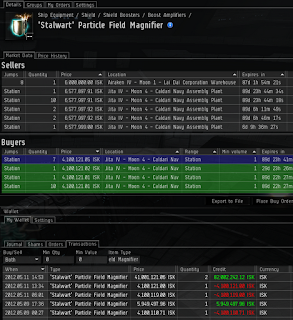 Lesson: Pay attention to your buy orders when you type them in. This guy put an extra "1" in the hundreds digit, and I made about 70 mil off his mistake. Woo!
Recap
30 days ago I gave a fresh alt 5 million isk and just the basic trade skills. Then I almost exclusively traded in stations, setting buy orders and flipping those to sell orders. I started in Jita, moved to Amarr and then to Dodixie, and ended up back in Jita. 5 mil was turned into 1,461 million, or a 29,236% increase is value. Here is the overall chart of the daily reports:


And a record setting day! And this gem happened today:

Recap
30 days ago I gave a fresh alt 5 million isk and just the basic trade skills. Then I almost exclusively traded in stations, setting buy orders and flipping those to sell orders. I started in Jita, moved to Amarr and then to Dodixie, and ended up back in Jita. 5 mil was turned into 1,461 million, or a 29,236% increase is value. Here is the overall chart of the daily reports:

You can see the dips when I moved, as I cleared out stock before moving on.
My final Trade skills are:
- Accounting 4
- Broker Relations 4
- Marketing 4
- Procurement 4
- Retail 4
- Trade 4
I didn't even use all of those skills.
Hypothesis: You can pay for a PLEX with a new character just by station trading.
Results: True.
Addendum
The full guide will be coming with lots more info. I expect to have it done sometime over the weekend. As promised, here is the complete list of items I traded in, pulled from EveHQ, so I make no claims for the accuracy:
| Transaction Trading Report | |||
| from Tuesday, April 10, 2012 to Friday, May 11, 2012 | |||
| Item | Amount Traded | Average Unit Profit | Total Profit |
| 100MN Afterburner II | 10 | 696,441.72 | 6,964,417.21 |
| 10MN MicroWarpdrive II | 2 | 168,664.68 | 337,329.36 |
| 1200mm Artillery Cannon I | 7 | 334,995.60 | 2,344,969.17 |
| 1200mm Artillery Cannon II | 12 | 1,229,084.83 | 14,749,017.98 |
| 1200mm Heavy 'Scout' Artillery I | 28 | 583,923.12 | 16,349,847.39 |
| 125mm Prototype Gauss Gun | 6 | 136,897.88 | 821,387.30 |
| 1400mm Gallium Cannon | 8 | 458,853.80 | 3,670,830.38 |
| 1400mm Prototype Siege Cannon | 15 | 625,820.00 | 9,387,299.97 |
| 1400mm 'Scout' Artillery I | 36 | 787,499.77 | 28,349,991.81 |
| 150mm Light AutoCannon I | 70 | 24,171.72 | 1,692,020.58 |
| 150mm Light Prototype Automatic Cannon | 22 | 87,572.32 | 1,926,590.95 |
| 150mm Light 'Scout' Autocannon I | 15 | 334,822.67 | 5,022,340.08 |
| 1MN Afterburner II | 10 | 528,613.80 | 5,286,138.03 |
| 200mm Compressed Coil Gun I | 14 | 95,853.95 | 1,341,955.32 |
| 200mm Light Carbine Repeating Cannon I | 20 | 198,975.35 | 3,979,506.96 |
| 200mm Light Gallium Machine Gun | 40 | 106,199.89 | 4,247,995.50 |
| 200mm Light 'Scout' Autocannon I | 32 | 489,007.61 | 15,648,243.50 |
| 200mm Prototype Gauss Gun | 26 | 785,169.97 | 20,414,419.22 |
| 200mm Railgun II | 5 | 640,696.27 | 3,203,481.37 |
| 200mm 'Scout' Accelerator Cannon | 10 | 153,799.95 | 1,537,999.53 |
| 220mm Medium Gallium Machine Gun | 22 | 479,051.07 | 10,539,123.64 |
| 220mm Vulcan AutoCannon II | 5 | 339,150.96 | 1,695,754.80 |
| 250mm Light Artillery Cannon I | 20 | 52,497.07 | 1,049,941.41 |
| 350mm Compressed Coil Gun I | 9 | 507,837.39 | 4,570,536.54 |
| 350mm Prototype Gauss Gun | 20 | 505,361.42 | 10,107,228.33 |
| 425mm AutoCannon II | 69 | 402,053.09 | 27,741,663.39 |
| 425mm Medium Gallium Machine Gun | 31 | 585,406.90 | 18,147,613.77 |
| 425mm Medium Prototype Automatic Cannon | 10 | 749,791.81 | 7,497,918.10 |
| 425mm Medium 'Scout' Autocannon I | 27 | 956,597.56 | 25,828,133.99 |
| 425mm Railgun II | 1 | 972,111.00 | 972,111.00 |
| 650mm Artillery Cannon II | 4 | 228,790.37 | 915,161.48 |
| 650mm Medium Prototype Siege Cannon | 20 | 203,999.03 | 4,079,980.60 |
| 650mm Medium 'Scout' Artillery I | 32 | 83,366.64 | 2,667,732.63 |
| 720mm Howitzer Artillery II | 6 | 646,737.61 | 3,880,425.67 |
| Acceleration Control | 10 | 11,847.45 | 118,474.47 |
| Adaptive Invulnerability Field II | 68 | 157,413.69 | 10,704,130.74 |
| Advanced 'Limos' Heavy Missile Bay I | 133 | 200,958.95 | 26,727,540.72 |
| Afterburner | 8 | 95,136.75 | 761,094.00 |
| Anode Electron Particle Cannon I | 7 | 302,799.97 | 2,119,599.80 |
| Anode Light Neutron Particle Cannon I | 15 | 164,052.64 | 2,460,789.65 |
| Anode Mega Neutron Particle Cannon I | 22 | 44,514.23 | 979,313.03 |
| Anode Neutron Particle Cannon I | 56 | 298,895.81 | 16,738,165.45 |
| 'Arbalest' Heavy Missile Launcher | 13 | 2,814,736.79 | 36,591,578.24 |
| 'Arbalest' Rocket Launcher I | 37 | 266,534.99 | 9,861,794.46 |
| Arkonor Mining Crystal II | 3 | 496,999.20 | 1,490,997.60 |
| Balmer Series Tracking Disruptor I | 22 | 737,147.67 | 16,217,248.82 |
| Basic Energized Adaptive Nano Membrane | 36 | 65,316.19 | 2,351,382.99 |
| Beta Reactor Control: Capacitor Power Relay I | 10 | 143,621.09 | 1,436,210.89 |
| Beta Reactor Control: Diagnostic System I | 10 | 134,489.90 | 1,344,898.95 |
| Broken Drone Transceiver | 265 | 36.39 | 9,644.33 |
| BZ-5 Neutralizing Spatial Destabilizer ECM | 20 | 352,944.31 | 7,058,886.29 |
| Cap Recharger I | 97 | 20,483.91 | 1,986,938.83 |
| Command Processor I | 10 | 304,994.96 | 3,049,949.55 |
| Conflagration L | 10 | 332,865.95 | 3,328,659.50 |
| Core Probe Launcher II | 1 | 226,997.99 | 226,997.99 |
| Covert Ops Cloaking Device II | 3 | 1,466,335.07 | 4,399,005.21 |
| Damage Control I | 6 | 452.02 | 2,712.12 |
| Damaged Artificial Neural Network | 111 | 179 | 19,869.00 |
| Drone Synaptic Relay Wiring | 171 | 2.1 | 359.1 |
| Dual 180mm AutoCannon I | 23 | 109,948.96 | 2,528,825.99 |
| Dual 250mm Prototype Gauss Gun | 26 | 182,865.51 | 4,754,503.16 |
| Dual 650mm Repeating Artillery II | 11 | 1,047,128.78 | 11,518,416.57 |
| Dual Heavy Modulated Pulse Energy Beam I | 10 | 324,178.02 | 3,241,780.23 |
| Dual Light Pulse Laser II | 25 | 234,712.98 | 5,867,824.46 |
| Dual Modulated Pulse Energy Beam I | 13 | 443,497.86 | 5,765,472.21 |
| Electron Blaster Cannon II | 3 | 988,993.19 | 2,966,979.56 |
| Energy Grid Upgrades | 2 | 168,853.45 | 337,706.90 |
| Energy Systems Operation | 2 | 49,999.99 | 99,999.98 |
| Enfeebling Phase Inversion ECM I | 40 | 278,241.61 | 11,129,664.40 |
| Evasive Maneuvering | 1 | 47,473.95 | 47,473.95 |
| Expanded Probe Launcher II | 3 | 1,875,631.86 | 5,626,895.57 |
| Experimental 100MN Afterburner I | 50 | 61,888.10 | 3,094,405.01 |
| Experimental 10MN MicroWarpdrive I | 150 | 71,752.98 | 10,762,947.68 |
| Experimental 1MN Afterburner I | 174 | 32,111.99 | 5,587,486.37 |
| F-90 Positional Sensor Subroutines | 16 | 275,573.99 | 4,409,183.90 |
| Faint Epsilon Warp Scrambler I | 47 | 357,181.51 | 16,787,530.91 |
| Fleeting Progressive Warp Scrambler I | 57 | 7,766.50 | 442,690.65 |
| Fleeting Propulsion Inhibitor I | 52 | 570,457.62 | 29,663,795.98 |
| Focused Afocal Pulse Maser I | 3 | 399,997.02 | 1,199,991.06 |
| Focused Anode Medium Particle Stream I | 14 | 292,801.38 | 4,099,219.37 |
| Focused Medium Pulse Laser I | 13 | 192,782.97 | 2,506,178.62 |
| Fuel Conservation | 10 | 4,548.50 | 45,484.97 |
| Gallente Cruiser | 2 | 154,000.01 | 308,000.02 |
| 'Halcyon' Core Equalizer I | 7 | -10,411.92 | -72,883.41 |
| Heat Sink I | 50 | 18,319.04 | 915,952.14 |
| Heavy Modulated Energy Beam I | 56 | 288,943.70 | 16,180,847.36 |
| Heavy Modulated Pulse Energy Beam I | 23 | 857,328.30 | 19,718,550.91 |
| Heavy Pulse Laser I | 2 | 82,990.43 | 165,980.87 |
| Heavy Unstable Power Fluctuator I | 55 | 193,519.71 | 10,643,583.87 |
| Hull Upgrades | 5 | 34,646.00 | 173,230.00 |
| Ion Blaster Cannon II | 9 | 538,250.56 | 4,844,255.05 |
| Kernite Mining Crystal II | 7 | 190,701.46 | 1,334,910.21 |
| Kinetic Deflection Amplifier II | 5 | 189,998.69 | 949,993.44 |
| Kinetic Deflection Field II | 20 | 62,477.04 | 1,249,540.90 |
| Large Armor Repairer I | 60 | 260,078.24 | 15,604,694.11 |
| Large Automated Carapace Restoration | 20 | -1.01 | -20.2 |
| Large Energy Transfer Array II | 9 | 963,890.86 | 8,675,017.74 |
| Large F-S9 Regolith Shield Induction | 40 | 51,340.17 | 2,053,606.73 |
| Large Remote Armor Repair System II | 5 | 458,622.08 | 2,293,110.40 |
| Large Shield Booster II | 6 | 255,266.13 | 1,531,596.75 |
| Light Electron Blaster I | 100 | 10,919.84 | 1,091,983.89 |
| Light Electron Blaster II | 6 | 616,341.46 | 3,698,048.78 |
| Light Neutron Blaster I | 288 | 24,411.14 | 7,030,407.57 |
| Low Frequency Sensor Suppressor I | 37 | 230,864.74 | 8,541,995.52 |
| Mark I Generator Refitting: Diagnostic System | 100 | 13,322.19 | 1,332,219.34 |
| Medium Anode Pulse Particle Stream I | 10 | 76,479.45 | 764,794.50 |
| Medium Electrochemical Capacitor Booster I | 1 | 0.66 | 0.66 |
| Medium Inefficient Armor Repair Unit | 19 | 17,678.86 | 335,898.30 |
| Medium Modulated Pulse Energy Beam I | 28 | 558,063.91 | 15,625,789.49 |
| Medium Nanobot Accelerator I | 5 | 875,687.91 | 4,378,439.54 |
| Medium Pulse Laser II | 37 | 354,620.02 | 13,120,940.56 |
| Medium Remote Armor Repair System II | 5 | 547,998.41 | 2,739,992.07 |
| Medium Semiconductor Memory Cell I | 1 | 2,147,877.19 | 2,147,877.19 |
| Medium Unstable Power Fluctuator I | 49 | 847,621.94 | 41,533,475.14 |
| Mega Modal Pulse Laser I | 14 | 1,336,236.11 | 18,707,305.48 |
| Mega Modulated Energy Beam I | 81 | 226,634.41 | 18,357,387.17 |
| Mega Modulated Pulse Energy Beam I | 12 | 157,040.48 | 1,884,485.81 |
| Micro Auxiliary Power Core I | 10 | 88,996.35 | 889,963.50 |
| Micro Auxiliary Power Core II | 8 | 1,652,367.52 | 13,218,940.17 |
| Mining Laser Upgrade II | 18 | 737,279.38 | 13,271,028.88 |
| Mobile Medium Warp Disruptor I | 3 | 1,279,051.74 | 3,837,155.21 |
| Modal Electron Particle Accelerator I | 3 | 3,150,286.43 | 9,450,859.29 |
| Modal Ion Particle Accelerator I | 33 | 1,085,437.43 | 35,819,435.23 |
| Modal Light Neutron Particle Accelerator I | 31 | 475,366.28 | 14,736,354.76 |
| Modal Mega Neutron Particle Accelerator I | 15 | 874,624.68 | 13,119,370.13 |
| Modal Neutron Particle Accelerator I | 51 | 1,132,616.64 | 57,763,448.63 |
| Modulated Strip Miner II | 23 | 1,672,616.19 | 38,470,172.29 |
| Parallel Weapon Navigation Transmitter | 20 | 188,998.97 | 3,779,979.40 |
| Phased Muon Sensor Disruptor I | 29 | 611,291.03 | 17,727,439.83 |
| Phased Weapon Navigation Array Generation Extron | 44 | 794,320.24 | 34,950,090.70 |
| Power Diagnostic System II | 28 | 104,687.50 | 2,931,249.87 |
| Prototype 'Arbalest' Heavy Assault Missile Launcher I | 36 | 460,588.90 | 16,581,200.41 |
| Prototype 'Arbalest' Light Missile Launcher | 24 | 314,951.56 | 7,558,837.36 |
| Prototype Cloaking Device I | 3 | 298,661.22 | 895,983.65 |
| Prototype Sensor Booster | 50 | 86,737.80 | 4,336,889.79 |
| Regulated Mega Neutron Phase Cannon I | 17 | 81,000.27 | 1,377,004.51 |
| Retail | 11 | 27,986.21 | 307,848.27 |
| Scorch M | 2 | 194,843.99 | 389,687.98 |
| Scorch S | 4 | 186,791.91 | 747,167.64 |
| Shield Boost Amplifier I | 10 | 169,872.73 | 1,698,727.27 |
| Shield Boost Amplifier II | 10 | 108,459.95 | 1,084,599.53 |
| Shield Power Relay I | 100 | 20,028.50 | 2,002,849.58 |
| Shield Power Relay II | 10 | 158,981.66 | 1,589,816.64 |
| Shield Recharger II | 36 | 63,734.36 | 2,294,437.07 |
| Small Auxiliary Thrusters I | 10 | 67,691.84 | 676,918.40 |
| Small Cargohold Optimization I | 2 | 349,998.97 | 699,997.94 |
| Small Diminishing Power System Drain I | 1 | 349,997.83 | 349,997.83 |
| Small Energy Neutralizer II | 13 | 636,544.07 | 8,275,072.93 |
| Small Shield Booster II | 4 | 175,395.40 | 701,581.58 |
| Small Unstable Power Fluctuator I | 12 | 564,236.33 | 6,770,835.99 |
| 'Stalwart' Particle Field Magnifier | 3 | 25,217,129.79 | 75,651,389.37 |
| Tachyon Beam Laser II | 5 | 1,031,320.67 | 5,156,603.33 |
| Tachyon Modulated Energy Beam I | 45 | 260,934.48 | 11,742,051.62 |
| Thermic Dissipation Field II | 38 | 254,820.10 | 9,683,163.80 |
| Trade | 6 | 56,492.41 | 338,954.48 |
| Upgraded 1MN Microwarpdrive I | 5 | 41,323.18 | 206,615.92 |
| Warp Core Stabilizer II | 35 | 384,619.21 | 13,461,672.34 |
| Warp Scrambler II | 2 | 299,888.33 | 599,776.65 |
| X-Large C5-L Emergency Shield Overload I | 10 | 753,397.99 | 7,533,979.93 |
| X-Large Shield Booster II | 15 | 581,089.96 | 8,716,349.34 |
Subscribe to:
Posts (Atom)
