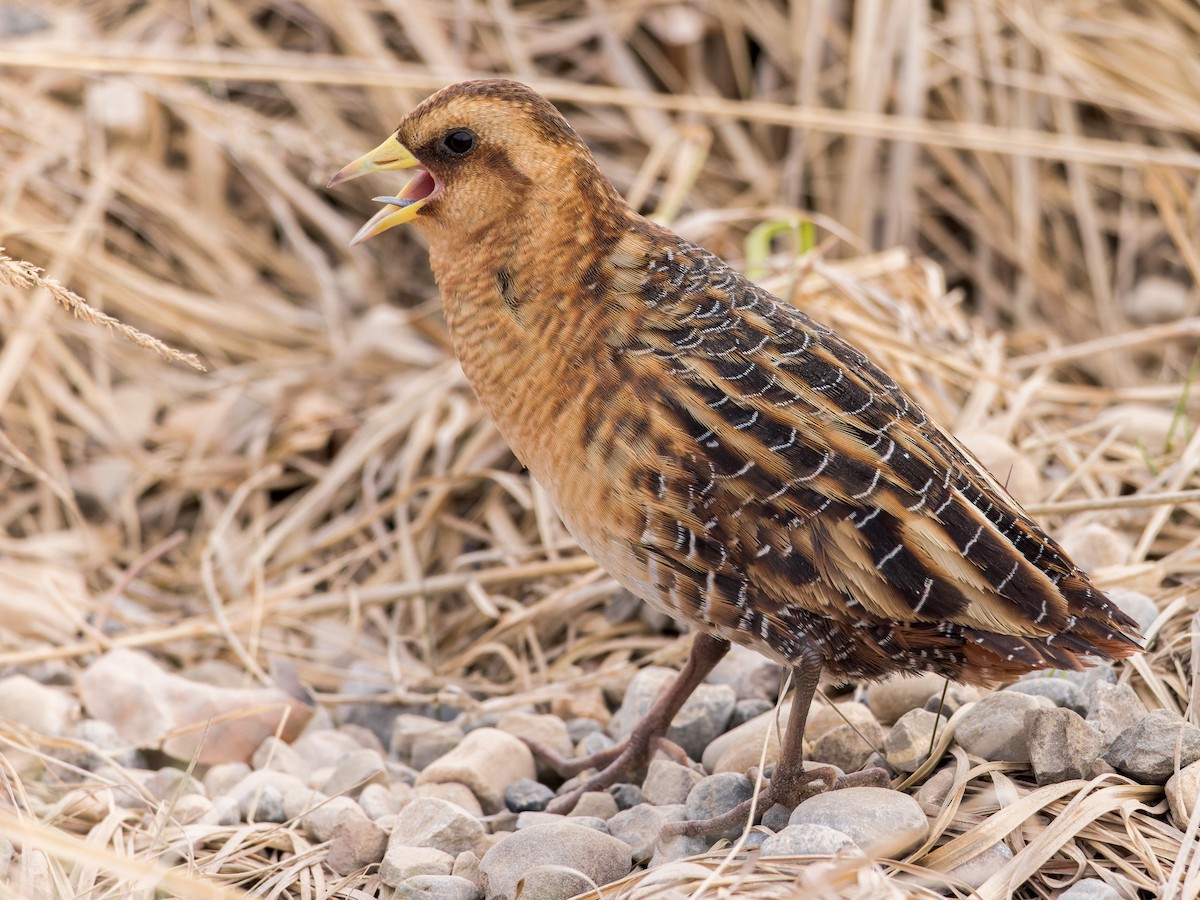
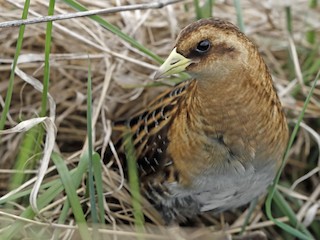
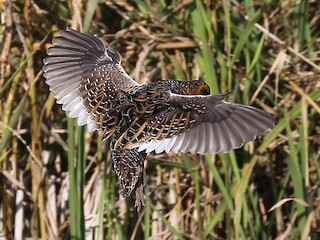
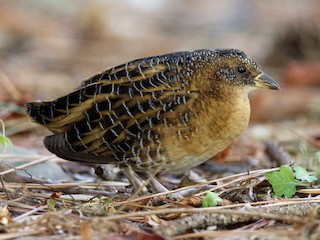
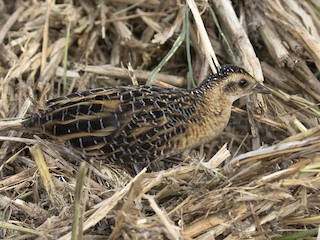

Yellow Rail Coturnicops noveboracensis Scientific name definitions
- LC Least Concern
- Names (29)
- Subspecies (2)
Text last updated March 2, 2015
Sign in to see your badges
Species names in eBird-supported languages
| Language | Common name |
|---|---|
| Afrikaans | Geelriethaan |
| Azerbaijani | Sarı yelbə |
| Bulgarian | Жълта пъструшка |
| Catalan | rasclet groguenc |
| Chinese (SIM) | 北美花田鸡 |
| Croatian | smeđi prepeličar |
| Czech | chřástal žlutavý |
| Danish | Gul Vagtelrikse |
| Dutch | Gele Ral |
| English | Yellow Rail |
| English (AVI) | Yellow Rail |
| English (United States) | Yellow Rail |
| Estonian | kold-vuttruik |
| Finnish | kultarääkkiäinen |
| French | Râle jaune |
| German | Gelbralle |
| Icelandic | Sólrella |
| Japanese | アメリカシマクイナ |
| Norwegian | okerrikse |
| Polish | rudokurka żółtawa |
| Russian | Жёлтая курочка-малютка |
| Serbian | Žuti barski petlić |
| Slovak | chriašteľ okrový |
| Spanish | Polluela amarillenta |
| Spanish (Mexico) | Polluela Amarilla |
| Spanish (Spain) | Polluela amarillenta |
| Swedish | gul dvärgrall |
| Turkish | Büyük Çil Yelvesi |
| Ukrainian | Погонич-пігмей жовтий |
Coturnicops noveboracensis (Gmelin, 1789)
Definitions
- COTURNICOPS
- noveboracensis
The Key to Scientific Names
Legend Overview
Originally Appeared in
Content Partner

Full content is available exclusively to Birds of the World subscribers. Sign in Learn more
Introduction
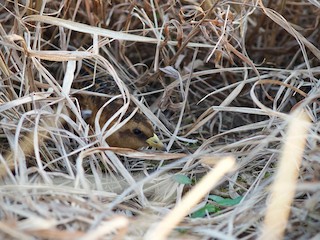
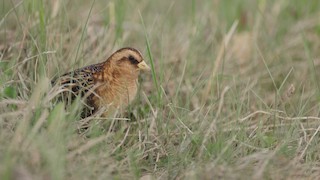
This secretive bird, the second smallest of North American rails, is likely more abundant than encounters would indicate. It is extremely difficult to observe because, like other rails, it prefers to run or hide instead of flying and commonly moves beneath procumbent vegetation. Sprunt's (Sprunt 1970: 197) description is revealing: “the Yellow Rail is much more like a small mammal than a bird. It slips silently through the grasses like a phantom, barely keeping out of the way of one's feet. The observer may be within inches of the birds and yet never catch a glimpse of them.”
The male's call during the breeding season, given most frequently after complete darkness, is a unique metallic 5-note call, click-click, click-click-click, easily imitated by tapping two stones together. Individual birds respond to such imitations, often approaching closely enough to be captured.
This species is widely distributed in the United States and Canada, chiefly east of the Rocky Mountains. Within the breeding range, however, its presence is quite local. Breeding birds generally inhabit fresh- and brackish-water marshes, preferring the higher (drier) margins. In autumn this rail is found in varied habitats such as hay fields, grain fields, and wet meadows, as well as in interior and coastal marshlands. Its principal foods are snails, other aquatic invertebrates, and seeds. The Yellow Rail, not legally hunted in any state or province, is listed as Threatened or Endangered in some states and as Vulnerable in Quebec. Vernacular names include Yellow Crake and Clicker.
Two subspecies are recognized in North America: Coturnicops noveboracensis noveboracensis of Canada and the United States, and C. n. goldmani, known only from the state of México, Mexico, and possibly extinct.
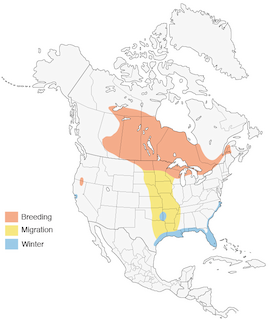
- Year-round
- Migration
- Breeding
- Non-Breeding
Very local breeder throughout range. Casual to other U.S. states.