


Ring (mathematics)
| Algebraic structure → Ring theory Ring theory |
|---|
|
Rings
Related structures
|


In mathematics, a ring is an algebraic structure consisting of a set with two binary operations typically called addition and multiplication and denoted like addition and multiplication of integers. They work similarly to integer addition and multiplication, except that multiplication in a ring does not need to be commutative. Ring elements may be numbers such as integers or complex numbers, but they may also be non-numerical objects such as polynomials, square matrices, functions, and power series.
| Algebraic structures |
|---|
More formally, a ring is a set that is endowed with two binary operations (addition and multiplication) such that the ring is an abelian group with respect to addition. The multiplication is associative, is distributive over the addition operation, and has a multiplicative identity element. Some authors apply the term ring to a further generalization, often called a rng, that omits the requirement for a multiplicative identity, and instead call the structure defined above a ring with identity.
A commutative ring is a ring with a commutative multiplication. This property has profound implications on ring properties. Commutative algebra, the theory of commutative rings, is a major branch of ring theory. Its development has been greatly influenced by problems and ideas of algebraic number theory and algebraic geometry. In turn, commutative algebra is a fundamental tool in these branches of mathematics.
Examples of commutative rings include every field (such as the real or complex numbers), the integers, the polynomials in one or several variables with coefficients in another ring, the coordinate ring of an affine algebraic variety, and the ring of integers of a number field. Examples of noncommutative rings include the ring of n × n real square matrices with n ≥ 2, group rings in representation theory, operator algebras in functional analysis, rings of differential operators, and cohomology rings in topology.
The conceptualization of rings spanned the 1870s to the 1920s, with key contributions by Richard Dedekind, David Hilbert, Abraham Fraenkel, and Emmy Noether. Rings were first formalized as a generalization of Dedekind domains that occur in number theory, and of polynomial rings and rings of invariants that occur in algebraic geometry and invariant theory. They later proved useful in other branches of mathematics such as geometry and analysis.
Rings appear in the following chain of class inclusions:
Definition
[edit]A ring is a set R equipped with two binary operations[a] + (addition) and ⋅ (multiplication) satisfying the following three sets of axioms, called the ring axioms:[1][2][3]
- R is an abelian group under addition, meaning that:
- (a + b) + c = a + (b + c) for all a, b, c in R (that is, + is associative).
- a + b = b + a for all a, b in R (that is, + is commutative).
- There is an element 0 in R such that a + 0 = a for all a in R (that is, 0 is an additive identity).
- For each a in R there exists −a in R such that a + (−a) = 0 (that is, −a is the additive inverse of a).
- R is a monoid under multiplication, meaning that:
- (a · b) · c = a · (b · c) for all a, b, c in R (that is, ⋅ is associative).
- There is an element 1 in R such that a · 1 = a and 1 · a = a for all a in R (that is, 1 is a multiplicative identity).[b]
- Multiplication is distributive with respect to addition, meaning that:
- a · (b + c) = (a · b) + (a · c) for all a, b, c in R (left distributivity).
- (b + c) · a = (b · a) + (c · a) for all a, b, c in R (right distributivity).
In notation, the multiplication symbol · is often omitted, in which case a · b is written as ab.
Variations on terminology
[edit]In the terminology of this article, a ring is defined to have a multiplicative identity, while a structure with the same axiomatic definition but without the requirement for a multiplicative identity is instead called a "rng" (IPA: /rʊŋ/) with a missing "i". For example, the set of even integers with the usual + and ⋅ is a rng, but not a ring. As explained in § History below, many authors apply the term "ring" without requiring a multiplicative identity.
Although ring addition is commutative, ring multiplication is not required to be commutative: ab need not necessarily equal ba. Rings that also satisfy commutativity for multiplication (such as the ring of integers) are called commutative rings. Books on commutative algebra or algebraic geometry often adopt the convention that ring means commutative ring, to simplify terminology.
In a ring, multiplicative inverses are not required to exist. A nonzero ring in which every nonzero element has a multiplicative inverse is called a division ring and a commutative division ring is called a field.
The additive group of a ring is the underlying set equipped with only the operation of addition. Although the definition requires that the additive group be abelian, this can be inferred from the other ring axioms.[4] The proof makes use of the "1", and does not work in a rng. (For a rng, omitting the axiom of commutativity of addition leaves it inferable from the remaining rng assumptions only for elements that are products: ab + cd = cd + ab.)
Some authors use the term "ring" to refer to structures in which there is no requirement for multiplication to be associative; see the nonassociative ring subsection below.[5] For these authors, every algebra is a "ring".
Illustration
[edit]
The most familiar example of a ring is the set of all integers consisting of the numbers


The axioms of a ring are modeled on familiar properties of addition and multiplication of integers.
Some properties
[edit]Some basic properties of a ring follow immediately from the axioms:
- The additive identity is unique.
- The additive inverse of each element is unique.
- The multiplicative identity is unique.
- For any element x in a ring R, one has x0 = 0 = 0x (zero is an absorbing element with respect to multiplication) and (–1)x = –x.
- If 0 = 1 in a ring R (or more generally, 0 is a unit element), then R has only one element, and is called the zero ring.
- If a ring R contains the zero ring as a subring, then R itself is the zero ring.[6]
- The binomial formula holds for any x and y satisfying xy = yx.
Example: Integers modulo 4
[edit]Equip the set with the following operations:
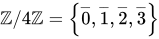
- The sum in is the remainder when the integer x + y is divided by 4 (as x + y is always smaller than 8, this remainder is either x + y or x + y − 4). For example, and
- The product in is the remainder when the integer xy is divided by 4. For example, and


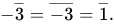
Then is a ring: each axiom follows from the corresponding axiom for If x is an integer, the remainder of x when divided by 4 may be considered as an element of and this element is often denoted by "x mod 4" or which is consistent with the notation for 0, 1, 2, 3. The additive inverse of any in is For example,


Example: 2-by-2 matrices
[edit]The set of 2-by-2 square matrices with entries in a field F is[7][8][9][10]

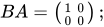
With the operations of matrix addition and matrix multiplication, satisfies the above ring axioms. The element is the multiplicative identity of the ring. If and then while this example shows that the ring is noncommutative.


More generally, for any ring R, commutative or not, and any nonnegative integer n, the square n × n matrices with entries in R form a ring; see Matrix ring.
History
[edit]
Dedekind
[edit]The study of rings originated from the theory of polynomial rings and the theory of algebraic integers.[11] In 1871, Richard Dedekind defined the concept of the ring of integers of a number field.[12] In this context, he introduced the terms "ideal" (inspired by Ernst Kummer's notion of ideal number) and "module" and studied their properties. Dedekind did not use the term "ring" and did not define the concept of a ring in a general setting.
Hilbert
[edit]The term "Zahlring" (number ring) was coined by David Hilbert in 1892 and published in 1897.[13] According to Harvey Cohn, Hilbert used the term for a ring that had the property of "circling directly back" to an element of itself (in the sense of an equivalence).[14] Specifically, in a ring of algebraic integers, all high powers of an algebraic integer can be written as an integral combination of a fixed set of lower powers, and thus the powers "cycle back". For instance, if a3 − 4a + 1 = 0 then:
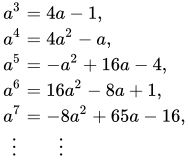
and so on; in general, an is going to be an integral linear combination of 1, a, and a2.
Fraenkel and Noether
[edit]The first axiomatic definition of a ring was given by Abraham Fraenkel in 1915,[15][16] but his axioms were stricter than those in the modern definition. For instance, he required every non-zero-divisor to have a multiplicative inverse.[17] In 1921, Emmy Noether gave a modern axiomatic definition of commutative rings (with and without 1) and developed the foundations of commutative ring theory in her paper Idealtheorie in Ringbereichen.[18]
Multiplicative identity and the term "ring"
[edit]Fraenkel applied the term "ring" to structures with axioms that included a multiplicative identity,[19] whereas Noether applied it to structures that did not.[18]
Most or all books on algebra[20][21] up to around 1960 followed Noether's convention of not requiring a 1 for a "ring". Starting in the 1960s, it became increasingly common to see books including the existence of 1 in the definition of "ring", especially in advanced books by notable authors such as Artin,[22] Bourbaki,[23] Eisenbud,[24] and Lang.[3] There are also books published as late as 2022 that use the term without the requirement for a 1.[25][26][27][28] Likewise, the Encyclopedia of Mathematics does not require unit elements in rings.[29] In a research article, the authors often specify which definition of ring they use in the beginning of that article.
Gardner and Wiegandt assert that, when dealing with several objects in the category of rings (as opposed to working with a fixed ring), if one requires all rings to have a 1, then some consequences include the lack of existence of infinite direct sums of rings, and that proper direct summands of rings are not subrings. They conclude that "in many, maybe most, branches of ring theory the requirement of the existence of a unity element is not sensible, and therefore unacceptable."[30] Poonen makes the counterargument that the natural notion for rings would be the direct product rather than the direct sum. However, his main argument is that rings without a multiplicative identity are not totally associative, in the sense that they do not contain the product of any finite sequence of ring elements, including the empty sequence.[c][31]
Authors who follow either convention for the use of the term "ring" may use one of the following terms to refer to objects satisfying the other convention:
- to include a requirement for a multiplicative identity: "unital ring", "unitary ring", "unit ring", "ring with unity", "ring with identity", "ring with a unit",[32] or "ring with 1".[33]
- to omit a requirement for a multiplicative identity: "rng"[34] or "pseudo-ring",[35] although the latter may be confusing because it also has other meanings.
Basic examples
[edit]Commutative rings
[edit]- The prototypical example is the ring of integers with the two operations of addition and multiplication.
- The rational, real and complex numbers are commutative rings of a type called fields.
- A unital associative algebra over a commutative ring R is itself a ring as well as an R-module. Some examples:
- The algebra R[X] of polynomials with coefficients in R.
- The algebra of formal power series with coefficients in R.
- The set of all continuous real-valued functions defined on the real line forms a commutative -algebra. The operations are pointwise addition and multiplication of functions.
- Let X be a set, and let R be a ring. Then the set of all functions from X to R forms a ring, which is commutative if R is commutative.
- The ring of quadratic integers, the integral closure of in a quadratic extension of It is a subring of the ring of all algebraic integers.
- The ring of profinite integers the (infinite) product of the rings of p-adic integers over all prime numbers p.
- The Hecke ring, the ring generated by Hecke operators.
- If S is a set, then the power set of S becomes a ring if we define addition to be the symmetric difference of sets and multiplication to be intersection. This is an example of a Boolean ring.
![{\displaystyle R[[X_{1},\dots ,X_{n}]]}](https://wikimedia.org/api/rest_v1/media/math/render/svg/9faeec0b7c5fd0fcd5c02b2d94988eb501c67591)


Noncommutative rings
[edit]- For any ring R and any natural number n, the set of all square n-by-n matrices with entries from R, forms a ring with matrix addition and matrix multiplication as operations. For n = 1, this matrix ring is isomorphic to R itself. For n > 1 (and R not the zero ring), this matrix ring is noncommutative.
- If G is an abelian group, then the endomorphisms of G form a ring, the endomorphism ring End(G) of G. The operations in this ring are addition and composition of endomorphisms. More generally, if V is a left module over a ring R, then the set of all R-linear maps forms a ring, also called the endomorphism ring and denoted by EndR(V).
- The endomorphism ring of an elliptic curve. It is a commutative ring if the elliptic curve is defined over a field of characteristic zero.
- If G is a group and R is a ring, the group ring of G over R is a free module over R having G as basis. Multiplication is defined by the rules that the elements of G commute with the elements of R and multiply together as they do in the group G.
- The ring of differential operators (depending on the context). In fact, many rings that appear in analysis are noncommutative. For example, most Banach algebras are noncommutative.
Non-rings
[edit]- The set of natural numbers with the usual operations is not a ring, since is not even a group (not all the elements are invertible with respect to addition – for instance, there is no natural number which can be added to 3 to get 0 as a result). There is a natural way to enlarge it to a ring, by including negative numbers to produce the ring of integers The natural numbers (including 0) form an algebraic structure known as a semiring (which has all of the axioms of a ring excluding that of an additive inverse).
- Let R be the set of all continuous functions on the real line that vanish outside a bounded interval that depends on the function, with addition as usual but with multiplication defined as convolution: Then R is a rng, but not a ring: the Dirac delta function has the property of a multiplicative identity, but it is not a function and hence is not an element of R.



Basic concepts
[edit]Products and powers
[edit]For each nonnegative integer n, given a sequence of n elements of R, one can define the product recursively: let P0 = 1 and let Pm = Pm−1am for 1 ≤ m ≤ n.

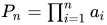
As a special case, one can define nonnegative integer powers of an element a of a ring: a0 = 1 and an = an−1a for n ≥ 1. Then am+n = aman for all m, n ≥ 0.
Elements in a ring
[edit]A left zero divisor of a ring R is an element a in the ring such that there exists a nonzero element b of R such that ab = 0.[d] A right zero divisor is defined similarly.
A nilpotent element is an element a such that an = 0 for some n > 0. One example of a nilpotent element is a nilpotent matrix. A nilpotent element in a nonzero ring is necessarily a zero divisor.
An idempotent is an element such that e2 = e. One example of an idempotent element is a projection in linear algebra.

A unit is an element a having a multiplicative inverse; in this case the inverse is unique, and is denoted by a–1. The set of units of a ring is a group under ring multiplication; this group is denoted by R× or R* or U(R). For example, if R is the ring of all square matrices of size n over a field, then R× consists of the set of all invertible matrices of size n, and is called the general linear group.
Subring
[edit]A subset S of R is called a subring if any one of the following equivalent conditions holds:
- the addition and multiplication of R restrict to give operations S × S → S making S a ring with the same multiplicative identity as R.
- 1 ∈ S; and for all x, y in S, the elements xy, x + y, and −x are in S.
- S can be equipped with operations making it a ring such that the inclusion map S → R is a ring homomorphism.
For example, the ring of integers is a subring of the field of real numbers and also a subring of the ring of polynomials (in both cases, contains 1, which is the multiplicative identity of the larger rings). On the other hand, the subset of even integers does not contain the identity element 1 and thus does not qualify as a subring of one could call a subrng, however.
![{\displaystyle \mathbb {Z} [X]}](https://wikimedia.org/api/rest_v1/media/math/render/svg/5a538d203a057d4c604f799c28e9a7be410fdcac)


An intersection of subrings is a subring. Given a subset E of R, the smallest subring of R containing E is the intersection of all subrings of R containing E, and it is called the subring generated by E.
For a ring R, the smallest subring of R is called the characteristic subring of R. It can be generated through addition of copies of 1 and −1. It is possible that n · 1 = 1 + 1 + ... + 1 (n times) can be zero. If n is the smallest positive integer such that this occurs, then n is called the characteristic of R. In some rings, n · 1 is never zero for any positive integer n, and those rings are said to have characteristic zero.
Given a ring R, let Z(R) denote the set of all elements x in R such that x commutes with every element in R: xy = yx for any y in R. Then Z(R) is a subring of R, called the center of R. More generally, given a subset X of R, let S be the set of all elements in R that commute with every element in X. Then S is a subring of R, called the centralizer (or commutant) of X. The center is the centralizer of the entire ring R. Elements or subsets of the center are said to be central in R; they (each individually) generate a subring of the center.
Ideal
[edit]Let R be a ring. A left ideal of R is a nonempty subset I of R such that for any x, y in I and r in R, the elements x + y and rx are in I. Let RI denote the R-span of I, that is, the set of finite sums

then I is a left ideal if RI ⊆ I. Similarly, a right ideal is a subset I such that IR ⊆ I. A subset I is said to be a two-sided ideal or simply ideal if it is both a left ideal and right ideal. A one-sided or two-sided ideal is then an additive subgroup of R. If E is a subset of R, then RE is a left ideal, called the left ideal generated by E; it is the smallest left ideal containing E. Similarly, one can consider the right ideal or the two-sided ideal generated by a subset of R.
If x is in R, then Rx is a left ideal, and xR is a right ideal; they are called the principal left ideal and right ideal generated by x. The principal ideal RxR is written as (x). For example, the set of all positive and negative multiples of 2 along with 0 form an ideal of the integers, and this ideal is generated by the integer 2. In fact, every ideal of the ring of integers is principal.
A ring is simple if it is nonzero and it has no proper nonzero two-sided ideals. A commutative simple ring is precisely a field.
Rings are often studied with special conditions set upon their ideals. For example, a ring in which there is no strictly increasing infinite chain of left ideals is called a left Noetherian ring. A ring in which there is no strictly decreasing infinite chain of left ideals is called a left Artinian ring. It is a somewhat surprising fact that a left Artinian ring is left Noetherian (the Hopkins–Levitzki theorem). The integers, however, form a Noetherian ring which is not Artinian.
For commutative rings, the ideals generalize the classical notion of divisibility and decomposition of an integer into prime numbers in algebra. A proper ideal P of R is called a prime ideal if for any elements we have that implies either or Equivalently, P is prime if for any ideals I, J we have that IJ ⊆ P implies either I ⊆ P or J ⊆ P. This latter formulation illustrates the idea of ideals as generalizations of elements.


Homomorphism
[edit]A homomorphism from a ring (R, +, ⋅) to a ring (S, ‡, ∗) is a function f from R to S that preserves the ring operations; namely, such that, for all a, b in R the following identities hold:
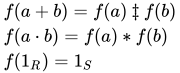
If one is working with rngs, then the third condition is dropped.
A ring homomorphism f is said to be an isomorphism if there exists an inverse homomorphism to f (that is, a ring homomorphism that is an inverse function), or equivalently if it is bijective.
Examples:
- The function that maps each integer x to its remainder modulo 4 (a number in {0, 1, 2, 3}) is a homomorphism from the ring to the quotient ring ("quotient ring" is defined below).
- If u is a unit element in a ring R, then is a ring homomorphism, called an inner automorphism of R.
- Let R be a commutative ring of prime characteristic p. Then x ↦ xp is a ring endomorphism of R called the Frobenius homomorphism.
- The Galois group of a field extension L / K is the set of all automorphisms of L whose restrictions to K are the identity.
- For any ring R, there is a unique ring homomorphism , and there is a unique ring homomorphism .
- An algebra homomorphism from a k-algebra to the endomorphism algebra of a vector space over k is called a representation of the algebra.



Given a ring homomorphism f : R → S, the set of all elements mapped to 0 by f is called the kernel of f. The kernel is a two-sided ideal of R. The image of f, on the other hand, is not always an ideal, but it is always a subring of S.
To give a ring homomorphism from a commutative ring R to a ring A with image contained in the center of A is the same as to give a structure of an algebra over R to A (which in particular gives a structure of an A-module).
Quotient ring
[edit]The notion of quotient ring is analogous to the notion of a quotient group. Given a ring (R, +, ⋅) and a two-sided ideal I of (R, +, ⋅), view I as subgroup of (R, +); then the quotient ring R / I is the set of cosets of I together with the operations

for all a, b in R. The ring R / I is also called a factor ring.
As with a quotient group, there is a canonical homomorphism p : R → R / I, given by x ↦ x + I. It is surjective and satisfies the following universal property:
- If f : R → S is a ring homomorphism such that f(I) = 0, then there is a unique homomorphism such that
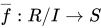

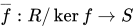
For any ring homomorphism f : R → S, invoking the universal property with I = ker f produces a homomorphism that gives an isomorphism from R / ker f to the image of f.
Modules
[edit]The concept of a module over a ring generalizes the concept of a vector space (over a field) by generalizing from multiplication of vectors with elements of a field (scalar multiplication) to multiplication with elements of a ring. More precisely, given a ring R, an R-module M is an abelian group equipped with an operation R × M → M (associating an element of M to every pair of an element of R and an element of M) that satisfies certain axioms. This operation is commonly denoted by juxtaposition and called multiplication. The axioms of modules are the following: for all a, b in R and all x, y in M,
- M is an abelian group under addition.
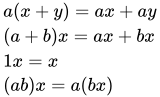
When the ring is noncommutative these axioms define left modules; right modules are defined similarly by writing xa instead of ax. This is not only a change of notation, as the last axiom of right modules (that is x(ab) = (xa)b) becomes (ab)x = b(ax), if left multiplication (by ring elements) is used for a right module.
Basic examples of modules are ideals, including the ring itself.
Although similarly defined, the theory of modules is much more complicated than that of vector space, mainly, because, unlike vector spaces, modules are not characterized (up to an isomorphism) by a single invariant (the dimension of a vector space). In particular, not all modules have a basis.
The axioms of modules imply that (−1)x = −x, where the first minus denotes the additive inverse in the ring and the second minus the additive inverse in the module. Using this and denoting repeated addition by a multiplication by a positive integer allows identifying abelian groups with modules over the ring of integers.
Any ring homomorphism induces a structure of a module: if f : R → S is a ring homomorphism, then S is a left module over R by the multiplication: rs = f(r)s. If R is commutative or if f(R) is contained in the center of S, the ring S is called a R-algebra. In particular, every ring is an algebra over the integers.
Constructions
[edit]Direct product
[edit]Let R and S be rings. Then the product R × S can be equipped with the following natural ring structure:

for all r1, r2 in R and s1, s2 in S. The ring R × S with the above operations of addition and multiplication and the multiplicative identity (1, 1) is called the direct product of R with S. The same construction also works for an arbitrary family of rings: if Ri are rings indexed by a set I, then is a ring with componentwise addition and multiplication.

Let R be a commutative ring and be ideals such that whenever i ≠ j. Then the Chinese remainder theorem says there is a canonical ring isomorphism:

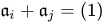

A "finite" direct product may also be viewed as a direct sum of ideals.[36] Namely, let be rings, the inclusions with the images (in particular are rings though not subrings). Then are ideals of R and as a direct sum of abelian groups (because for abelian groups finite products are the same as direct sums). Clearly the direct sum of such ideals also defines a product of rings that is isomorphic to R. Equivalently, the above can be done through central idempotents. Assume that R has the above decomposition. Then we can write By the conditions on one has that ei are central idempotents and eiej = 0, i ≠ j (orthogonal). Again, one can reverse the construction. Namely, if one is given a partition of 1 in orthogonal central idempotents, then let which are two-sided ideals. If each ei is not a sum of orthogonal central idempotents,[e] then their direct sum is isomorphic to R.







An important application of an infinite direct product is the construction of a projective limit of rings (see below). Another application is a restricted product of a family of rings (cf. adele ring).
Polynomial ring
[edit]Given a symbol t (called a variable) and a commutative ring R, the set of polynomials
![{\displaystyle R[t]=\left\{a_{n}t^{n}+a_{n-1}t^{n-1}+\dots +a_{1}t+a_{0}\mid n\geq 0,a_{j}\in R\right\}}](https://wikimedia.org/api/rest_v1/media/math/render/svg/3eebb362f161716c1bcb50a5656fbfbc21532a5d)
forms a commutative ring with the usual addition and multiplication, containing R as a subring. It is called the polynomial ring over R. More generally, the set of all polynomials in variables forms a commutative ring, containing as subrings.
![{\displaystyle R\left[t_{1},\ldots ,t_{n}\right]}](https://wikimedia.org/api/rest_v1/media/math/render/svg/dc4cf3e812fcb5095239260dbc2ba56ceae257e5)

![{\displaystyle R\left[t_{i}\right]}](https://wikimedia.org/api/rest_v1/media/math/render/svg/1e9b4f740e9cf30c4b29d9510608e04a28906ec6)
If R is an integral domain, then R[t] is also an integral domain; its field of fractions is the field of rational functions. If R is a Noetherian ring, then R[t] is a Noetherian ring. If R is a unique factorization domain, then R[t] is a unique factorization domain. Finally, R is a field if and only if R[t] is a principal ideal domain.
Let be commutative rings. Given an element x of S, one can consider the ring homomorphism

![{\displaystyle R[t]\to S,\quad f\mapsto f(x)}](https://wikimedia.org/api/rest_v1/media/math/render/svg/0226daa10f64386e959d3aadf12fb73e82b45082)
(that is, the substitution). If S = R[t] and x = t, then f(t) = f. Because of this, the polynomial f is often also denoted by f(t). The image of the map is denoted by R[x]; it is the same thing as the subring of S generated by R and x.

Example: denotes the image of the homomorphism
![{\displaystyle k\left[t^{2},t^{3}\right]}](https://wikimedia.org/api/rest_v1/media/math/render/svg/2e4541532126a442f0b3099109c17c60a30b0bb5)
![{\displaystyle k[x,y]\to k[t],\,f\mapsto f\left(t^{2},t^{3}\right).}](https://wikimedia.org/api/rest_v1/media/math/render/svg/70de42b23023914ef0b1a1e71bcff1fdc76af67b)
In other words, it is the subalgebra of k[t] generated by t2 and t3.
Example: let f be a polynomial in one variable, that is, an element in a polynomial ring R. Then f(x + h) is an element in R[h] and f(x + h) – f(x) is divisible by h in that ring. The result of substituting zero to h in (f(x + h) – f(x)) / h is f' (x), the derivative of f at x.
The substitution is a special case of the universal property of a polynomial ring. The property states: given a ring homomorphism and an element x in S there exists a unique ring homomorphism such that and restricts to ϕ.[37] For example, choosing a basis, a symmetric algebra satisfies the universal property and so is a polynomial ring.

![{\displaystyle {\overline {\phi }}:R[t]\to S}](https://wikimedia.org/api/rest_v1/media/math/render/svg/a9727858171f165d5705e60857e97068df5611bd)


To give an example, let S be the ring of all functions from R to itself; the addition and the multiplication are those of functions. Let x be the identity function. Each r in R defines a constant function, giving rise to the homomorphism R → S. The universal property says that this map extends uniquely to
![{\displaystyle R[t]\to S,\quad f\mapsto {\overline {f}}}](https://wikimedia.org/api/rest_v1/media/math/render/svg/15eb76de81b0c53d2b82343a721fc4d0cc6f6e29)
(t maps to x) where is the polynomial function defined by f. The resulting map is injective if and only if R is infinite.

Given a non-constant monic polynomial f in R[t], there exists a ring S containing R such that f is a product of linear factors in S[t].[38]
Let k be an algebraically closed field. The Hilbert's Nullstellensatz (theorem of zeros) states that there is a natural one-to-one correspondence between the set of all prime ideals in and the set of closed subvarieties of kn. In particular, many local problems in algebraic geometry may be attacked through the study of the generators of an ideal in a polynomial ring. (cf. Gröbner basis.)
![{\displaystyle k\left[t_{1},\ldots ,t_{n}\right]}](https://wikimedia.org/api/rest_v1/media/math/render/svg/627d900f3df1fb1ea626778cc817791536cad857)
There are some other related constructions. A formal power series ring consists of formal power series
![{\displaystyle R[\![t]\!]}](https://wikimedia.org/api/rest_v1/media/math/render/svg/3b0ed61bc4efa03186f6fadccd730eb17bc9e0c5)

together with multiplication and addition that mimic those for convergent series. It contains R[t] as a subring. A formal power series ring does not have the universal property of a polynomial ring; a series may not converge after a substitution. The important advantage of a formal power series ring over a polynomial ring is that it is local (in fact, complete).
Matrix ring and endomorphism ring
[edit]Let R be a ring (not necessarily commutative). The set of all square matrices of size n with entries in R forms a ring with the entry-wise addition and the usual matrix multiplication. It is called the matrix ring and is denoted by Mn(R). Given a right R-module U, the set of all R-linear maps from U to itself forms a ring with addition that is of function and multiplication that is of composition of functions; it is called the endomorphism ring of U and is denoted by EndR(U).
As in linear algebra, a matrix ring may be canonically interpreted as an endomorphism ring: This is a special case of the following fact: If is an R-linear map, then f may be written as a matrix with entries fij in S = EndR(U), resulting in the ring isomorphism:



Any ring homomorphism R → S induces Mn(R) → Mn(S).[39]
Schur's lemma says that if U is a simple right R-module, then EndR(U) is a division ring.[40] If is a direct sum of mi-copies of simple R-modules then
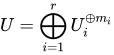

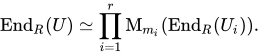
The Artin–Wedderburn theorem states any semisimple ring (cf. below) is of this form.
A ring R and the matrix ring Mn(R) over it are Morita equivalent: the category of right modules of R is equivalent to the category of right modules over Mn(R).[39] In particular, two-sided ideals in R correspond in one-to-one to two-sided ideals in Mn(R).
Limits and colimits of rings
[edit]Let Ri be a sequence of rings such that Ri is a subring of Ri + 1 for all i. Then the union (or filtered colimit) of Ri is the ring defined as follows: it is the disjoint union of all Ri's modulo the equivalence relation x ~ y if and only if x = y in Ri for sufficiently large i.

Examples of colimits:
- A polynomial ring in infinitely many variables:
- The
![{\displaystyle R[t_{1},t_{2},\cdots ]=\varinjlim R[t_{1},t_{2},\cdots ,t_{m}].}](https://wikimedia.org/api/rest_v1/media/math/render/svg/0c562ae4e64063e5aedc587c8442c596aed80eb0)